
The writing was on the wall. Or should that be “is”? Above the stage, scene after scene, captions chart the events in Hitler’s ascendancy, up to the Anschluss in 1938. Brecht liked signposting – placards and banners tell us where we are, when to applaud – because getting lost in the story meant losing sight of its message. In exile in 1941, he wrote a parable play about the rise of fascism whose meaning was so blindingly obvious that perhaps we would never be blind to the danger signs again. He glued pictures of Hitler and his cronies into his typescript – never forget the subject – imagining them as 1930s Chicago mobsters: a brief history of skulduggery, thuggery, then lawless brutality. So it returns, loud and lurid, in a carnivalesque production in which the warning lights are practically flashing.
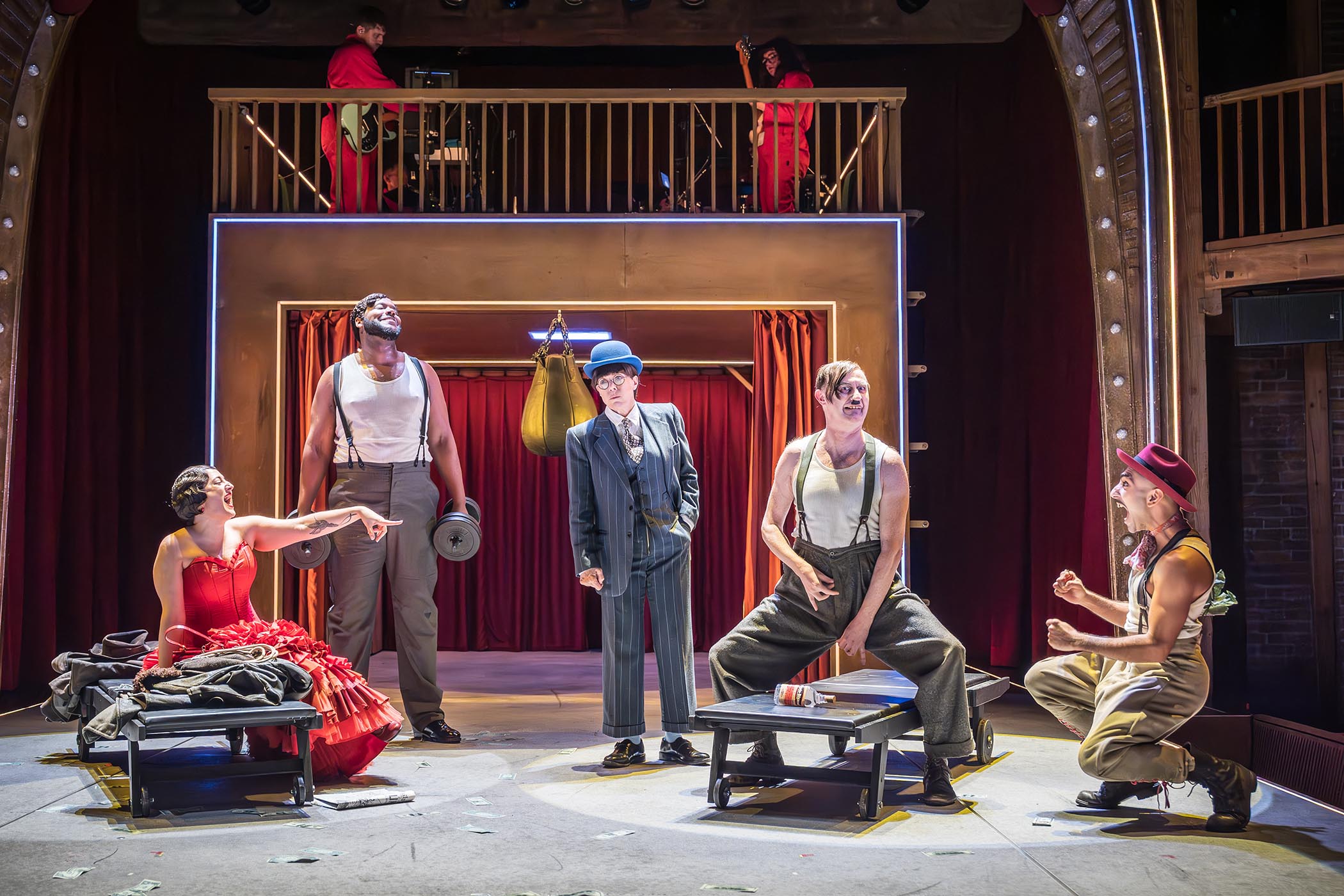
Is it possible to understand every aspect of a play – to have it rigorously spelled out to you – and still not know what to make of it? The Resistible Rise of Arturo Ui is billed as a satire but, by mistake or design, it isn’t very funny. We are supposed to be alert, but the information makes us lazy. Certainly, it is energetic, dynamically staged and visually striking in Georgia Lowe’s maximalist, cabaret-inspired design.
Part of the problem is that, although Stephen Sharkey’s 2011 translation is fresh and zinging – white-hot with profanities – the trajectory is familiar and simplistic. Ui (Mark Gatiss) – complete with toothbrush moustache, part-Al Capone, part-Charlie Chaplin – goes from lowlife gangster to cartoonish dictator through a combination of intimidation, extortion and coiffing.
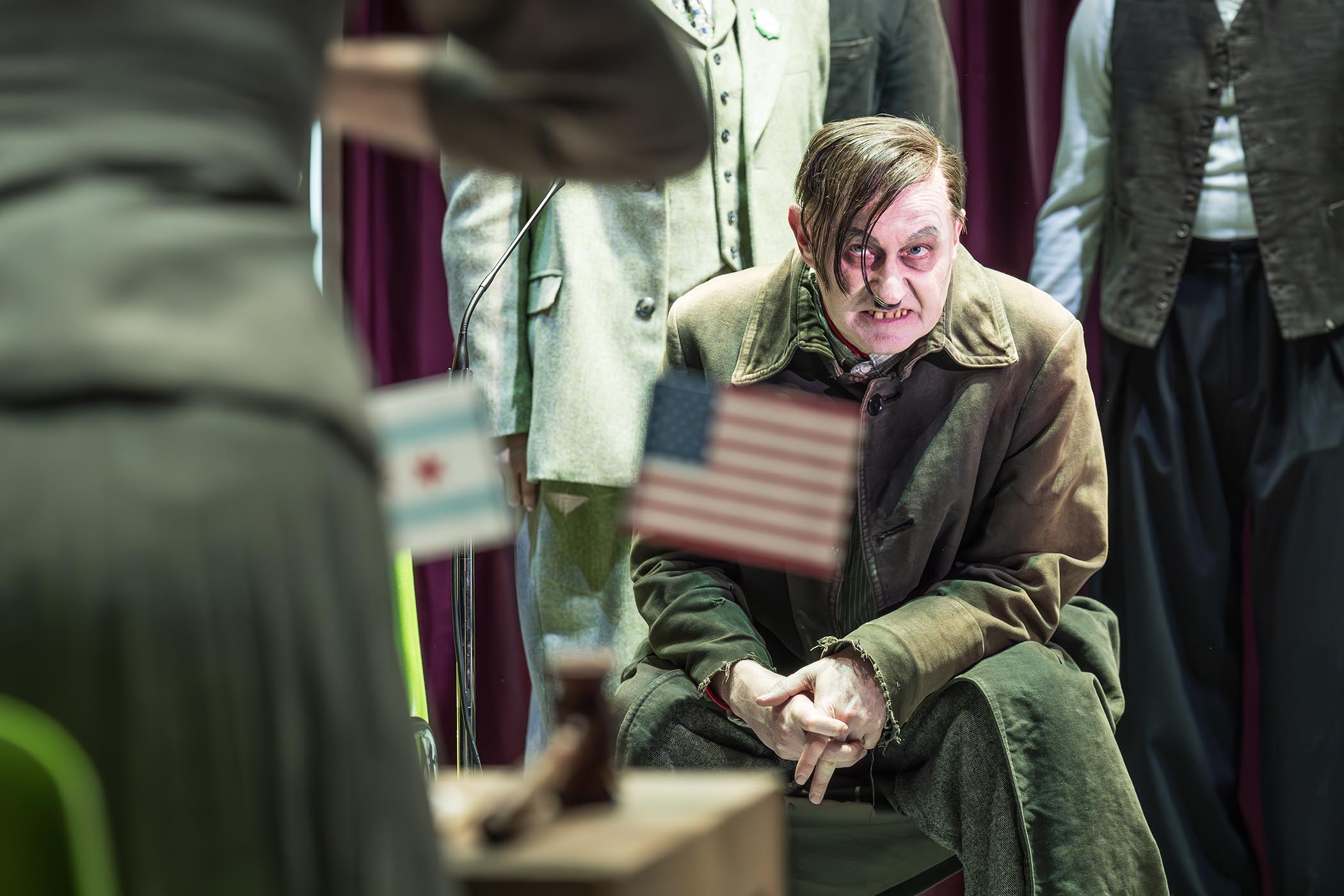
Allusions to Donald Trump are light touch until a show trial after an arson attack on a warehouse (the 1933 Reichstag fire), when the heavy hand of the supposed law is felt: a stampede of ICE agents, masked and booted. Such is the predictable rise of Arturo Ui. In Brecht, you always know what’s coming.
Gatiss’s character undergoes a transformation; sort of The Princess Diaries, if the princess were a despot
Gatiss’s character undergoes a transformation; sort of The Princess Diaries, if the princess were a despot
Ui operates a racket in the local vegetable trade, promising protection to the Cauliflower Trust (Prussian landowners) in exchange for a fee. His stooges distribute beatings, armed with guns made from raw veg: not so much carrot as stick. Brecht subtitled his parody A Gangster Spectacle, and director Seán Linnen has created just that, with all the bells and dog whistles. His strident, smartly constructed production concerns the theatricality of fascism: there’s the regalia, the rock score, by the band Placebo, played live and going rat-a-tat-tat. There are movement sequences, much swaggering and “speechifying”, many fists balled in operatic menace. In Lowe’s gloriously garish set, the eyes gorge on queasy neon green and sickly pink (does the mountain of doughnuts symbolise greed, do we think?). There is a tremendous ensemble cast – goons, the lot of them – with grins as broad as their accents, and a sinister clown in Mawaan Rizwan, who, with manic eyes and unnerving glee, plays Giri (the Hermann Göring stand-in) in imitation of Cabaret’s Emcee.
Most of all, there is a showman: resistible – in fact repellent – and yet compelling. Gatiss is a grotesque, a Frankenstein’s Führer, with the head of Hitler and Trump’s pointing finger. Made up in panda eyes and fake teeth, he is not the dog of the Berliner Ensemble’s 1995 production, entering shirtless on all fours, but weasel-like and snivelling – a “ferret”, as the script says, trained to sniff out prey. His Ui is distorted and distorting: hunched, as a knot of insecurity, then growing in stature, in steadiness; the more bloody-minded he becomes, the less he bends. He barks and bristles. He preens – forever smoothing that oily side parting – because perhaps he sees that he is ugly. He is a man motivated purely by ego, and by image. Ideology is a foreign concept.
In one scene, Ui enlists the help of a thesp (Christopher Godwin), who teaches him the power of oratory through Shakespeare (“The evil that men do lives after them,” quoth he) and a “commanding gait” – cue the unlikely origin of the goose-step. Confronted with his reflection in a mirror, he spies what we have all missed – potential – and undergoes a transformation; sort of The Princess Diaries, if the princess were a despot. It is a ridiculous role to which Gatiss lends serious gravitas: just witness him brandishing a celery spear, or steaming – a picture of paranoia – in the bathtub.
But Ui is a ghoul in want of a horror story. Odd, given the context, how this production thrills without ever quite chilling. Violence is stylised; fear is fodder for comedy. The real terror, Gatiss has said, is how we fall for the same tricks: the voice, the posture, the bullshit. Yet we are never expected to fall for this. In the epilogue, wiping his moustache away, Gatiss addresses the audience, turning suddenly grave: “The bitch that bore him is in heat again.” It’s a circus in here, but out there someone is writing the great Trump play.
Photographs by Marc Brenner
Newsletters
Choose the newsletters you want to receive
View more
For information about how The Observer protects your data, read our Privacy Policy