Crack open an old chestnut and you find a fresh kernel. That’s the hope driving Thea Sharrock’s production of High Noon, based on the 1952 movie, though billed as a new play by Eric Roth, who wrote the screenplay for Forrest Gump.
There is nothing fanciful in the idea that the western directed by Fred Zinnemann still has something to say about the condition of the US, though it is open to more than one interpretation. A marshal hands in his tin star on getting married to a Quaker and prepares for a peaceful life in Hadleyville. Until he hears that an outlaw he jailed years ago is heading to town looking for revenge. Urged to leave, he stays to slug it out. His wife refuses to be with a man who kills; the townspeople who once declared support fail to rally behind him. He is set for solitary confrontation.
A variety of US presidents - Ronald Reagan, Harry Truman, Bill Clinton – have nominated High Noon as their favourite movie. After all, if its primary attraction is in glamorising the idea of the man who stands alone – in this case the marshal, not the villain – it also promotes two positions not always considered compatible: a call for law and order, for living by the rules, and a denunciation of small-town herd mentality. The movie’s scriptwriter, Carl Foreman, was blacklisted by the House Un-American Activities committee and felt bitterly betrayed; John Wayne hated High Noon. Roth sees in it – and makes of it – an anti-Trump stance. He does not have to do much to underscore the present-day parallels: some of the townsfolk think the returning thug is simply telling it like it is.
A clock ticks out the plot in real time, but the pace is leisurely; early scenes more high tea than high noon
A clock ticks out the plot in real time, but the pace is leisurely; early scenes more high tea than high noon
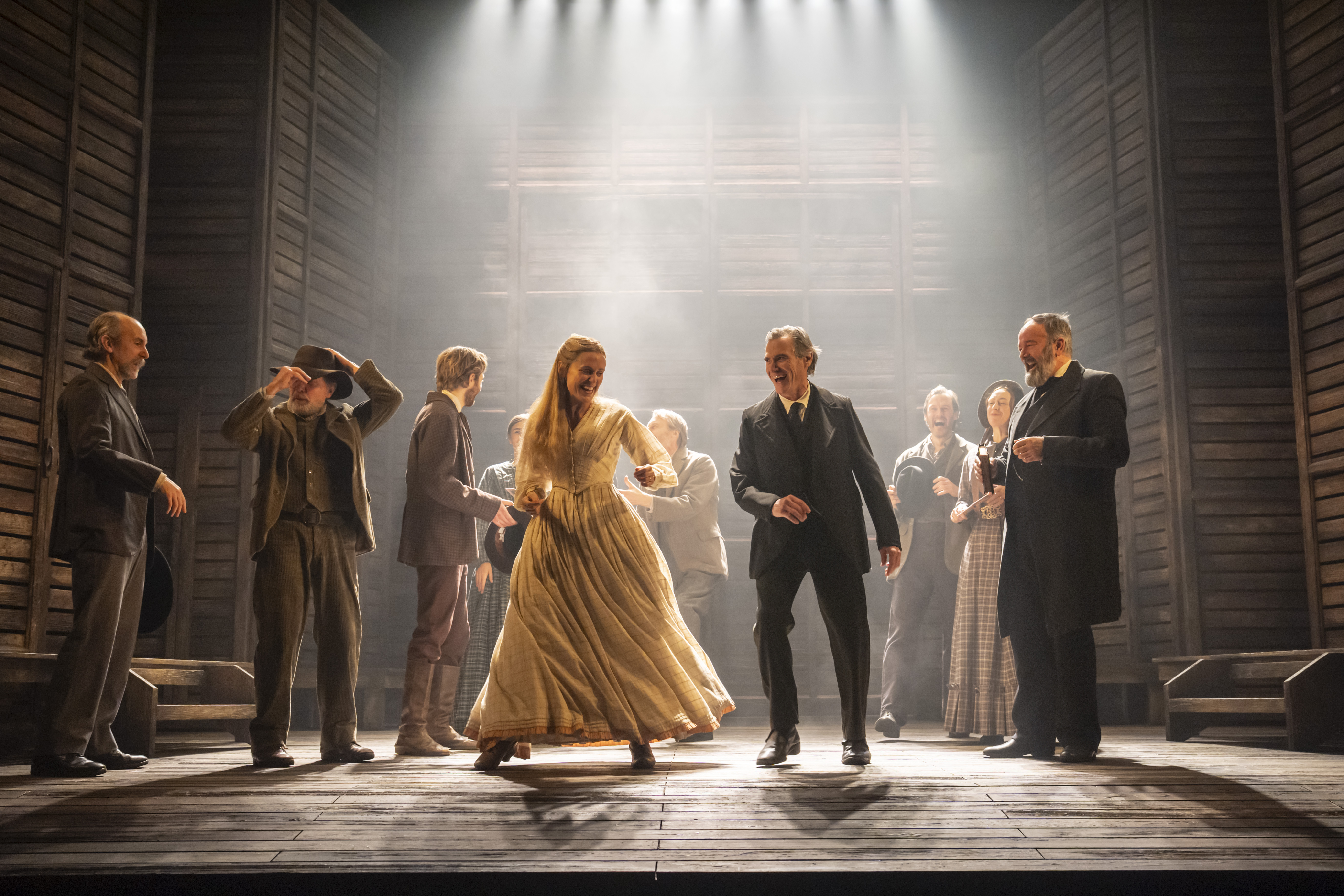
Neat, but hold your horses (there aren’t any – the couple have to giddyap out of town on a table). Though the film is not action-packed, it is suspense-driven. Sharrock’s production is engaging rather than exciting. A big clock hangs over the stage, ticking out the plot in real time, but the pace is leisurely; the opening scenes more high tea than high noon. Tim Hatley’s design – floor-to-ceiling wooden slats – suggests the west without doggedly copying its architecture; a solitary guitar plays Frankie Laine’s Do Not Forsake Me, Oh My Darling; men stand around, no bandy legs, no hands on holsters.
Wildness and vastness are missing. The sight of the rickety town dropped in a wide landscape, the long railway lines dwindling in the distance imply that these fights are not only between individuals: here are the warring factions of an entire country. Roth has to spell out the significance too lingeringly.
Still: gold, not tin, stars for the couple in the roles created by Gary Cooper and Grace Kelly. Billy Crudup is a convincing marshal: more open, less invulnerable, more 21st century than Cooper; slippy-eyed, moving deliberately, he does not coast on cragginess. Denise Gough bursts out of the part of the Quaker wife, which Roth has built up, though not to the point of suggesting that it was as important for her as for her husband to stick to her – well – guns.
Kelly was dewy as she made her wedding vows; Gough, with one long plait down her back (Kelly’s plaits were immaculately wound up), is restless. Fidgeting through the ceremony, she sighs with relief when she is married. She makes you believe that her religion is a choice, a reaction to harsh experience.
Songs by, among others, Bruce Springsteen and Ry Cooder sprinkle the action, attractively though not always urgently. Gough delivers them with a sense of necessity, explaining that Quakers don’t approve of singing but she just can’t help doing it. You believe this when she sings I’m on Fire; she unleashes a lament as if letting loose a trapped bird from her throat.
Billy Howle – who raged impressively two years ago in Look Back in Anger – is outstanding as another impotently furious young man: the envious deputy who is given a touch of homosexual longing (he likes the look of his boss in the shower). First seen tucking his shirt into his pants after sex with a clever Mexican businesswoman (an overpouting Rosa Salazar), Howle swaggers, but also twitches and shuffles. He unravels within and without: his jerkin is always drifting apart. As so often, dress adds not only texture but a quiet backstory.
Hatley’s costumes – from Gough’s cream wedding gown with its cloth-covered buttons to the men’s faded weskits – are unstarched, often slightly grubby. Not many dry cleaners in Hadleyville.
Newsletters
Choose the newsletters you want to receive
View more
For information about how The Observer protects your data, read our Privacy Policy
High Noon is at Harold Pinter theatre, London SW1, until 6 March
Photograph by Johan Persson