
It begins with a doll’s house. Miniature things are good for the imagination; they make the world seem big. The moon is up, a quiet falls, and the roof is lifted, revealing a row of little iron beds. Not a home, but an orphanage. Wendy had her house built around her; Matilda, through guile, was eventually shown the way in to hers. Sophie, the girl protagonist of Roald Dahl’s The BFG – adapted for the stage by the RSC in time for Christmas – starts in a dormitory and ends in a palace, like in a fairytale or a dream. Dahl dedicated the book to his daughter, Olivia, who died of measles at age seven; he gives her his most generous ending.
The BFG is a story about dreaming, which opens with a child who cannot sleep. Sophie, awake at the witching hour, is kidsnatched by a giant, who collects night visions in jars, then blows them into children’s bedrooms. He takes her to his mythical land, a realm of imagination, where we learn he is friendly – an inventor, an alchemist – and bullied by giants greater than he: suffice to say, Bloodbottler does not bottle dreams. The pair stage a resistance, enlisting the help of the queen of England; small, as Sophie says, “doesn’t mean weak”. The challenge, for theatre-makers, is not finding an audience – The BFG has sold more than 20 million copies globally and is Dahl’s third most read book in Britain, after Charlie and the Chocolate Factory and Matilda. But it presents two problems for a director: how to summon giants, in all their mighty materiality? And how to materialise a dream?
These are questions Daniel Evans, co-artistic director of the RSC, has considered for seven years – a long time to be in Giant Country. For him, The BFG isn’t a cautionary tale – though it has the giants, queens and orphans of fairy stories – but it does bear the marks of Dahl’s sharp bite. “It taps into something primal,” he says: a fear of being lonely, but also “wanting to belong, discovering power, imagination…” Also a sense of threat: “Children love being scared, because they don’t feel patronised.” His smile is impish: “We do see children in the audience bury [themselves] into their parents’ armpits.”
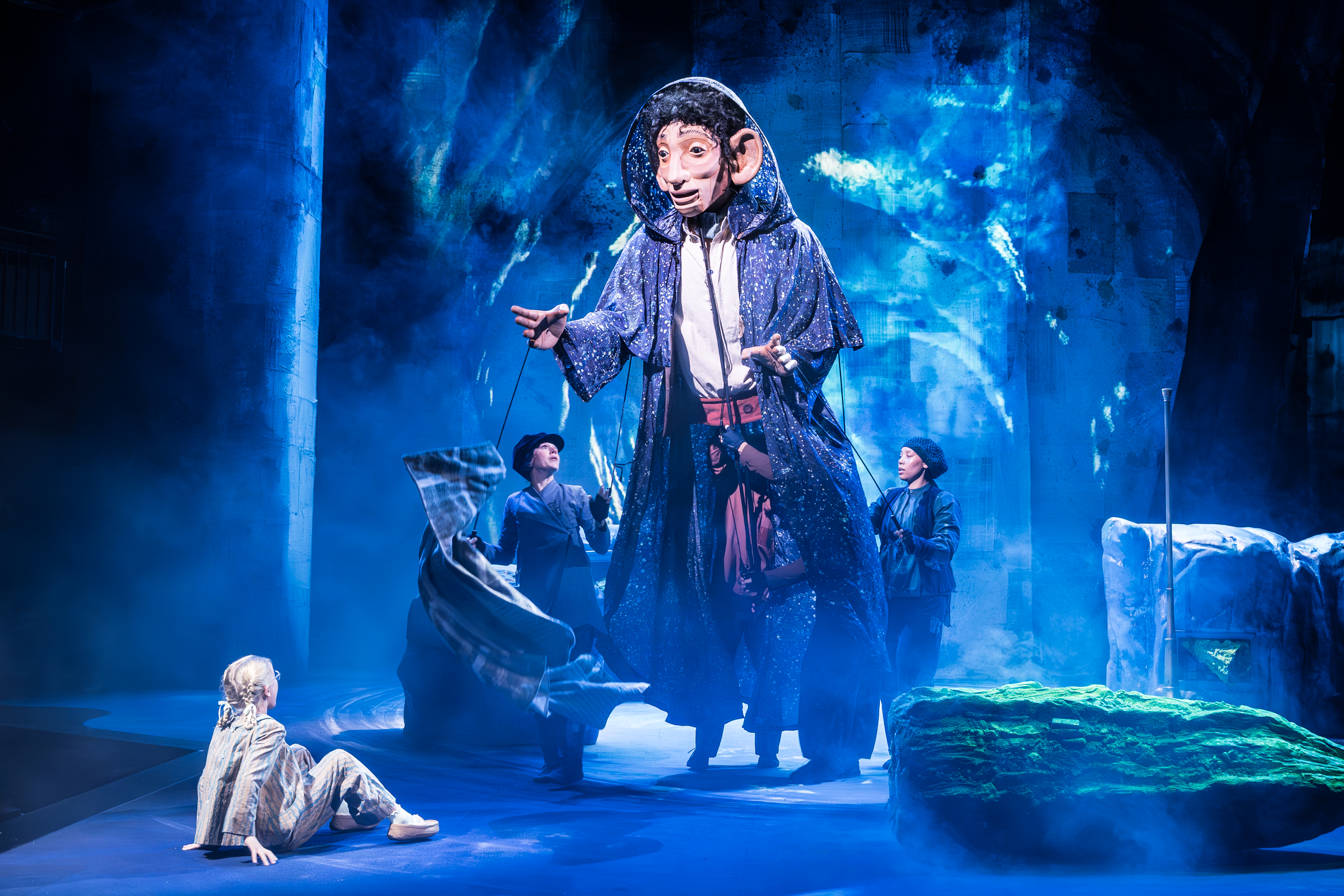
‘Small doesn’t mean weak’: the BFG towers over Sophie, whose role is shared between three young actors
We are speaking in an office in Stratford-upon-Avon in a building that houses the company’s costume workshop, bursting with Elizabethan bodices, ruffs, puffed sleeves, and a prop store to which Evans will soon add jars of dreams and snozzcumbers of neon green. Plus, giants measuring up to 16ft and a teeny Sophie puppet, all crafted by a creative team that includes design doyenne Vicki Mortimer; the puppet designer behind Spirited Away; and the illusionist Chris Fisher, who conjured magic in Harry Potter and the Cursed Child and the nosebleed in Stranger Things on stage.
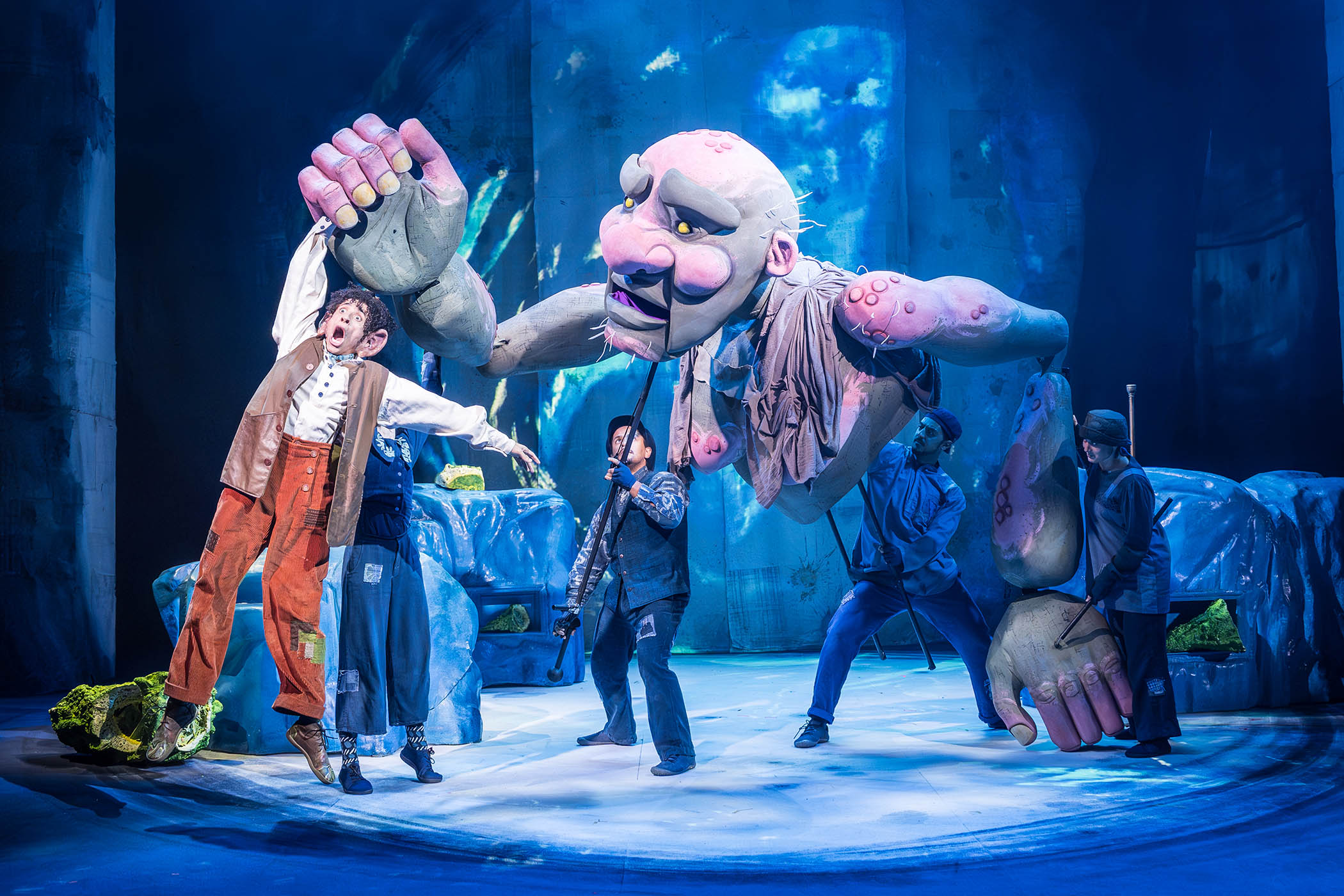
For Evans, The BFG is a story about power and perspective, “about how we identify with being powerless, and also how power and size often correlate.” Scale is key to this production: Dahl’s lesson in relativity provides its architecture: characters, living and inanimate, are like Russian dolls, unfolding in three sizes. Human Sophie (one of three young actors plays her on different nights) is only ever on stage with puppet BFG (designed by Toby Olié, former War Horse puppeteer) who is manipulated by four puppeteers and eye-level with the circle seats; human BFG (John Leader) towers over puppet Sophie and shrinks next to an enormous, neolithic Bloodbottler and his lumbering stooges: they knuckle-walk, as would gorillas, clash skulls like great boulders. There are smaller iterations too, all animated with liveness and synchronicity: the actors voice the puppets offstage with two monitors – close-up and wide-shot – “like they’re doing a live anime”.
The BFG is one of the RSC’s biggest shows since Matilda the Musical, the multi-Olivier award-winner that premiered in Stratford in 2010. More than a decade later it was turned into a movie by Netflix, which in 2021 bought the rights to all Dahl’s works for a reported £500m. Evans shrewdly sidesteps comparisons. But, after urging half of staff to apply for voluntary redundancy in September this year amid a suspected shortfall of up to £6m, it is clear the RSC needs a hit to last long beyond the festive season (The BFG will go on tour in Chichester and Singapore).
This is not a festive story; there is no beanstalk alongside the giants. But there is a timeless familiarity to the production – the feeling that it has always been there, like a childhood memory. And the atmosphere is one of night-before-Christmas naughty wakefulness: hushed, in a friendly darkness. It is suggested in the reading lamps pinned to headboards, lighting up private golden realms; and in the papery lanterns and heavy curtains, half-open – good for peeping. The original score, by Oleta Haffner and played by an eight-piece band, is orchestral, cinematic, but mostly elegiac, textural and shimmering, like a lullaby. This is theatre as bedtime story, or the other way around. What happens when we fall asleep?
“This is going to sound corny,” Evans says, “but I thought a lot about being at the RSC and Shakespeare himself. He talks about theatre being like a dream. ‘We are such stuff as dreams are made on.”’ Shows, vivid yet ephemeral, offer a respite from reality, then melt away. “Dreams are in our heads and different for each of us. We’ve tried to do something that leaves room for the audience to imagine what they are.” In the book, dreams are caught the “same way you is catching butteryflies”, BFG says: so on stage, they must take flight, be netted, bottled in a jar then blown through a trumpet. Fisher, the illusionist tasked with making make-believe, has the additional challenge of an unforgivingly close audience in the Royal Shakespeare theatre's thrust staging. He makes a virtue of it: his dreams fly overhead – not abstract wisps, exactly, but mysterious somethings, in Tinkerbell green or snaking, as on a Nokia screen.
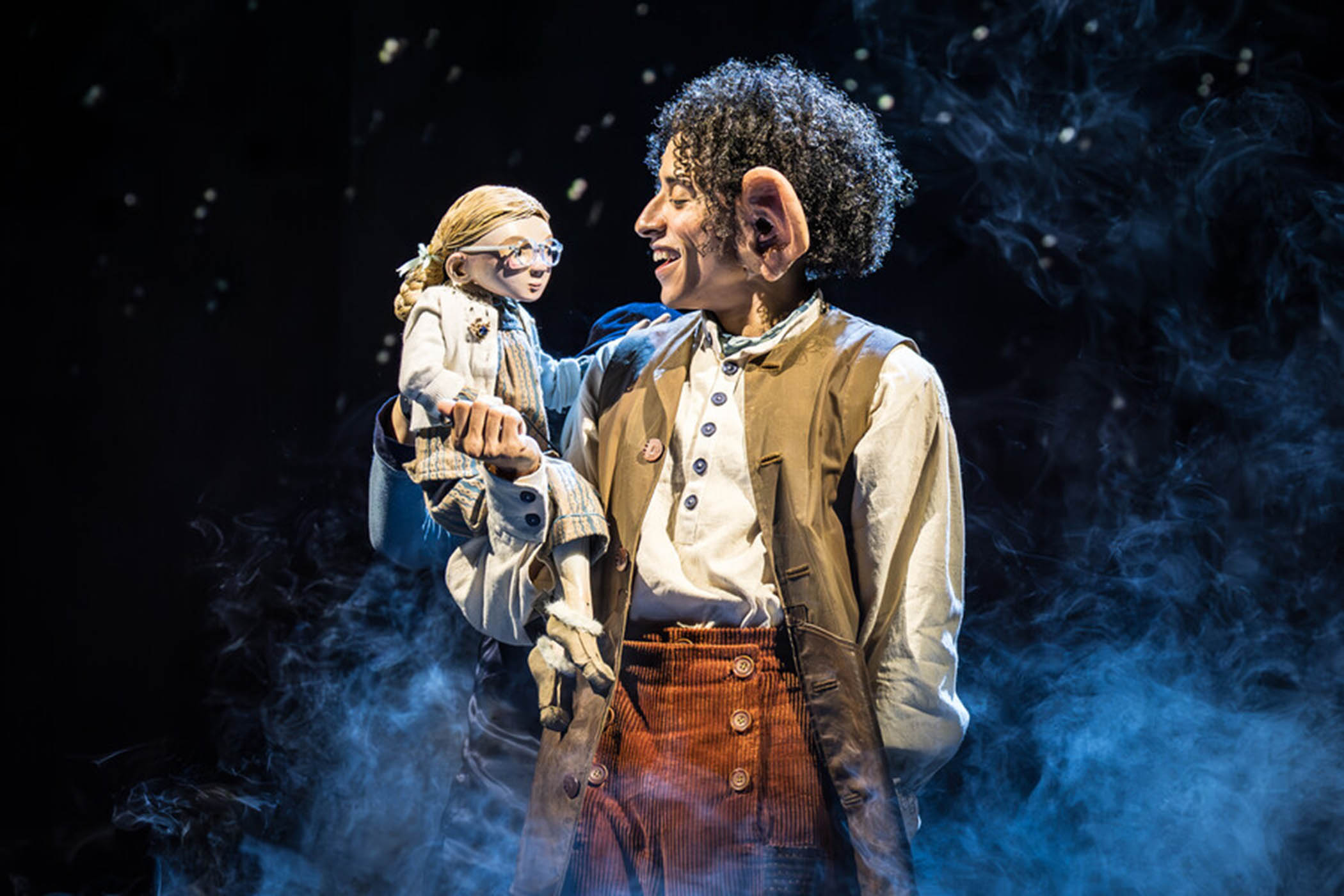
The characters unfold in three sizes, like Russian dolls
Attitudes towards family theatre have shifted – audiences want more interactivity, greater safeguarding – but the priority, says Bernie Bhangoo of the Roald Dahl Story Company (RDSC), is innovation. Attitudes have shifted towards Dahl too. His antisemitism, long apparent, was the subject of Giant, a hit stage show starring John Lithgow. Publishers, once warned by the author against changing “a single comma”, have rewritten or removed potentially offensive language. The RDSC, which manages Dahl’s literary estate and was acquired in the 2021 Netflix deal, has apologised for his antisemitic views. But as its practice has changed, from rights holder into co-producing and creative, is there a desire to sanitise his reputation? To emphasise in his stories the nice not the nasty, and draw out, as Netflix suggested, the “possibility of young people”?
“Dahl’s stories are inherently on the side of children,” Bhangoo says, “and particularly on the side of children who have been made to feel marginalised or small – that perspective has never felt more resonant.” This mission is sensitively woven into playwright Tom Wells’s adaptation: his Sophie is more armoured up and wary; a hardened orphan forced to squash her imagination. “Let’s get it over with – just eat me,” she tells BFG defeatedly: “Nobody’s looking for me.” Her arc is explicit: “BFG reminds her there’s something soft within her that she needs to reawaken,” Evans says. “Because she’s still a child. And being a child is being free to imagine.”
Newsletters
Choose the newsletters you want to receive
View more
For information about how The Observer protects your data, read our Privacy Policy
New sets of puppets elicit squeals in the stalls – the joy of mental gymnastics. They are vehicles for connection and projection; operated simultaneously by human hands and the audience’s imagination. “Audience members are at once in it and admiring the puppeteers. You don’t get that in cinema or CGI. You don’t see the workings.”
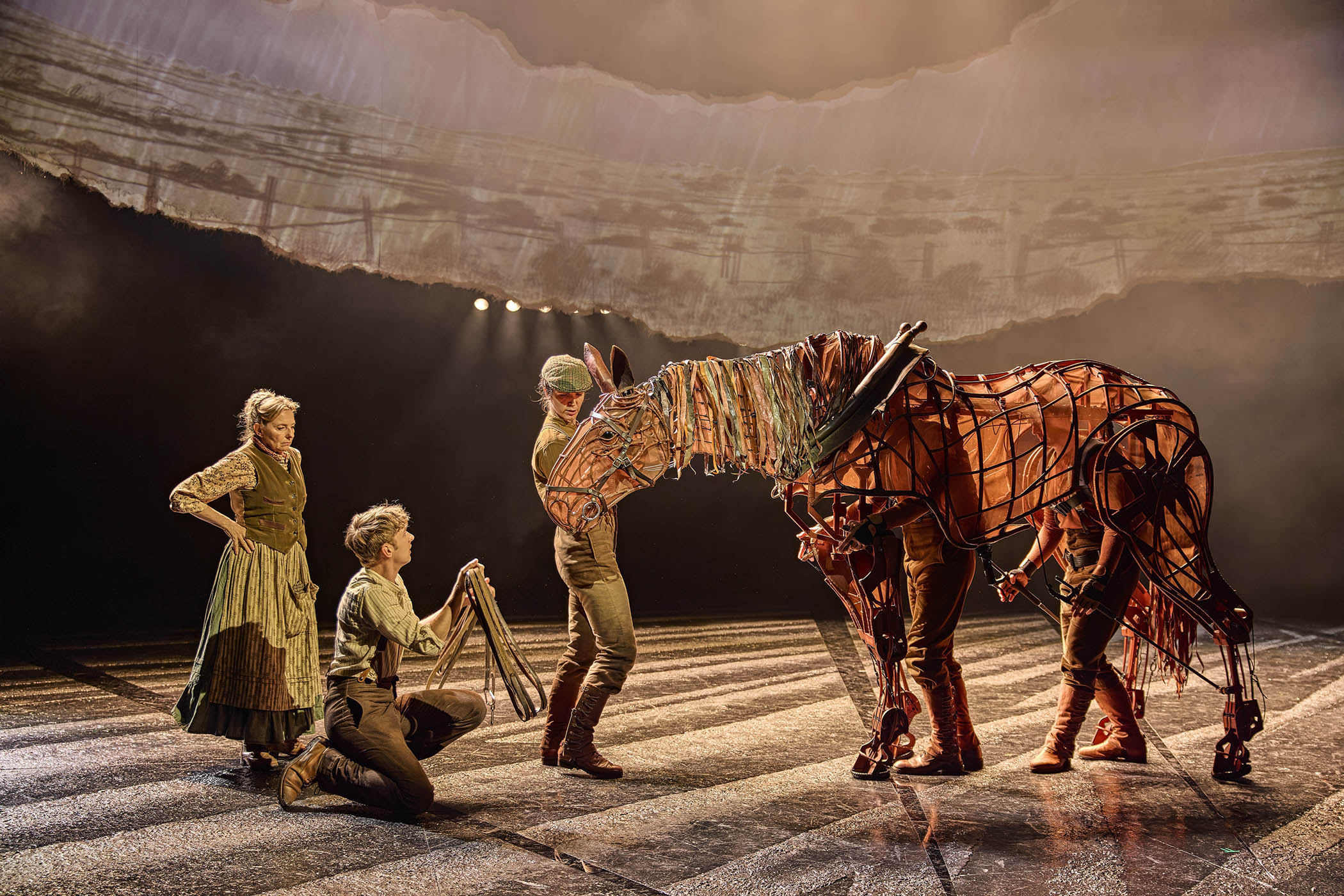
This is an analogue craft, resurgent in a tech-heavy space: Paddington and My Neighbour Totoro will stay put in the West End into next year; The Herds’s life-size animals walked 20,000km from Africa to Scandinavia, pulling crowds all the way. And for their sophistication, there is a homespun quality to the RSC’s puppets – nutcracker-jawed, like the work of the Chitty Chitty Bang Bang toymaker. Daringly, BFG, modelled on Leader, is not the wizened, white-haired figure who leapt from Quentin Blake’s dip pen off the page: he is sinewy rather than wrinkled, with black curls and beady eyes – a mouselike giant, big ears twitching expressively.
Was Evans worried about disappointing audiences with a younger-looking, unfamiliar BFG? “In the story he’s 125, but giants aren’t born, they don’t die – they appear and disappear,” he says. “It was more, how do we capture the spirit of someone who invents words, is incredibly agile, leaps across lakes and seas? That, to me, isn’t necessarily an old person.” His dynamic with Sophie is transformed, from father or grandfather, to something closer to an older sibling: BFG as co-conspirator, not mentor, dusting everything with playful mischief.
There are no further RSC-Dahl projects in the works, but the guardians of the author’s legacy are happy they have achieved their aim to find “new expressions” of his material. Though when I ask Evans his favourite line in the play, adapted or original, it comes straight from the source. “It gets me every time. When mixing the dream, Sophie says: ‘If we can’t save tonight’s children, we can anyway save tomorrow’s.’” He is visibly moved – by that note of pragmatic optimism; always that sense of potential. “It’s a perfect Sophie line,” Evans adds, “not precocious, but wise and simple. A simple truth: ‘children are being eaten, we have to stop it’. If only other people felt the same.” So, yes, a Christmas message of goodwill, from the author of naughty and nice.
Photographs by Marc Brenner