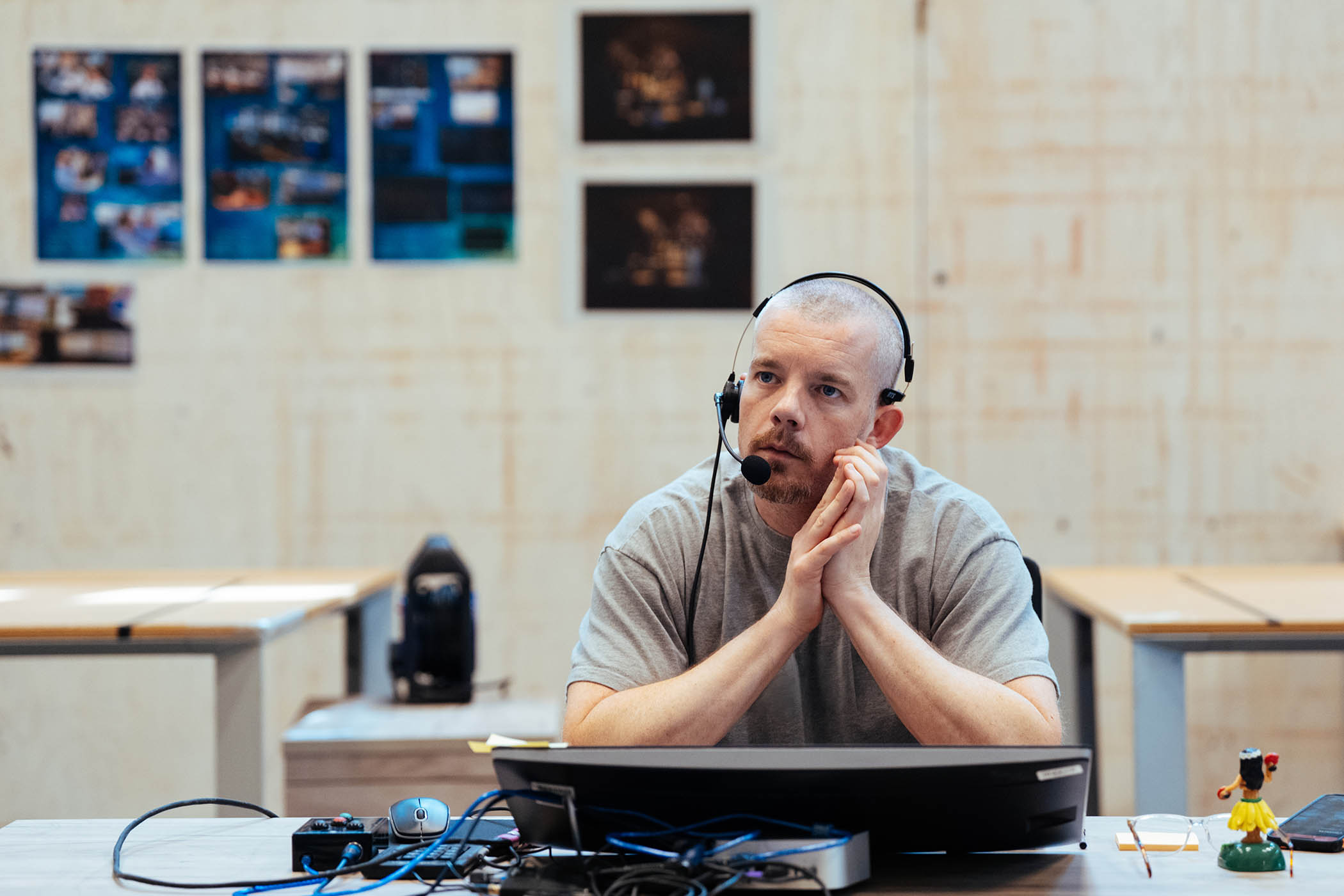
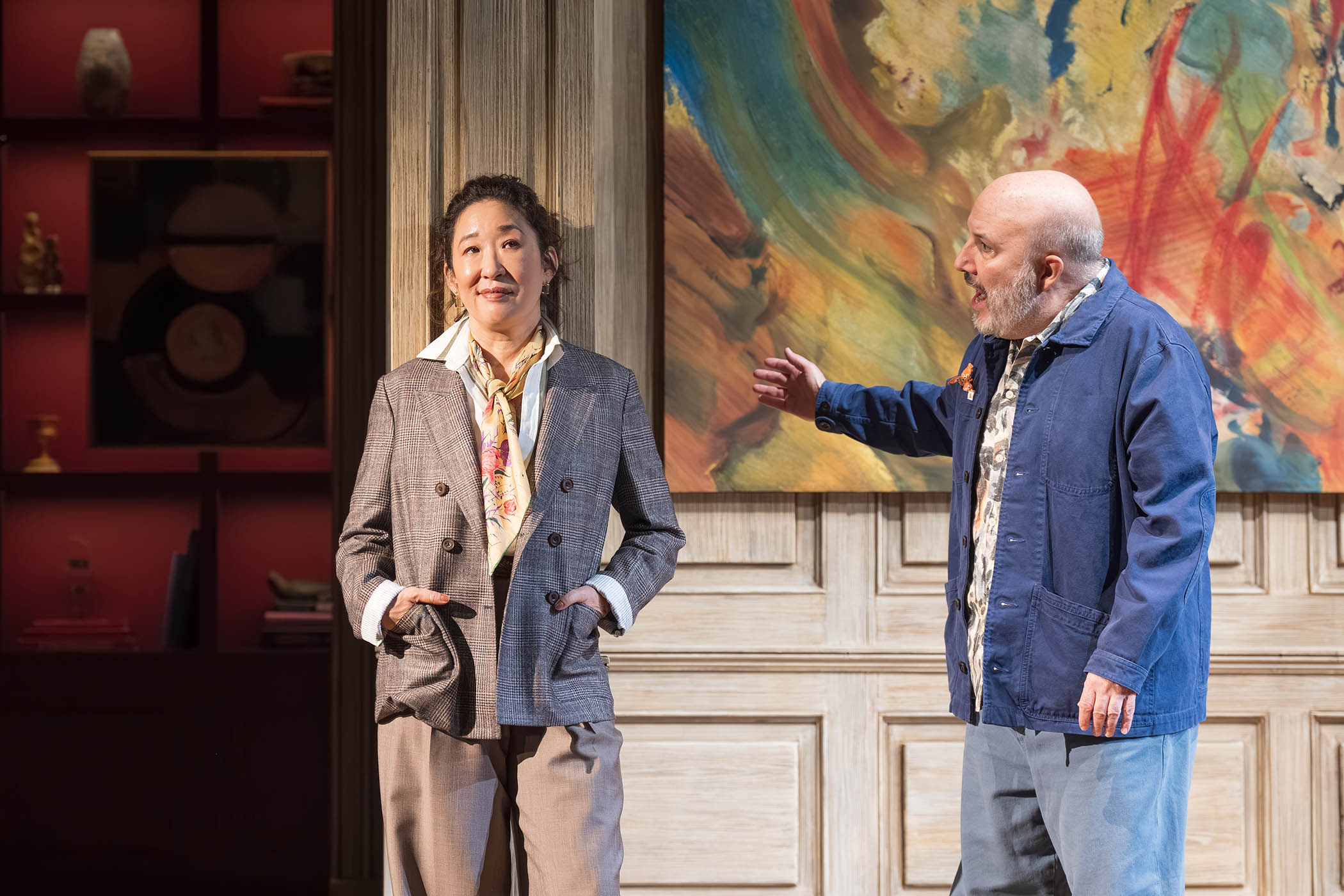
In a high ceilinged basement rehearsal space on Dryden Street in London, where the windows up at street level make the room feel as though it’s at the bottom of a lift shaft, the Punchdrunk founder Felix Barrett is directing a tense phone call. Russell Tovey, sitting at an office desk with a complicated phone system in front of him, plays an emergency services operator named Joe, who fields one cryptic 999 call from a woman in distress, which he must then decode. The scene is the last of Joe’s long log of incoming and outgoing calls.
“Where do I make the decision, does it come in the moment?” Tovey asks Barrett after they finish running the scene.
“You shock yourself, I think,” Barrett springs forward to reply.
“Mmm, yes. It’s like the air goes out the room,” Tovey says.
They run the scene again, Tovey pacing while the sound engineer brings in a muffled beat that grows louder. The pair are rehearsing The Guilty, Chloë Moss’s claustrophobic play set during a stressful night shift, which officially opens at the Donmar Warehouse on Tuesday.
“We did a version where Russell didn’t move at all. I thought it would be terrible, but it was almost impossible to watch because you’re hanging on every micro-gesture,” Barrett says later that afternoon in the now empty rehearsal room. “When you’re seeing someone do very little, it becomes quite hypnotic.”
Playing with senses is a recurring theme in Barrett’s work with the experiential theatre company, best known for its large-scale immersive productions. In plays such as Sleep No More and The Drowned Man, audiences were given sinister expressionless masks to wear while they roamed through sets as the action unfolded. “Punchdrunk is this sense of being punched in the face – that moment where you’re falling backwards and seeing stars,” says Barrett, with his hair in a flyaway top-knot suggestive of his boyish energy. “We often use sensory deprivation and the heightening of other senses like touch, which is so rarely used theatrically.”
In The Guilty, our hearing is manipulated – that muffled heartbeat is actually the ticking of a clock, abstracted by the sound engineer so that you can’t quite tell what it is. “The audience will never notice it arriving, and then it’ll be inside them,” Barrett says.
The 48-year-old director lives in south-east London with his partner and their four sons. As a teenager he wanted to be a film director, but a teacher insisted he do a drama degree first. “He was completely right, but when I was doing my degree, I realised that straight plays felt very pedestrian. I was thinking, is there a way that you can get that crackle and energy of films and make them live?” He founded Punchdrunk after he graduated 26 years ago and has served as artistic director since.
When I saw The Drowned Man across four floors of a disused Royal Mail sorting office in 2013, an actor led me away from my friends and into a tiny room where he delivered an intimate monologue inches from my face. I felt raw for days afterwards. Barrett grins when I recount this experience: “The best feedback I get is, ‘You’ll never guess what happened to me last night’ rather than ‘I went to see the show.’”
Newsletters
Choose the newsletters you want to receive
View more
For information about how The Observer protects your data, read our Privacy Policy
Punchdrunk creates enormous, hyper-realistic worlds that audiences can get lost in. The Burnt City in 2022 wove a Greek tragedy about the fall of Troy through the corridors of a 100,000 sq ft former armoury in Woolwich, south-east London. They reused this labyrinthian venue for the video game-inspired space mission Lander 23 earlier this year. But The Guilty marks a return to traditional theatre spaces, away from tunnels and warehouses. “As the years have gone by and more and more people have started to make work that’s similar, I’ve started to move further away from it,” Barrett says.
He was approached by a producer about adapting The Guilty from two films of the same name (the original Danish, and an American remake starring Jake Gyllenhaal). The idea of putting a thriller on stage intrigued Barrett, as did the challenge of downsizing, creating intensity in smaller moments. The agony Joe endures over one night of panicked calls sparked something in the director, who jumps up to show me pictures taped to the wall behind him.
“There’s a brutality to being that 999 operator. You’re suddenly plunged into real trauma. For most people [making the call], it’s the worst time of their lives. There’s something almost Greek about it,” he says. “How do you process all that once they go away?”
He points to a printout of Caravaggio’s The Entombment of Christ. Looking over at the blue metal lockers in the office set-up, he wondered aloud whether someone could have the image – of the lifeless body of Jesus being lowered into the tomb – pinned up on the inside of a locker door, a clue to be glimpsed momentarily as it swings open.
Either way, it couldn’t be shown on a smartphone screen – the last two decades of Punchdrunk have taught him to avoid that medium. “I went through a phase of trying to do shows on phones, thinking, what’s the positive to be found from them? But the screen is just so passive,” he sighs. “What would aliens make of us all walking around face down, with all this wonder around us?”