
Audiences don’t often stand to applaud at the National. They’ll be even warier now. Automatic ovations are one of the many signs of sycophancy gunned down in Martin Crimp’s adaptation of Molière. Another is enthusiastically greeting someone whose name you don’t remember. A third: being kind when a young person hands over their bad first novel.
Le Mis – unlike Les Mis, a moderate commercial success when first seen in 1666 – has always been a slippery play: it needed to be opaque in order not to be suppressed. The figure who gives the play its title – in the original, a gent; in Crimp, a Booker prize-winning woman – has a reputation for being fierce and grumpy, but the targets for scorn are usually reasonable. Speaking out against insincerity is not actually a sign of hating the human race, rather of having high aspirations for it.
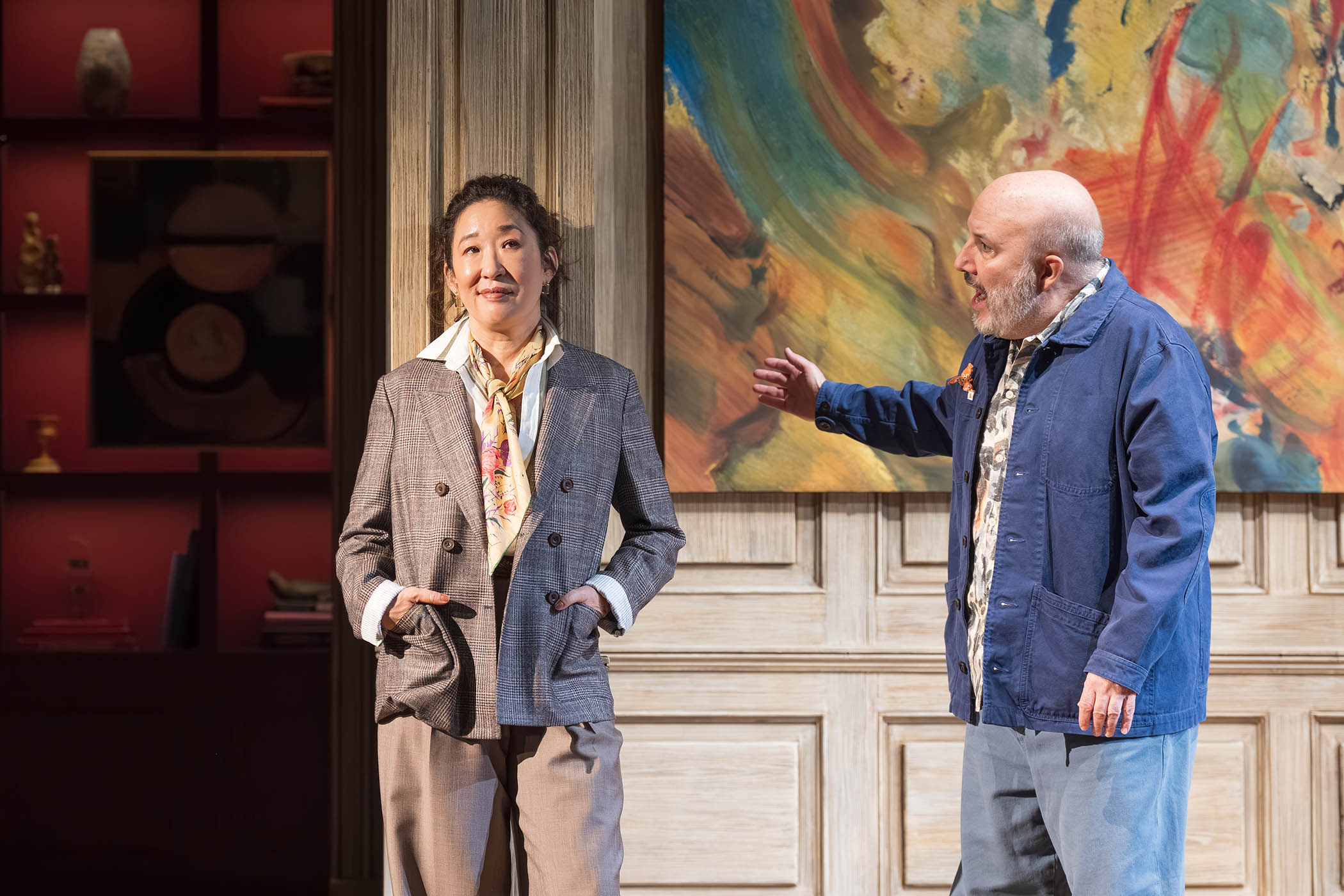
The Mis, of course, overdoes the lacerations. Everyone likes to think they want honesty from their friends but prefers it when it is directed at someone else. Killing Eve’s Sandra Oh gleams with success and principle – she refuses to retract an unspecified insult that will cost her a hefty prize – crackles with well-groomed fury and slides into disarray in front of her ill-chosen lover. There are parallels – the reproving character, the misplaced adoration, the final declaration of isolation – with Shakespeare’s Malvolio. Oh hits home by being as unbending as an outraged exclamation mark.
The most nuanced performance – a performance that alone makes attendance worthwhile – comes from Paul Chahidi. He has long been a distinctive stage presence, playing the edge between comedy and anxiety: dimpling as Maria in an all-male Twelfth Night, sardonic in Phaedra. I now want to see him counter-cast as a villain: Iago, perhaps? Meanwhile, he is perfect as the confidant, the person who, in turns, looks a hypocrite, a trimmer – “swivel”, he urges his furious friend – or simply kind, haunted by a sadness.
The switch in gender ushers in references to cancel culture, mansplaining and #MeToo, alongside swipes at hacking, trolling and any kind of sucking up.
The switch in gender ushers in references to cancel culture, mansplaining and #MeToo, alongside swipes at hacking, trolling and any kind of sucking up.
A very funny early scene has him agonising when an aspiring young writer, cleverly delivered at a gasp by Imogen Elliott, thrusts her fiction – “trauma”, “beauty”, “structural inequality” – on the acclaimed novelist and gets an unvarnished truth back, including a brilliant rebuke for her lazy non-description of “a modest kitchen”. You can read the whole episode in Chahidi’s face and gestures, as he taps his chin or mouths a sigh.
Such a guide is sometimes needed. One of Indhu Rubasingham’s directorial talents – evident in her 2015 staging of The Motherfucker With the Hat – is for comedy. Her production gets off to a flying start: vivacious and speedy, firmly situated in aspirational opulence by Robert Jones’s design with its plump upholstery and splashy abstract canvases, lit with a confident glare by Tim Lutkin. It has a spectacular finale, both a tribute to Molière and a reminder not to trust your eyes. Yet in the middle scenes, the action is slack and muddled.
Crimp has tremendous theatrical form, not least with his superb 2019 rap adaptation of Cyrano de Bergerac. His script for The Misanthrope is sharply worded, and has rhymes that close like a trap, but the satirical targets proliferate to such a degree that it becomes hard to know what is going on, difficult to find a strong pulse. It is like watching an already convoluted plot through a swarm of mosquitoes.
This is Crimp’s second revision of an adaptation that premiered in 1996. Then, Alan Bennett got a mischievous mention. In his 2009 version, Crimp had a go at Tom Stoppard. Now a coded reference to a director who sets plays in Perspex boxes brings the brilliant Simon Stone into the ring (Chahidi was in one of those boxes in Phaedra). The underlying animus – satirising the fashionable, kicking the hypocrites, airing what it is to speak an unvarnished truth – is the same but the focus is different.
Seventeen years ago, there were explosions about bankers and much irony about celebrity culture, the latter given a characteristically Crimpian meta twist as, co-starring with Damian Lewis, Keira Knightley appeared as a Hollywood actor – an exaggerated version of herself. Now the switch in gender of the central figure ushers in references to cancel culture, mansplaining and #MeToo, alongside swipes at hacking, trolling and any kind of sucking up.
One character has not survived the latest revisions. In 2009, Crimp created a critic called Covington – a cut-and-shut job on the critical Michaels, Billington and Coveney. He has not invented a new Covington: I won’t be the only pen in the stalls who is quite happy about that.
Newsletters
Choose the newsletters you want to receive
View more
For information about how The Observer protects your data, read our Privacy Policy
The Misanthrope is at the National Theatre, London, until 1 August
Photograph by Marc Brenner