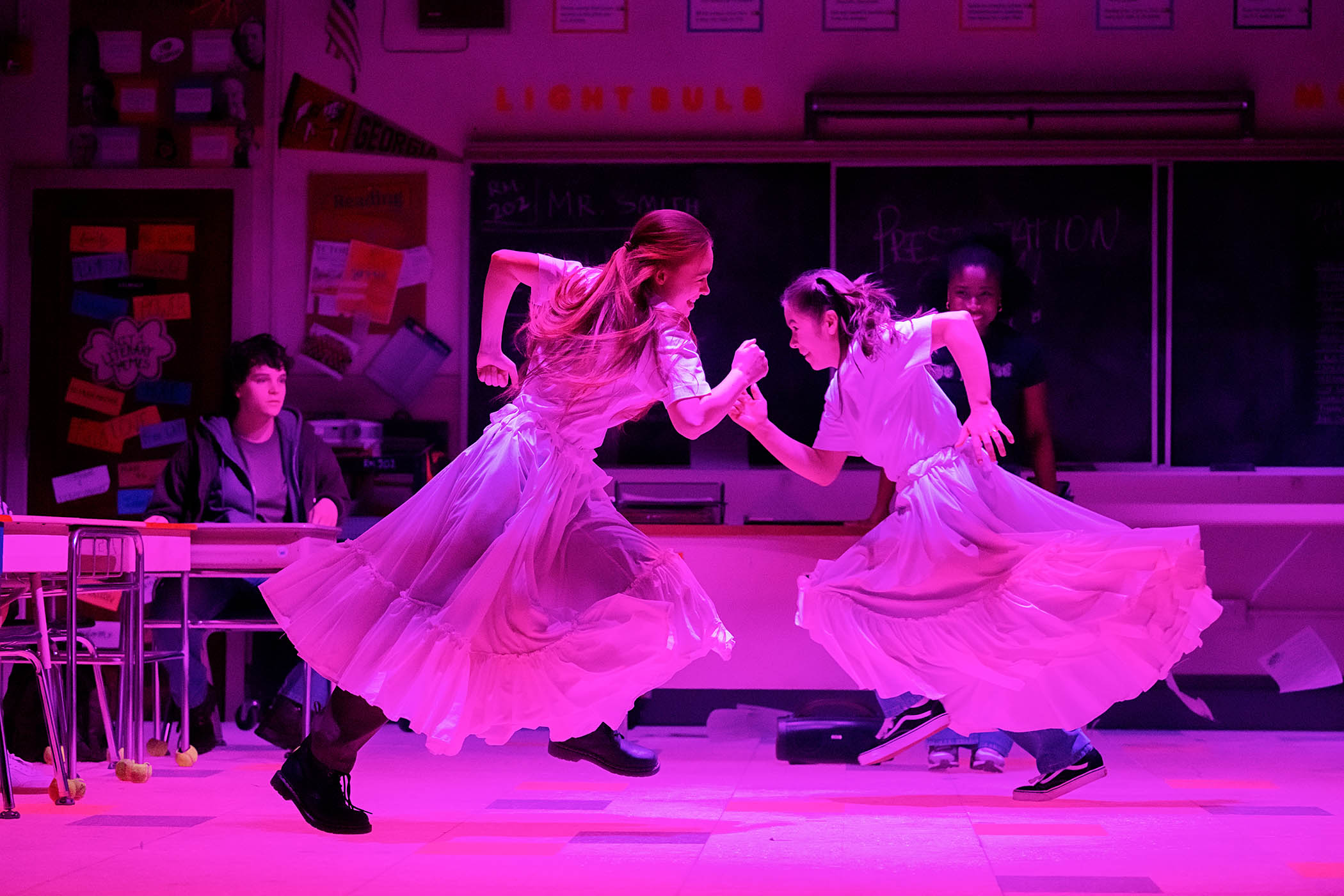

Terrible to start at the end, but allow me, because the last five minutes of John Proctor is the Villain contain some of the most stirring theatre I have seen in ages. I have to speak personally, as Kimberly Belfower’s play, which recontextualises Arthur Miller’s The Crucible for the MeToo age, is so attuned to its audience – young women – that it seems to speak directly to them. It closes with two girls – playing Abigail Williams and Elizabeth Proctor in a school presentation – dancing hysterically in the woods of their classroom, where there are dangers lurking. The dance is an exorcism, irrepressible, purging, and also a rebellion: their teacher, fearing his reputation, tries in vain to stop it. The song is Lorde’s Green Light; the stage lights turn pink. Nuance is abandoned – what good did that do us anyway? – and replaced with an image of girlhood that is defiantly, unapologetically girly.
Is this Tony-nominated play a modern classic, as some suggest? Time will tell, but surely it would not hurt for all schoolchildren to see or read or perform it. Partly, it is a vital social drama, transporting Miller’s 1950s McCarthy-era allegory from Salem in 1692 to a claustrophobic classroom in rural Georgia, 2018. Primarily, it is a coming-of-age school comedy about a group of teenagers and their dubious teacher: The History Boys for girls, for the modern world.
Four friends are responding to their post-Weinstein moment by setting up a feminism club – “to spread awareness, foster dialogue, and ignite change” – alongside their study of The Crucible in English class. In literal terms, they are rethinking the narratives they are taught. The trusted Mr Smith, charismatic with a hero’s smile, is like “the teacher in an inspirational movie”; he will be suspicious to many from the moment he cringingly declares “the future is female”. He discusses the play’s protagonist: the Christian man who seduces a teenager but admits his sins, too late, yet in time to be forgiven. He says John Proctor is the hero; one of the girls, having returned to school after an unexplained three-month absence, counters that Proctor is the villain. The girl, Shelby, has lank red hair and a proudly raised chin, revealing her shame. Whose version do we believe?
Belflower’s script is sharp and sweet, full of self-discovery, pop culture references – “Beth, do you want to have sex with Harry Styles?” – and youth, stumbling over its sentences. Danya Taymor’s direction is dynamic, exaggerated but finding equilibrium in all the emotional unsteadiness, and drawing out of her nine-strong cast nine strong performances. A drama such as this lives or dies on the strength of its characterisation, so this one lives wholeheartedly: there is the preppy, apple-cheeked Ivy (Clare Hughes); perceptive out-of-towner Nell (Lauryn Ajufo); Beth, the overzealous, wide-eyed swot (an awe-inspiring Holly Howden Gilchrist); would-be weirdo Rae (Miya James) and the glowering, magnetic Shelby (Sadie Soverall).
They are archetypes; we recognise them, and project on to them. Maybe we were them, maybe we ignored them. Maybe, once upon a time in history, they were figures of fun, fear, contempt or pity. In a drama that exists between extremes of ignorance and self-knowledge, the brilliant tension is that those girls, who have so much more to learn, are showing us the way.
John Proctor is the Villain is at the Royal Court, London, until 25 April
Photograph by Camilla Greenwell
Newsletters
Choose the newsletters you want to receive
View more
For information about how The Observer protects your data, read our Privacy Policy