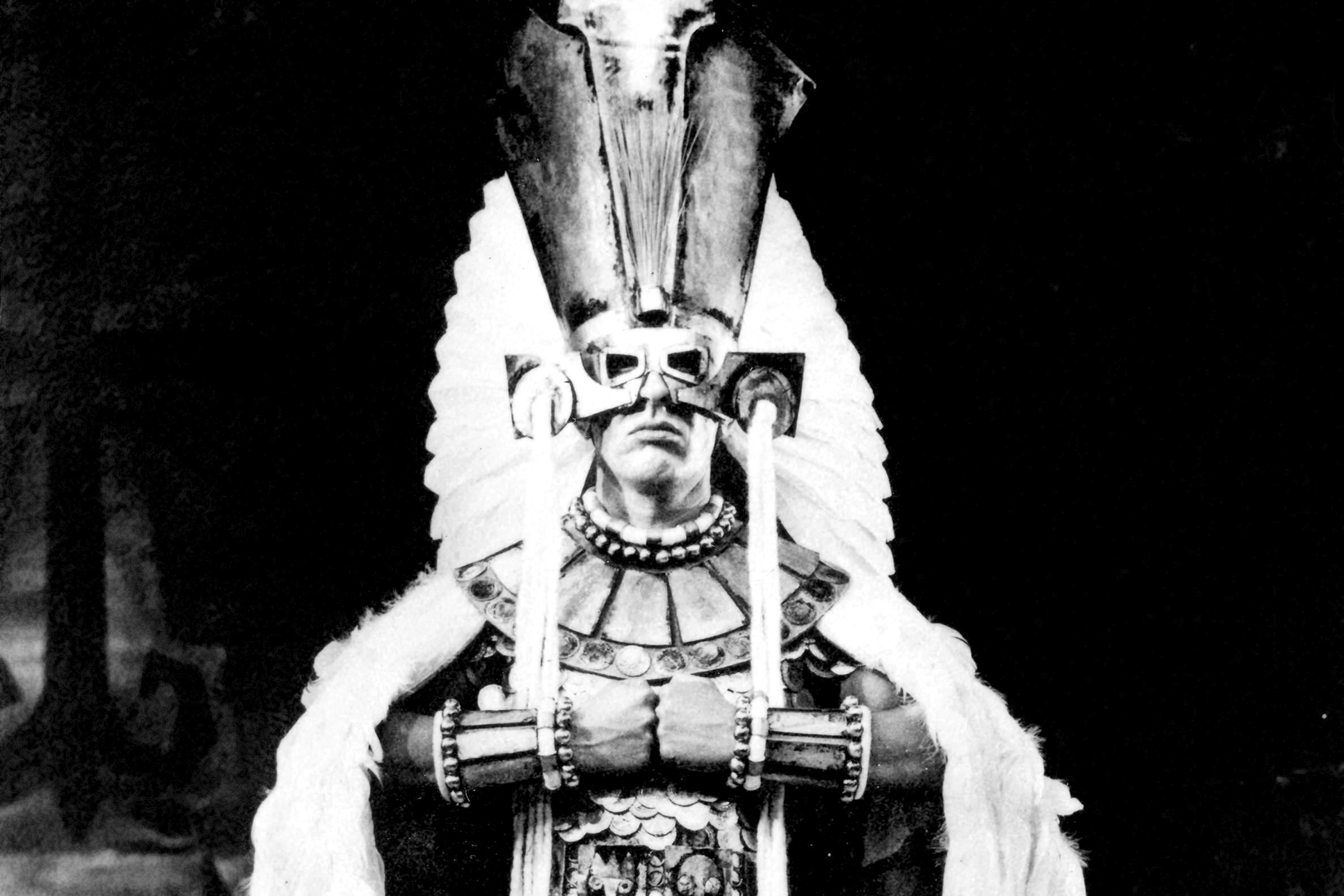

On a December night in 1964, an unearthly creation is revealed on the stage of Chichester Festival Theatre. Piercing shafts of white light. An immense metallic sun opens gleaming petals on to the figure of an eerie masked deity sheathed in white feathers. Glints of gold, a headpiece hinting at the pharaohs. Sounds of a tropical forest: haunting bird calls, disturbing feral howls, a deep humming resonating through the theatre.
The Royal Hunt of the Sun, written by Peter Shaffer and now staged by the National Theatre at the Old Vic in its second year, remains the most thrilling theatrical experience of my life. I was just 21: nothing since has even come close to the visual excitement, the grandeur and glamour of that evening. Epic, exotic and erotic. Intense and tragic. And lots of tan makeup. I took my mother that night because Shaffer and his identical twin Anthony (who wrote The Wicker Man) were my cousins through our mothers – both Fredman before marriage. But we never met.
When 33-year-old Robert Stephens took the role of Atahuallpa, Inca Sun God of 16th-century Peru, he was considered the natural successor to Laurence Olivier. Though highly respected – and eventually knighted – that prediction was not fulfilled. Versatile and volatile, an addictive personality and several marriages finally outweighed his talent. For this most famous performance, he worked out in the gym for months to sculpt the musculature of a Greek athlete. (In 1964 gyms catered mainly to professional sportspeople.) Regally robed, with long black hair, exaggeratedly hooded eyes and thick fake eyelashes, he was majestic. Stripped to a loincloth before his dreadful sacrificial death, darkened flesh oiled and gleaming, he was dazzling, dominating the stage with his sheer physicality.
All the casting was stellar: Michael Gambon, Anthony Hopkins, Derek Jacobi, Christopher Timothy, Oliver Cotton, Edward Petherbridge, Robert Lang, Edward Hardwicke and John McEnery. Colin Blakely, described by Olivier as “deeply enthusiastic, courageous, gifted,” was co-lead, Atahuallpa’s nemesis Francisco Pizarro. With what he called his “rough, knocked-about looking face,” he was utterly convincing as the grizzled Spanish conquistador, cruel and melancholic, who led 167 armoured men to kill thousands of unarmed Incas.
The production was operatic, due to director John Dexter’s eclectic background: theatre history claims he was drawn to the play, previously considered “unstageable,” by Shaffer’s stage direction: They cross the Andes. (Which they do.) Claude Chagrin choreographed the cast, meshing with the minimalist sets of Michael Annals. I can still see black crucifixes sharpened into chilling knifepoints. The naked feathered bodies of slaughtered Incas spilling across the stage under billows of bloodied silk in the massacre. Later, circling figures in funeral masks, the guttural laments and hollow drum beats of the Chant of Resurrection as they beseech their garrotted king to revive with the sun as he had promised: “If you kill me tonight I will arise at dawn.” The sound effects – unseen wildlife, human humming – were part of Marc Wilkinson’s score with cymbals and sleigh-bells, flutes and maracas, triangles, tablas and bongos - even a glockenspiel..
The theme of Royal Hunt is the quest for God. The writing is poetic: I can still recall lines: “The cold high night of the Andes hung with stars like crystal apples.” Shaffer (who was Jewish) suggests links between Atahuallpa and Christ. Both 33, both offer themselves for sacrifice, both die a painful human death. Pizarro’s words to the Inca emperor emphasise this. They’ll knock you down but your father the Sun will pick you up again. Bloodstained and gold-strewn, this recounting of history is bookended by an ancient soldier storyteller. Old Martin witnesses the complex relationship of the two leaders, the almost love and ultimate betrayal when Pizarro, who promised life to Atahuallpa in exchange for a roomful of gold, is forced to allow his assassination. Even at the end, Pizarro somehow believes the sovereign will survive, true to the last words he speaks to his captor: “I will swallow death and spit it out of me.”
Only tinkling bells accompany the scene where Atahuallpa recites the harvest song to Pizarro, about a tiny bird which must not steal grain but evade traps and the black bird nailed to a branch as warning. He croaks, halting and tuneless but so moving, like some wild creature forced to vocalise. The play ends as the despairing Pizarro lies cradling the body of the Sun God, and sings it himself, voice harsh as his “life of wounds and hunger”. The same words, but now about him and his avaricious army. “See, see the fate, O little finch, of robber birds, O little finch.”
Afterwards, when the storm of applause finally died away, Mum and I went quietly home to Ealing on the tube.
Marcelle Bernstein is the author of several books and from 1964-71 was The Observer Magazine’s chief interviewer
Caption: Robert Stephens in The Royal Hunt of the Sun in 1964; photograph by Angus McBean; Harvard Theatre Collection; Mander and Mitchenson/University of Bristol/ArenaPAL
Newsletters
Choose the newsletters you want to receive
View more
For information about how The Observer protects your data, read our Privacy Policy