I first saw the Michael Sheen effect 15 years ago. His mercurial transformations as an actor had long been evident, not least in 2003, when he played – differently – Caligula on stage and Tony Blair on screen. Yet in 2011, during the mighty staging of The Passion in his childhood home of Port Talbot, another dimension became apparent. Sheen was a local hero: just as well, since he was playing Jesus Christ. As he carried the cross through the streets, hundreds of residents urged him to transcendence: “Come on, Michael!”
South Wales has proved rich in theatrical talent – Richard Burton and Anthony Hopkins also grew up in Port Talbot – but poor in state subsidy. It was in response to the Arts Council’s withdrawal of funding to the National Theatre of Wales that a year ago Sheen announced he was founding a Welsh National Theatre with his own money. He has Swansea-born Russell T Davies as creative associate and a partnership – which Sheen has described as essential – with the Rose theatre in Kingston, south London where Our Town will, after Llandudno and Mold, open at the end of February.
The US playwright Thornton Wilder’s 1938 work is a clever choice with which to start. It is welcoming; it celebrates the intermeshing of lives and the theatre’s ability to conjure this. Evoking a small town with a jostle of characters, fragmentary scenes, comedy and dark shadows, it has much in common with Under Milk Wood. Dylan Thomas is never far away in Swansea; round the corner from the Grand is a pub named after his silver-tongued clergyman, Eli Jenkins.
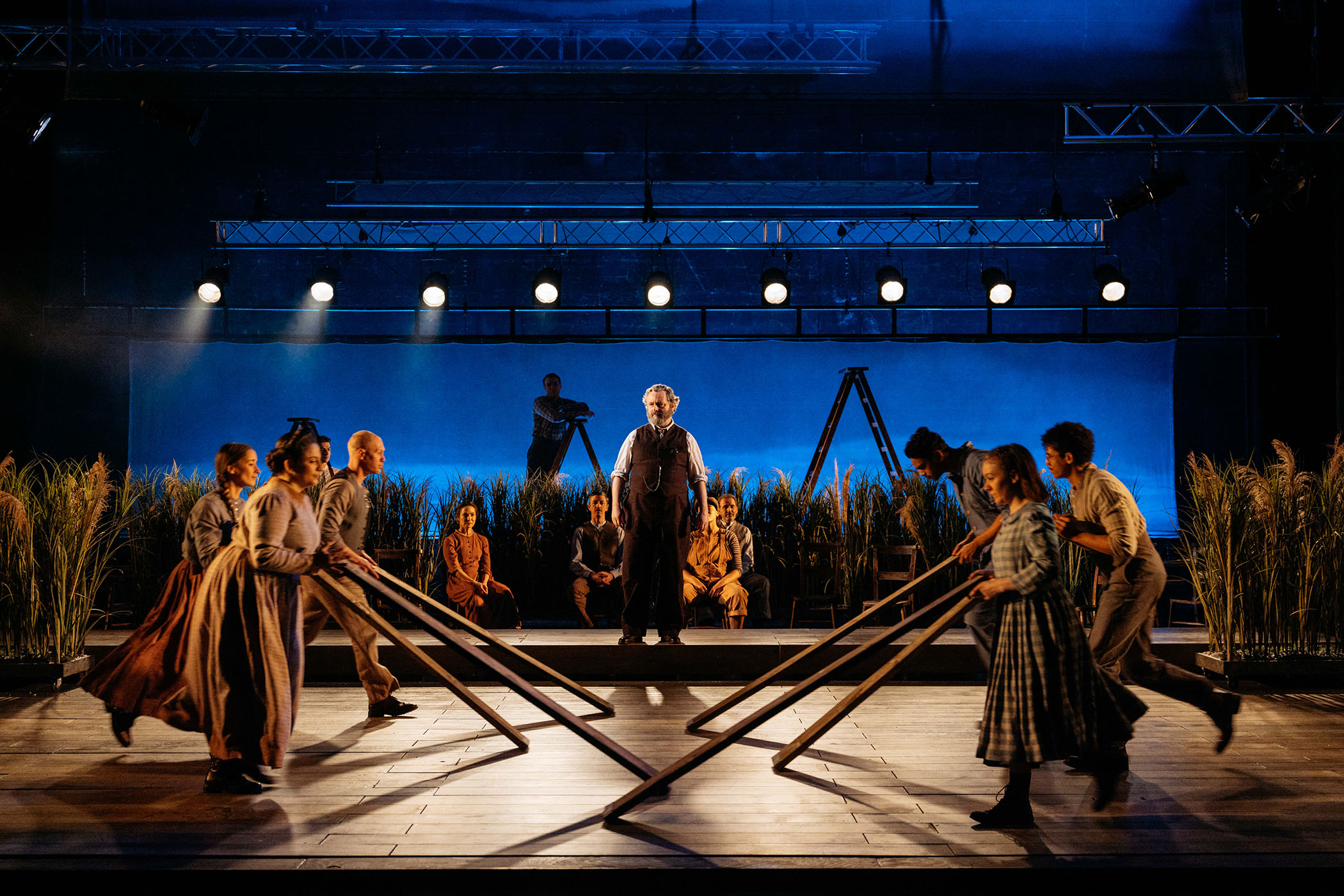
Sheen, in the role of a stage manager, gets a rumble of appreciation as soon as he appears in waistcoat and whiskers
Sheen, in the role of a stage manager, gets a rumble of appreciation as soon as he appears in waistcoat and whiskers
Sheen has used his celebrity like a lightning rod to bring in audiences and channel warmth on to the stage. In the role of a stage manager, who steers the audience through the action, he gets a rumble of appreciation as soon as he appears in waistcoat and whiskers. Like Burton in the film adaptation of Thomas’s drama, he is a narrator who murmurs comfortingly and ushers in chill winds; Wilder appeared in the part himself for a couple of weeks on Broadway. He magics existences from nothing; when he clicks his fingers the lights go down.
Francesca Goodridge’s expansive production brings Welsh accents and resonant Welsh hymns to Wilder’s play, which is set in New Hampshire in the early years of the 20th century: the unexpected mixture proves intriguing rather than disconcerting. These characters travel well. As always, the more detailed, the more universal.
The drama’s rosy first half, flirting with sentimentality, has one single developing thread – of a teenage romance – but largely presents warm wisps of everyday life: a newspaper boy delivering papers and a doctor delivering twins; a drunk choirmaster – everyone knows and everyone pretends not to tattle about him – who weaves sadly across the boards; a shopkeeper dispensing strawberry sodas. The smell of heliotrope drifts from one garden, and one nose, to another. In a dramatic shift of mood after the interval, death has claimed some vital characters. Their ghosts, perched high on unreachable ladders, look down on their friends and families, again summoning memories of Under Milk Wood, where one of the most sensuous voices is that of a dead woman.
Our town is, says one citizen, “very ordinary”. The point of the play is to show how particular it is to each resident, and how the residents depend on each other. Hayley Grindle’s design beautifully enables this: the cast are seen making their houses, streets and civic buildings. Planks of wood become doorways, tables, the cross of a church, the rails for trains, whose whistles sound from time to time like a call from the wild. I wish only that chairs were not brandished in the air – a cliche that should be at least temporarily retired; waived, not waved.
Jess Williams’s work as movement director is crucial to the sense of civic interdependence: the 18-strong cast weave across the stage – fluidly but not over-balletically – as if they were making a cat’s cradle with their activity. Equally important is Ryan Joseph Stafford’s lighting design, its initial radiance the more striking because it is fringed by darkness, against which characters first glow, and to which they eventually return.
Wilder’s script sometimes lumbers. Yet though it is old-fashioned in its explicitness, it is timely. In pleading with its audience to appreciate taken-for-granted moments – giving significance to everyday gestures and phrases in the way they do in attending to a good play – this could be called a lesson in mindfulness. In other words, art.
Our Town is at Swansea Grand until 31 January, then touring
Newsletters
Choose the newsletters you want to receive
View more
For information about how The Observer protects your data, read our Privacy Policy
Photograph by Helen Murray