Adventurous theatre does not always wave a flag saying bold. It may simply go against the grain of expectation. Barbara Pym presents the least likely of dramatic prospects. The action in her novels – the first published in 1950 – is a matter of minutely observed behaviour and inward slippage; her characters speak quietly and have modest means. The early books are heavy on curates; all feature women who are considered not so much single as spinsters.
Pym has become most famous less for any single book than for falling out of fashion, ceasing to be published, and for being hauled back to public attention when hailed by two chap writers as a neglected talent. In 1977, the Times Literary Supplement asked a number of “literary figures” to nominate the 20th-century writers they considered most underrated. Pym, who had been turned down by her long-term publisher, was the only living writer picked twice – by David Cecil and Philip Larkin (who chose DH Lawrence’s Women in Love as the most overrated novel). Suddenly, she was in demand again.
Larkin’s territory overlaps with Pym’s in the land of disappointment. The novelist Samantha Harvey, who in 2024 won the Booker prize for Orbital, set in a space station, is an improbable adapter for a novel about four timid office workers, two of them bedsitter dwellers, all facing retirement, all differently bewildered by the bustle of 1970s London. Yet Harvey was, as she explained eloquently last month in The Observer, drawn to Quartet in Autumn (1977) precisely because of its distance from her own work, fascinated in particular by the way Pym hovers around her characters’ psyches without quite entering them. Harvey has done a good job in putting these psyches on stage.
Awkwardness and avoidance – meticulously conveyed by all four actors – are habitual
Awkwardness and avoidance – meticulously conveyed by all four actors – are habitual
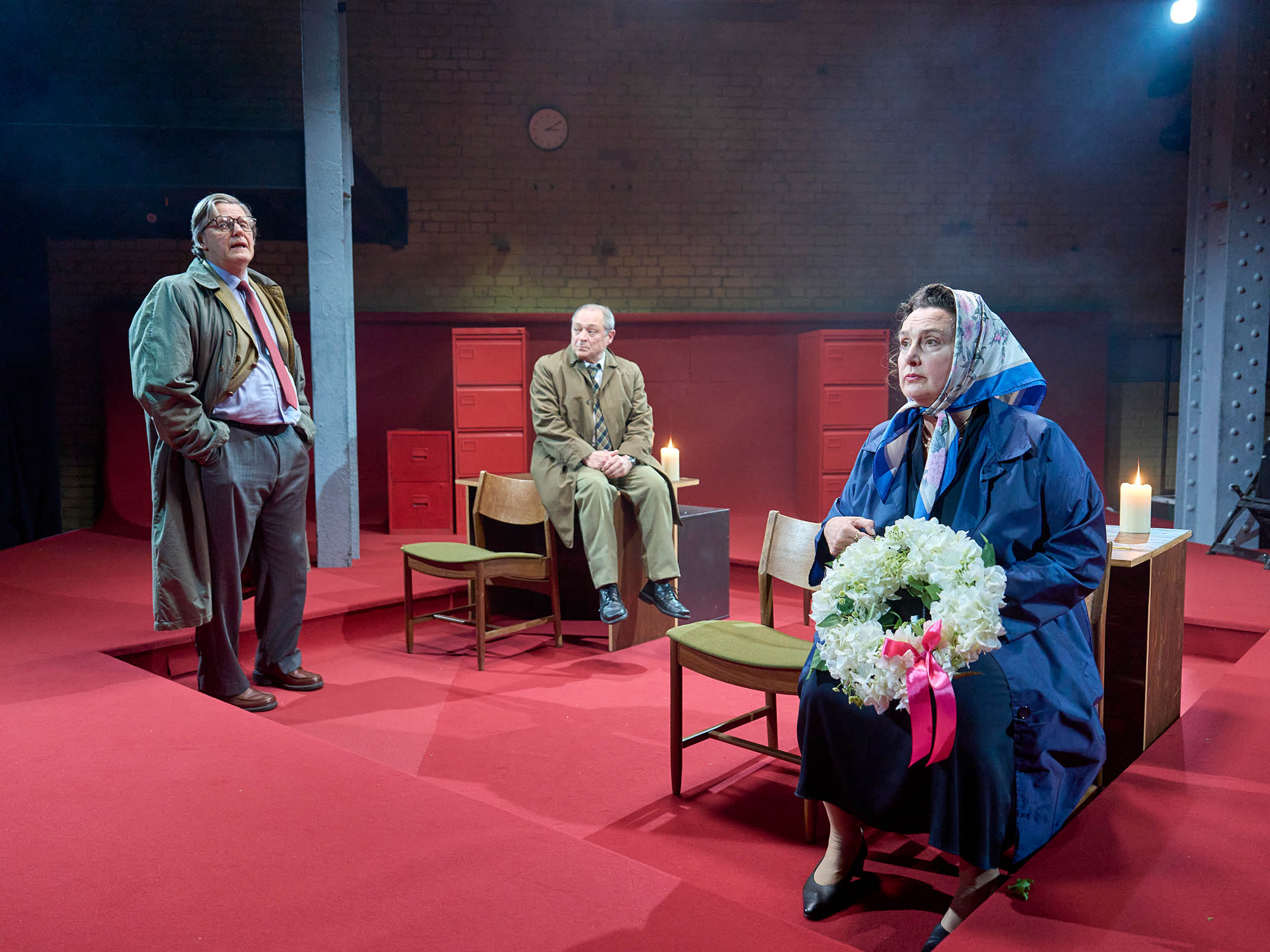
As has director Dominic Dromgoole. It is evident before anyone speaks in the tiny Arcola theatre that Pym’s precision has been honoured. Ellie Wintour’s design – a small space carved out of a small stage in which characters have established small but distinct domains – is drab and tidy. Four tables, each with its own dimmed lamp, are angled towards each other – close but not overlapping. On one, there is a pair of specs. On another, a headscarf. A spider plant straggles. Here is room for two men and two women to work side by side, near enough to irritate each other, while keeping themselves to themselves.
Pooky Quesnel’s Marcia – cleverly got up by Wintour in diamond-pattern tights that jangle with the different aggressions of her skirt and top – is abrasive, secretive, obsessed with the surgeon who performed her mastectomy (an operation to which she continually alludes without ever explaining). Unknown to her colleagues, she collects milk bottles (one brand only) in her garden shed and busily catalogues a vast hoard of tinned stew and peaches. Next to her is chirpy Norman (Paul Rider), who performs annoying stretching exercises behind his desk and regularly emits needling remarks; the two tussle over a family-size tin of instant coffee.
Anthony Calf’s Edwin (in V-neck sweater and tie, as is Norman) is earnest, bland, regulating his life according to the calendar of the church. Kate Duchêne, as Letty, supplies an air of doleful gentleness that changes in the course of the evening to something sharper and more hopeful. She gives up trying to read sociology books, decides she may not, after all, move to the country to comfort her jilted friend Marjorie: it is too full of dead hedgehogs. For the first time in 60 years, she thinks she has choices.
Awkwardness and avoidance – meticulously conveyed by all four actors – are habitual. At a funeral, three characters pass a wreath between them as if engaged in a hazardous party game. Yet Letty gets a glimpse of other more inhabited lives, not least when, complaining to her new Nigerian landlords that the sound of their hymns is disturbing, she is met with the revelatory response: “Christianity is disturbing”; she backs away, but wistfully. Uneasiness is comically sketched yet pervasive.
Brilliantly, Pym makes office life – with its sibling-like customs and rivalries – the main point of her characters’ existence while being itself pointless. No one knows what these people actually do. When the two women retire, it turns out that their boss is equally in the dark: he has no idea of their activities but praises them for their diligence – a diligence so exemplary that they will not be replaced. In the hands of a heavier writer, with a splashier canvas, this would be called Orwellian.
Photograph by Manuel Harlan
Newsletters
Choose the newsletters you want to receive
View more
For information about how The Observer protects your data, read our Privacy Policy