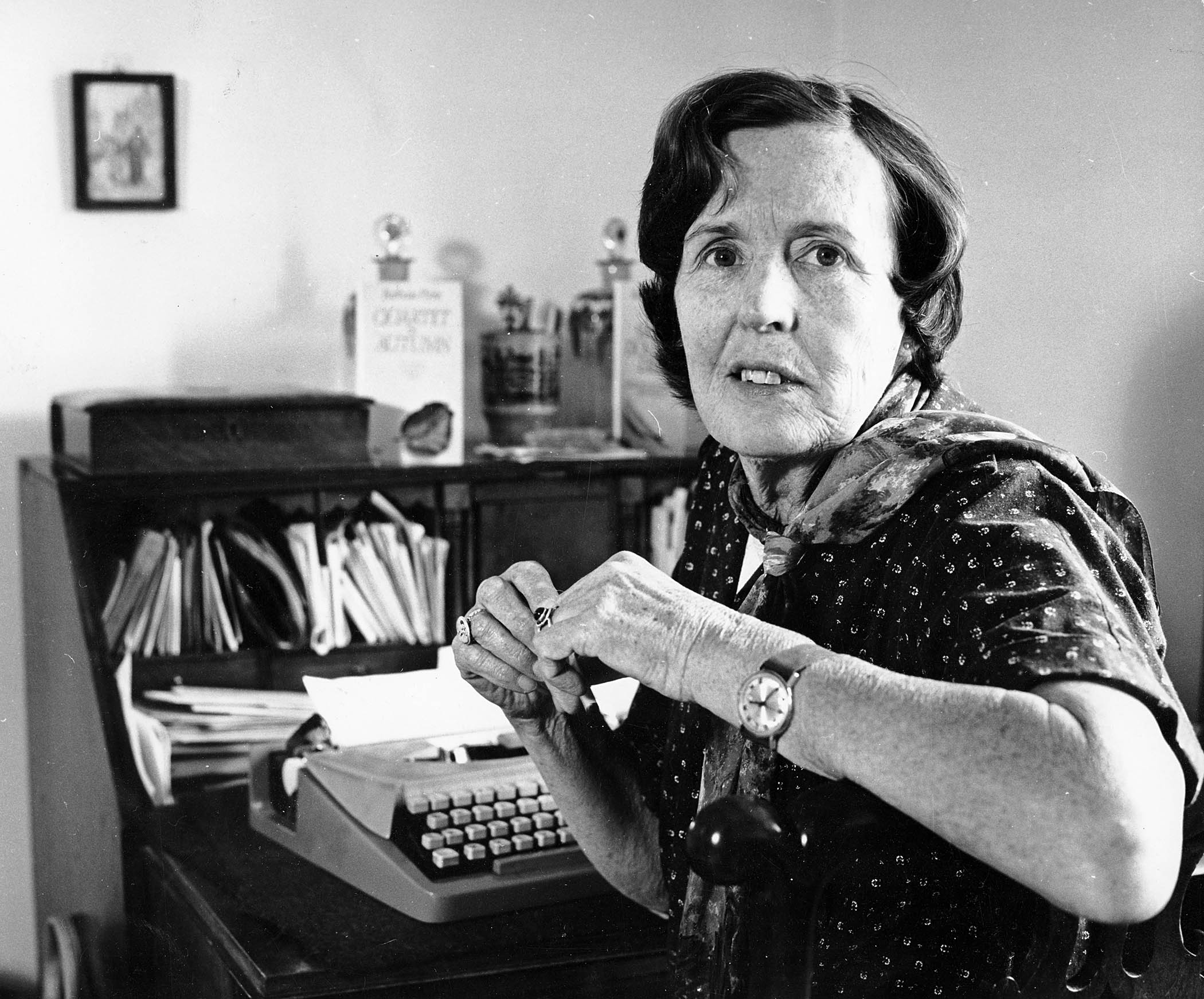


I wonder if writers are drawn to the novels they could never write themselves? When I first read Barbara Pym’s Quartet in Autumn it was obvious to me, by the end of page one, that it was way wide of my own register. By page five, I was coveting its ease and transparency of style, its social precision. A hundred-odd pages in, I understood that it had pulled off some kind of stealth manoeuvre on me; it had – one spacious, unfussy sentence at a time – tackled me to the ground. Dusk falls around you as you read; it’s a funny book, a light book and it’s dark. The darkest of Pym’s work by far.
When I first read Quartet in Autumn, I had an impulse I’d never had after reading a novel – to write a stage adaptation of it. I’d had vague notions of writing a play one day and here was an unexpected invitation. There was something in its limited cast and setting, its brilliant balance of the said and unsaid, the inner and outer, the complex, amusing performance of being alive. It’s an odd, beguiling novel, and my process of adapting it has only taken me more deeply into its layers.
Pym published six novels between 1950 and 1961, then was dropped by her publisher. Sixteen years passed. She continued to write, to be rejected, until, in 1977, Philip Larkin and Lord David Cecil nominated her as “the most underrated writer’ for a piece in the TLS. Suddenly, with the endorsement of actual men, publishers vied for her. Later that year, Quartet in Autumn was published and went on to be shortlisted for the Booker prize; her next novel followed in 1978. Pym died in 1980, aged 66. Four more novels and one collection of fiction were published posthumously.
In a career almost defined by setback and rejection, what amazes me about Pym’s work is its consonance, its nerve, its steady interest in the same concerns – chiefly the minor but detailed workings of (often female) lives that orbit the gloried but equally detailed workings of the church.
The feeling I get when I read Pym is that the world of her 13 novels is a world in miniature, a doll’s house, and moving from novel to novel is to step from room to room; similar décor, similar view from the window, the air smells faintly the same, a person in a photo frame in that room is sitting at the table in this one. Characters reappear from book to book. Her novels mutually haunt one another; they form a continuous whole, a careful, intricate lace-making.
Quartet in Autumn is both part of that whole and also slantwise to it. Undoubtedly, it is haunted by its predecessors. In Pym’s second novel, Excellent Women (1952), there’s a scene in which the protagonist, Mildred, makes a brief visit to her male friend’s place of work. The women in her stories do this – gaze in on a universe from which they’re largely excluded and on which the curtains are quickly closed. No more looking. Whatever is happening there is of passing relevance, and anyway, a bit absurd.
She writes about people for whom platitudes serve in lieu of meaningful connection
She writes about people for whom platitudes serve in lieu of meaningful connection
But before the curtains are closed on this scene, Mildred observes: “Two elderly grey men were sitting at a table, one with a bag of sweets which he hastily put away into a drawer, the other with a card index which he naturally did not attempt to conceal.” Here is the haunting. Pym, in glimpsing this office and these men, has (presumably unknowingly) prepared a stage set for the novel she’ll go on to write 25 years later. It has yet to find its characters – but it will. That book will be Quartet in Autumn, and that man hiding his sweets could well be Edwin, one of the four people who make up the quartet. We see him early in the novel, an elderly grey man, at his desk, biting (Pym can’t resist a dose of bathos) the heads off jelly babies. We’re still in her familiar, coherent world, but now it’s tilted. Now the office is foreground, the church background. It’s 1977, society has changed and Pym is writing into a new reality in ways that are themselves new. Her old work haunts these pages, but something brilliantly different is happening.
This was how I visualised the office in Quartet, as a stage set, a confine – a raft, perhaps, bearing its four characters forwards into a turbulent future. The quartet is Letty, Edwin, Marcia and Norman. They work together and are all in their early 60s (which did count as elderly then, in which case I myself am elderly minus a mere decade). None of the four appears to do any work or to know what their work is. Their employers don’t know either. I don’t think Pym wants to say that work doesn’t matter but, rather, that so many people are forced into working lives that are unfulfilling, and that the only thing more frightening than becoming stuck in this life for ever is being involuntarily excluded or ejected from it.
This is at the heart of Quartet in Autumn; the two women, Letty and Marcia, are about to retire. The question is, and then what? There’s no true friendship within the group, more a frequently tested tolerance of one another. And yet what else do they have beyond this raft? Loneliness is always lapping at, and over, the edges.
It’s a novel of anxiety about being left behind. It’s London in the mid-70s; the welfare state is well established, but what does that mean for community? Do people not look out for one another any more? Are you stuffed in your bedsit with your state pension and the occasional GP appointment to look forward to and left to feel grateful? Britain has joined the EEC, globalisation is in the air, people are agitated by – guess what? – race and immigration.
Newsletters
Choose the newsletters you want to receive
View more
For information about how The Observer protects your data, read our Privacy Policy
Pym’s characters are agitated in different ways. Norman expresses straight-up racism; Edwin, a widower and the only one of the four to have been married, copes with change by holding fast to his life around the church which, too, is changing. It’s going a bit rock’n’roll, a bit freestyle, for his tastes. Letty has a growing if barely understood awareness of Britain’s dreariness, her own greyness – “crushed and dried up by the weak British sun” – in contrast to the baffling radiance of her new Nigerian landlord.
Change, the age-old and steadfast precursor to fear. This is, to me, a novel about four people who are afraid, but who’ve been so conditioned to function at the uppermost surface of their selfhood that what they feel hardly registers or matters. In all of Pym’s work this idea recurs. She writes about appearances, people doing what seems to be the done thing, living on a diet of platitudes that serve in lieu of meaningful connection, and yet, seen another way, are the sum of meaningful connection. Perhaps good relationships with others consist, thinks Letty, of small acts of kindness, “not unlike the pigeons picking insects off each other”.
Pym wants to challenge the idea of “depth” as an indicator of meaning. She doesn’t want to get under the skin of her characters – their skin is interesting to her, it’s where their living selves meet the world, a swarming point of sensation and reaction and interaction.
For me, this is where Quartet in Autumn is most brilliant, most strange and subtle, and most at an angle to her other work. Also, most seductive in terms of adaptation. There’s so much surface to work from and it’s buzzing with nuance. Though it’s a comic novel, it relies less, I think, on some of the pat one-liners and Wildean witticisms of her other novels, which tend to seal and gloss the surface. The seemingly simple but subtle third-person voice of Quartet breaks up the surface and finds its texture.
That voice is democratising; we consider men’s and women’s lives alongside each other rather than, as is common in Pym’s other work, women’s lives as defined by their futile yearning for the vast acreage of men’s lives that remains forever mysterious and out of their reach. In Quartet, life is out of reach for all four of them. This is less a novel about gender (though it is that) than one about humans ageing in a world that is running away from them.
Whoever the narrator of Quartet is – not the characters, not Pym, not some aloof omniscience – it performs the deft trick of being observant without being detached. It’s a narration that’s feeling blind for the contours of its characters; finding little lumps and bumps, irregularities, without being compelled to diagnose or excuse them. It knows a little more about each of the characters than they themselves are conscious of. It knows the thoughts they’re having but have only half-registered.
Still, it never goes so far as to flatten, patronise or laugh at them, and here, again, I see these people on stage. Timid, unthinking, ridiculous, petty, but at times found blinking into the light of self-awareness. Caught out by moments of fleeting grace.
This isn’t a satirical novel – it’s more tender and attentive than that. Letty tells her punctilious and prim landlady about a meal she had after a funeral, but hesitates when it comes to saying she had oeufs florentine. It sounds “frivolous and unfeeling”, she decides, and yet it was what she wanted, and she enjoyed it and shouldn’t lie. In a moment of real angst she decides, instead, to say she had an “egg dish”.
Letty lives, as do the other three, at the outer edge of herself. Don’t question or reflect too much; don’t expect or want too much; don’t dwell. And yet through the novel her whole self is propelled, not entirely consciously, by the want for more, and the indignation at a life lived on scraps. This is the beautiful balancing act of Quartet’s voice, this pulling towards and resisting the characters’ inner selves; this wide narrative playground of surfaces that Pym writes from.
Most lives have unexamined terrain, and this is where the tragicomic lives. Pym travels the terrain with care, without judgment, and with a level of fascinated attention that’s rare and enviable even among novelists. Quartet isn’t groundbreaking or subversive, but it is the work of a writer who’s radically interested, who finds humour and soul, in every little thing.
Quartet in Autumn, adapted by Samantha Harvey and directed by Dominic Dromgoole, is at the Arcola theatre, London, from 7 May to 13 June. The book on which it is based is published by Pan Macmillan (£9.99). Order a copy at The Observer Shop for £8.99. Delivery charges may apply.