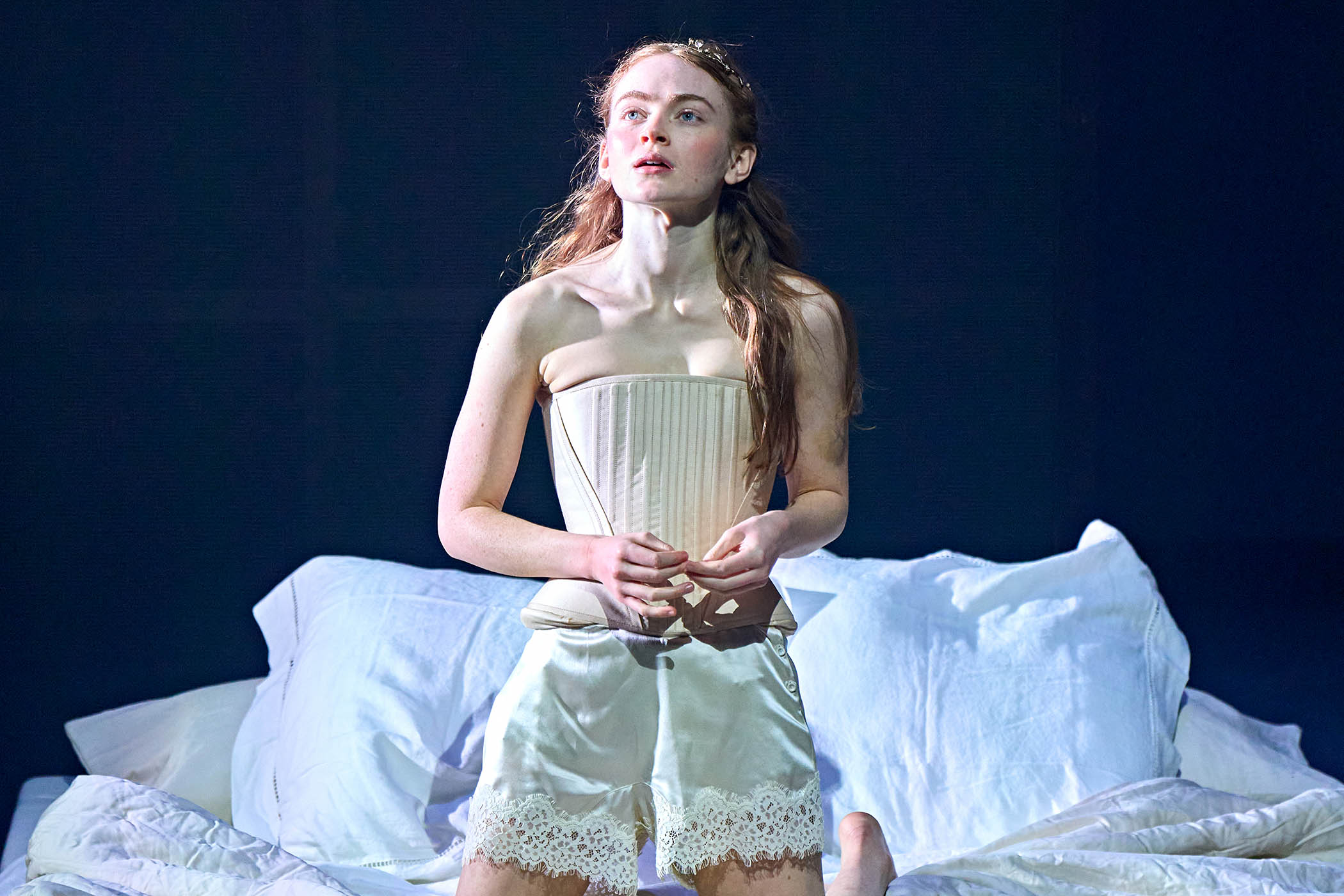


Star-crossed lovers of course, but also a cross star. I have never seen such a nervy, angry Juliet, one so skimming along on a wire of anxiety. Sadie Sink of Stranger Things is all angles, for much of the time exposed in camiknickers, once in a crimson sticking-out dress, something between a little girl’s party frock and a cocktail number. She bounces up and down on the bed that dominates the stage, wrestles with pillows like a boisterous 10-year-old, surrounds her words and gestures with a windmill whirl of hands.
She is arresting, high-pitched, opening a vein of the play that is often submerged in luscious lines. She also overdoes it, signalling the originality with those neurasthenic fingers. Like Robert Icke’s production, she conveys something essential about the action of this romance – its hysteria and its precariousness – yet detracts from that truth with hyperactivity, multiple underlinings.
Icke has brought new life to British theatre. As a schoolboy in Stockton-on-Tees, he put on A Midsummer Night’s Dream and realised, when Bottom came on with false teeth made by a local dentist and the audience gasped – “You heard them saying ‘Fucking hell’” – that a classic could be a “rollercoaster”. He has shaken the stage with Oresteia, with a surveillance-state Hamlet, with his 2024 Oedipus. He first directed Romeo and Juliet 14 years ago.
Though the prologue announces a “two hour traffic”, Icke’s version is a deal longer, but never slow. There is an irony here: Icke, who dreamed of being a concert pianist, is the most time-conscious of directors. He has described Romeo and Juliet as being “date-stamped throughout”, and a digital clock is always on display, its numbers eventually becoming scrambled, like the protagonists’ hopes. Clocks are a recognisable part of Icke’s recurring furniture: one ticked away in Oedipus.
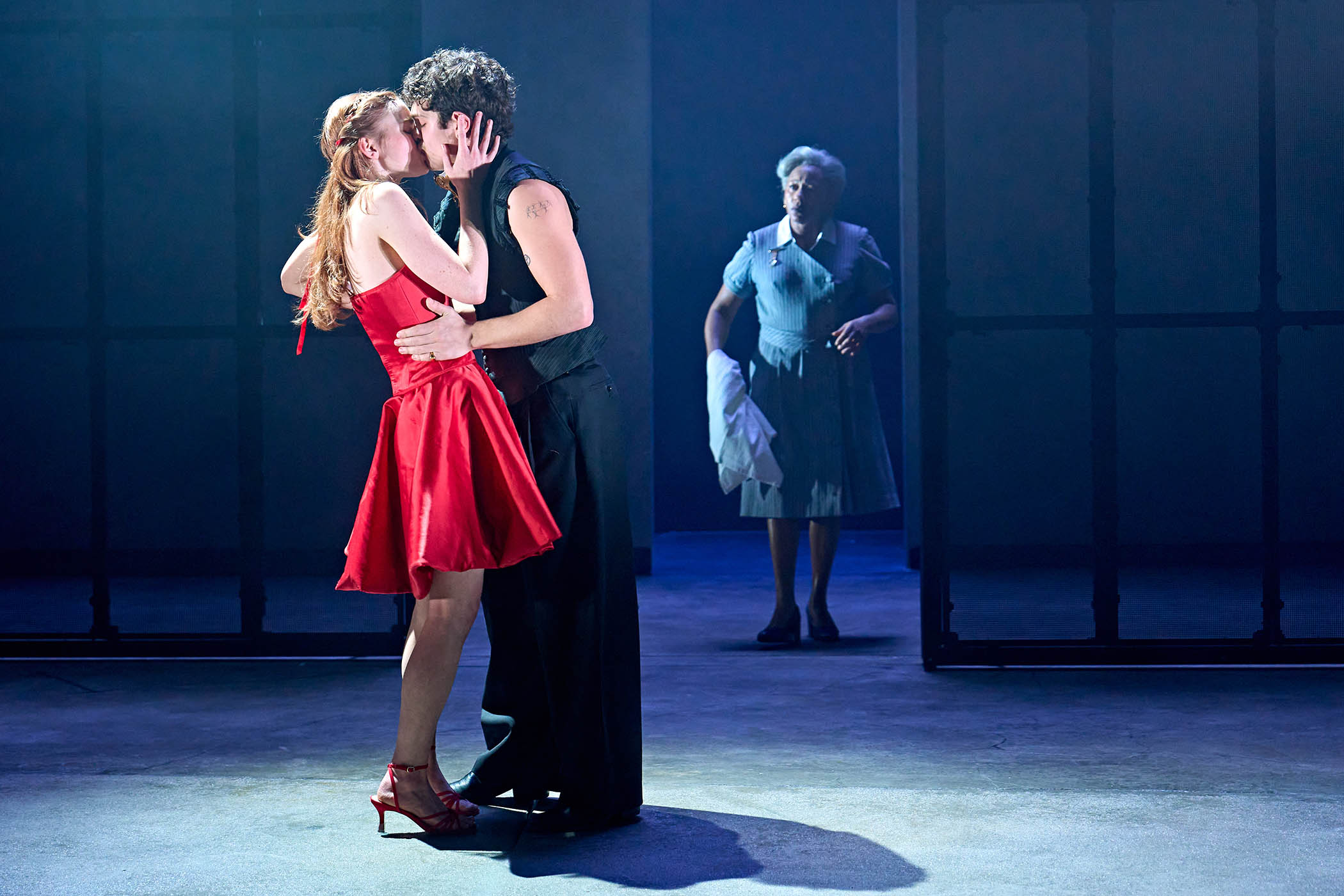
Sadie Sink and Noah Jupe in Romeo and Juliet at the Harold Pinter theatre
Still, Icke is not merely a timekeeper: he is a pacemaker. He wakes audiences up to the rhythm of a plot. In Romeo and Juliet, this is a bumpy matter, made up of coincidences and near misses. Icke plays with these bumps, introducing alternative – sliding-door – versions of the action that are signalled with a boom from Giles Thomas’s electronic sound design and a flash of Jon Clark’s raptor lighting. The Nurse, a gutsy Clare Perkins, with a starched uniform and a big embrace, might easily have failed to deliver the marriage messages between the lovers, driven away by the awful joshing of his friends. A scene often performed as if it were high-spirited banter, when Romeo’s mates jeer at the messenger for her age (what more risible than a not-young woman?) is rightly threatening here, much closer to the brutal scene in West Side Story where Anita, bringing news to Tony, is assaulted by the brawling Jets.
I have reviewed Romeo and Juliet 16 times for The Observer, including one musical version (not West Side Story), one radically updated adaptation, with the marvellous Rosie Sheehy as “Julie”, and, during lockdown, Simon Godwin’s successful fusion of film and theatre starring Josh O’Connor and a rapt Jessie Buckley.
Yet Icke’s is the only version to press home the plot’s happenchance nature. It topples into high romance as Romeo swoops from adoration of his former flame to love of Juliet. It tumbles into tragedy when plague prevents delivery of the note explaining the potion wheeze to Romeo. Is this really a farce with a sad face?
The prevailing mood is of tension, instability. Kasper Hilton-Hille – quick to moon at the Nurse, but rarely moony – is a high-velocity, sometimes maddening Mercutio, who nonetheless delivers the Queen Mab speech with utter absorption, enclosed in a bubble of light. Hildegard Bechtler’s design is grave: its monumental bed easily becomes a tomb; large sliding panels take on a blood-coloured flush. The backing track includes Adrianne Lenker’s Not a Lot, Just Forever, with the lyrics: “I wanna be your wife / So I hold you to my knife.” Eden Epstein, persuasively edgy as Juliet’s mother, looks wiped out with sorrow. Noah Jupe from the film Hamnet is a thoughtful Romeo, clear-spoken, though sometimes mistaking stress for emphasis.
I would not have expected to pluck a useful insult from a play so laden with rosy passages. Yet last week I heard a description I had forgotten: the Nurse tells Juliet that, compared with Paris, Romeo is “a dishcloth”. I thought this might be an Icke implant. Not at all. True, the original “dishclout” has been sensibly updated to dishcloth, but the sneer is there, spanking fresh and very useful. Thanks Shakespeare, thanks Icke.
Romeo and Juliet is at the Harold Pinter theatre, London, until 20 June
Newsletters
Choose the newsletters you want to receive
View more
For information about how The Observer protects your data, read our Privacy Policy
Photographs by Manuel Harlan