


When I was a child, I used to run away to the theatre. Perhaps it was the influence of Bunty magazine, in which girls were always running away to the ballet. My taste was middlebrow. I ran away to A Midsummer Night’s Dream at Regent’s Park Theatre (Ralph Fiennes was Cobweb); to Look Back in Anger at the London Coliseum, where I understood that Kenneth Branagh is too middle-class to play Jimmy Porter. I went to Eugene O’Neill’s A Touch of the Poet at the Young Vic, with Timothy Dalton, who wore a fake stomach as Cornelius Melody. I went to that twice. Dalton was a girl’s idea of handsome, and he was playing James Bond.
I was obviously a star-fucker and theatre was, to me, an adjunct of telly, or film. I paid for that. I sat through John Malkovich in Lanford Wilson’s Burn This (overwrought) and Dustin Hoffman’s The Merchant of Venice (I couldn’t hear). I went to Leeds on the coach to watch Christopher Ecclestone in Hamlet at the Leeds Playhouse, and I was glad I did: I like a cross Hamlet. Mostly I walked out of Shakespeare. I walked out of Daniel Day-Lewis’s Hamlet at the National Theatre and Timothy West’s King Lear at the Old Vic. I didn’t walk out of Sean Bean’s Macbeth, but I should have because I was laughing so much. Apparently the same thing happened to Peter O’Toole. I now prefer to read Shakespeare.
I should have forgotten film stars and stuck to the specialists, but occasionally I got lucky. Juliet Stephenson as the Duchess of Malfi; Paul Scofield in Ibsen’s John Gabriel Borkman at the National Theatre in 1996. Scofield is my favourite actor: I can still hear him shouting his pretend name.Occasionally, I got unlucky: Fiona Shaw as Medea in 2001 in a bright yellow raincoat, later asking the press, “Did anyone faint?” They didn’t.
Eventually, I knew my taste, which is pantomime (if with a child; without a child it’s weird) and musical theatre. It suits my star-fuckery because everyone is famous in musical theatre. Both are art forms of the ordinary, and both are filthy. (I just saw Ed Rowe play Widow Twankey in Aladdin. Filthy.) I believe the line from the agent in Tootsie (Sydney Pollack): nobody wants to watch a play about people living next to chemical waste. They can do that at home.
I should have known I was a musical-theatre person when my mother took me to Cabaret in 1985, with Wayne Sleep as the emcee. (I do not remember him being very convincing. He seemed too happy to be an avatar for the fall of the Weimar Republic). But the last line of If You Could See Her [With My Eyes] – “She wouldn’t look Jewish at all!” – frightened me, and I haven’t been frightened at the theatre since. Cabaret is singularly frightening. Most musical theatre – the rest of the good stuff, though I don’t include Lloyd-Webber or Disney, and Cabaret is supreme — is just dopamine: an art form for the calamitous 20th century. I would rather have the anaesthetic than the pain. Anyone can be unhappy. Few people can sing to Broadway standard.
I have seen Frankie Vaughn — who you will have forgotten, but I can’t — as Julian in 42nd Street. Catherine Zeta-Jones stepped out of the chorus line to play the leading lady, which is also the plot of 42nd Street. But women have more freedom in musical theatre than elsewhere. They are freed from staring at chemical waste, and they have a full orchestra. I loved Guys and Dolls, which is a drug (a musical) about a drug (gambling), and gamblers are the most self-aware of addicts: “And the devil will drag you under / by that fancy tie round your wicked throat.”
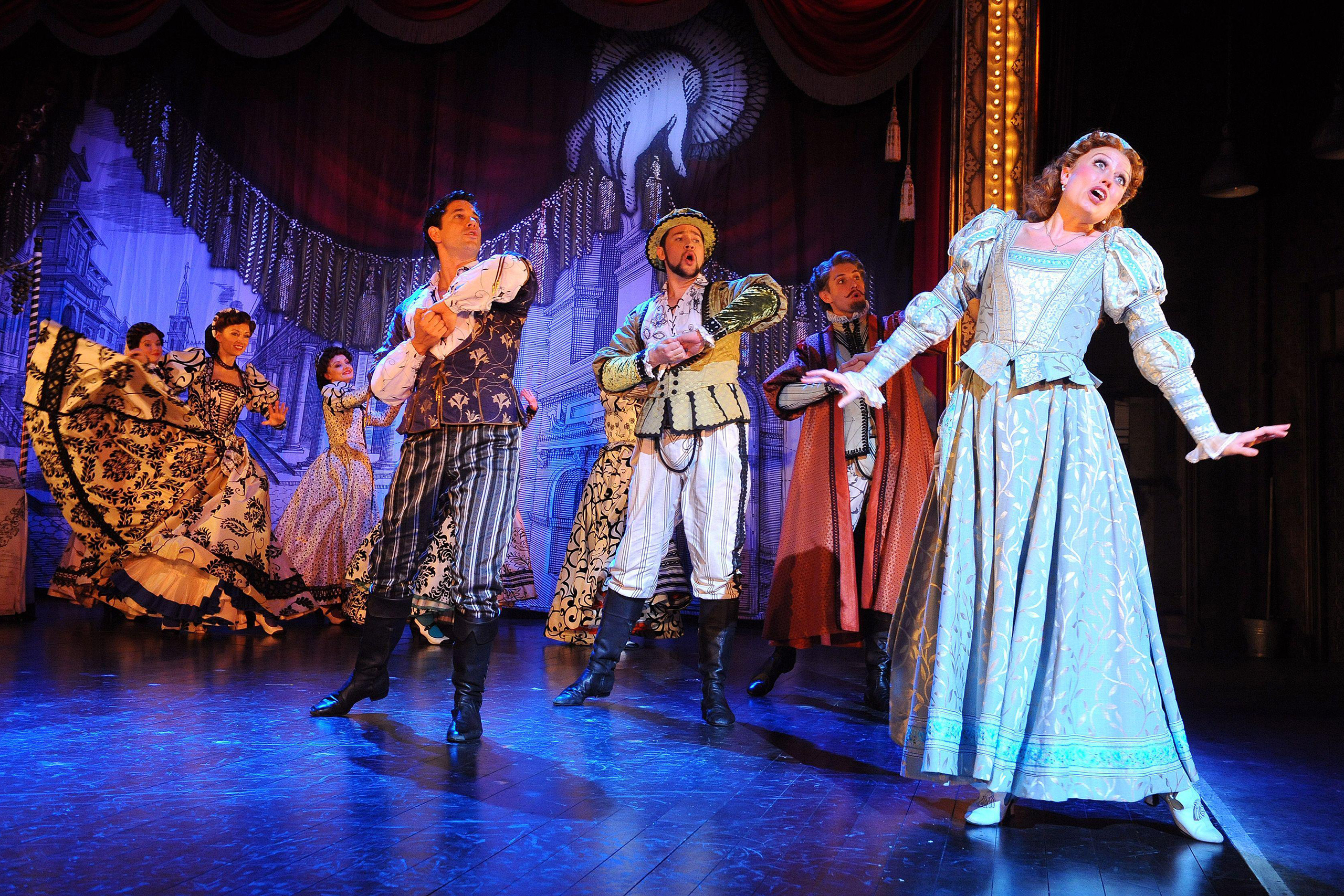
I loved Cole Porter’s Anything Goes: “At words poetic I’m so pathetic.” It’s a flex. Porter is the greatest lyricist: no one can dispute it. My greatest night at the theatre was not Scofield in Ibsen. It was people I hadn’t heard of – musical theatre specialists are not commonly famous, and they shouldn’t be – in Porter’s Kiss Me, Kate at the Old Vic in 2013. It starred Alex Bourne, happily impersonating Howard Keel, and Holly Dale Spencer as Lois. The second female lead gets the best song. It’s Always True To You (In My Fashion), with surely the greatest lyric in musical theatre: “If a Gable boat means a sable coat anchors aweigh!” But musical theatre is the home of women singing about what sluts they are. Porter is ever filthy. Tom, Dick or Harry has for its chorus: “Adick Dick.” This is the art form of the happiest masses. We know what he meant.
Tanya Gold is a writer who regularly contributes to The Observer
Photo: PA Images / Alamy
Newsletters
Choose the newsletters you want to receive
View more
For information about how The Observer protects your data, read our Privacy Policy