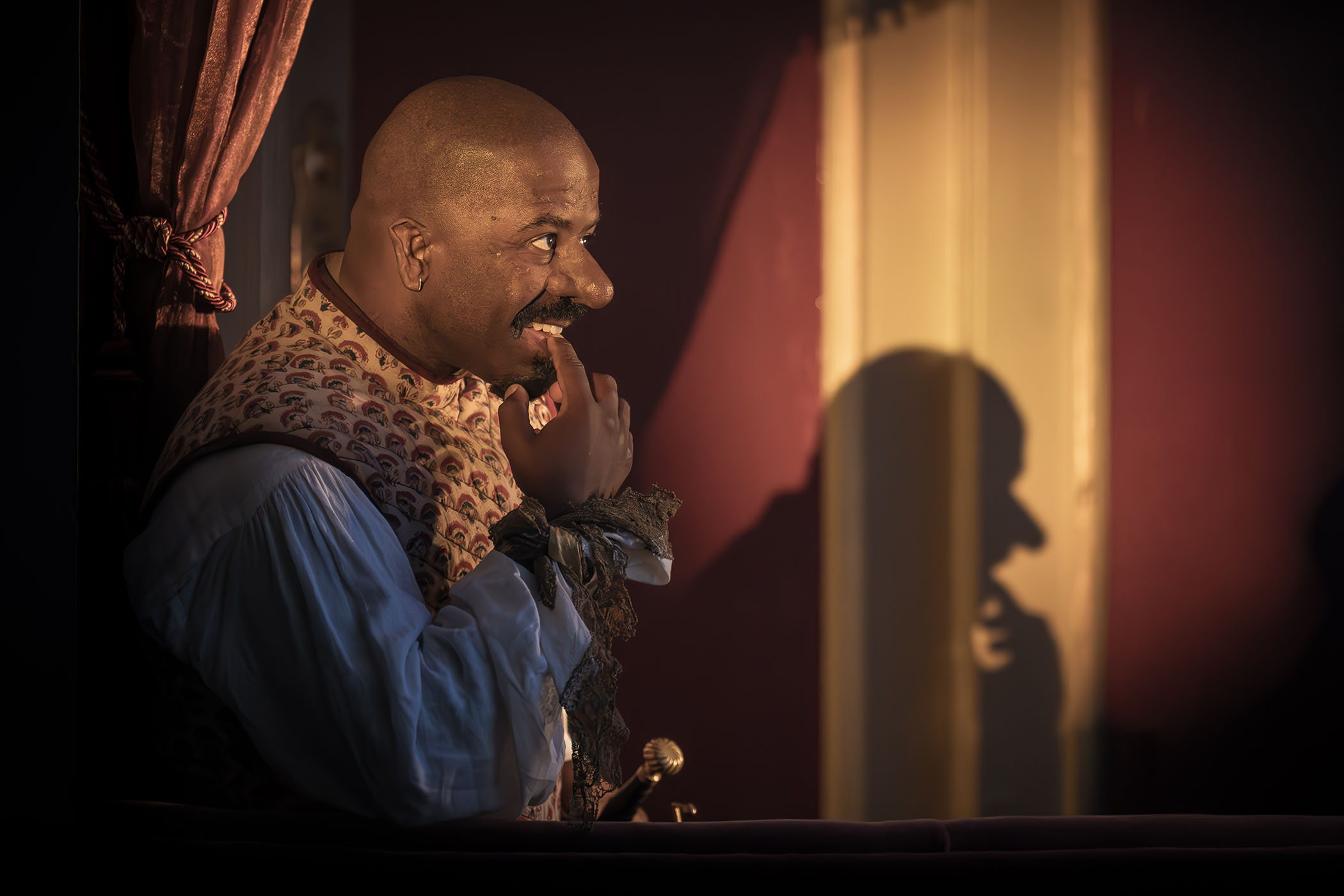



Splashy though it is – so many fights and verbal flourishes – Cyrano de Bergerac is extraordinarily penetrating. Quizzing on the question of love: do people fall for what they hear or what they see? Quizzing alike about performance: are we audiences or spectators at the theatre, drawn in by voices or by images? Cyrano, thinking himself too ugly to approach his adored Roxane, gives his silver-tongued tributes to Christian, a handsome suitor for whom words do not come easy. Roxane hears one man and sees another: which has she actually fallen for?
This should be the perfect drama: a plot that has to be enacted. Nevertheless, I used to dread Edmond Rostand’s play with its big boots and flung-out arms. Its praise of panache often sounded like the eulogies bestowed on Boris Johnson.
That dread has been vanquished. In 2019, Jamie Lloyd staged a bewitching adaptation by Martin Crimp that recreated the play’s duels as rap sequences. Now the drama is made vibrant in an entirely different way; in a fiery, romantic RSC version by Simon Evans and Debris Stevenson, first seen last year in Stratford-upon-Avon. Directed by Evans, it has, essential to its luminosity, Adrian Lester at the centre.
A racing quality powers Lester, who moves across the stage like a laser
A racing quality powers Lester, who moves across the stage like a laser
Lester’s reputation is high. That’s thanks in part to TV’s Hustle. Still, you need to see him on stage to realise his full vocal and physical reach. He has been lucky enough to have, or clever enough to choose, parts that keep propelling him in different directions. One of Nicholas Hytner’s best and first moves on taking over at the National Theatre was to cast him as Henry V. Lester has been an inspiring Ira Aldridge, an authoritative Othello. Thirty years ago, he dazzled in Sondheim’s Company: when he raced around the iron walkways of the Donmar, the audience leaned forward as if to grab him.
That racing quality powers Lester, who moves across the stage like a laser. He echoes the grace of a well-turned phrase by floating an arm as if balanced on an invisible wave, conjuring the physical allure Cyrano thinks he lacks. Yet, of course, it is his vocal pull that is crucial. In that rare thing, a really useful programme note, Stevenson explains how she and Evans established different speech habits for each character: straightforward Christian does not use any Latinate words; responsive Roxane often breaks her lines; Cyrano swings between rhythms. The result, never apparent as “poetic codes”, is clarity and richness of character.
Susannah Fielding is an exceptionally vivid Roxane: she makes you want to see a play with her name on it. Flashing-eyed early on (oh the relief that her dull husband is safely dead), in the last scene, she flares where others would sink. Finally realising the author of the words that have seduced her, she rages at being duped, and at the waste of her life. Greer Dale-Foulkes is luscious as her maid, who, just before rushing off to be a nun, grabs a long-fancied man and snogs him: “That was excellent,” he beams.
It is hard to play pretty and not very bright without seeming null but Levi Brown makes Christian honest and appealing. Scott Handy is an avidly creepy Comte de Guiche. Grace Smart’s costume design (her set is more staid) niftily projects character traits: De Guiche is trad 17th century, Roxane has a bob and free-flowing plunge-necked blouse, and Cyrano mixes jeans with a straitjacketing doublet. Cleverly, a band – Cyrano has won their services in a bet – offer yet another vocalisation of desire, sending out childhood tunes, melodically assenting to the action.
There is occasional overemphasis. A too larky introduction to the play’s performing aspect; a rhetorical flourish too far: “What is poetry but a mask?” Yet the core of the play could hardly be better expressed or delivered. Not least because it is short on sentimentality. Cyrano’s anxiety, naturally, focuses on his nose; Lester does have a big stuck-on conk – like a carrot you might find among the ugly veg in a supermarket – but his obsession with it is made not merely neurotic but self-preening, finally controlling. It has always seemed unconvincing to me.
Who looks for a bloke with a button nose? A big hooter holds infinite promise.
Cyrano de Bergerac is at the Noël Coward, London, until 5 September
Newsletters
Choose the newsletters you want to receive
View more
For information about how The Observer protects your data, read our Privacy Policy
Photograph by Marc Brenner