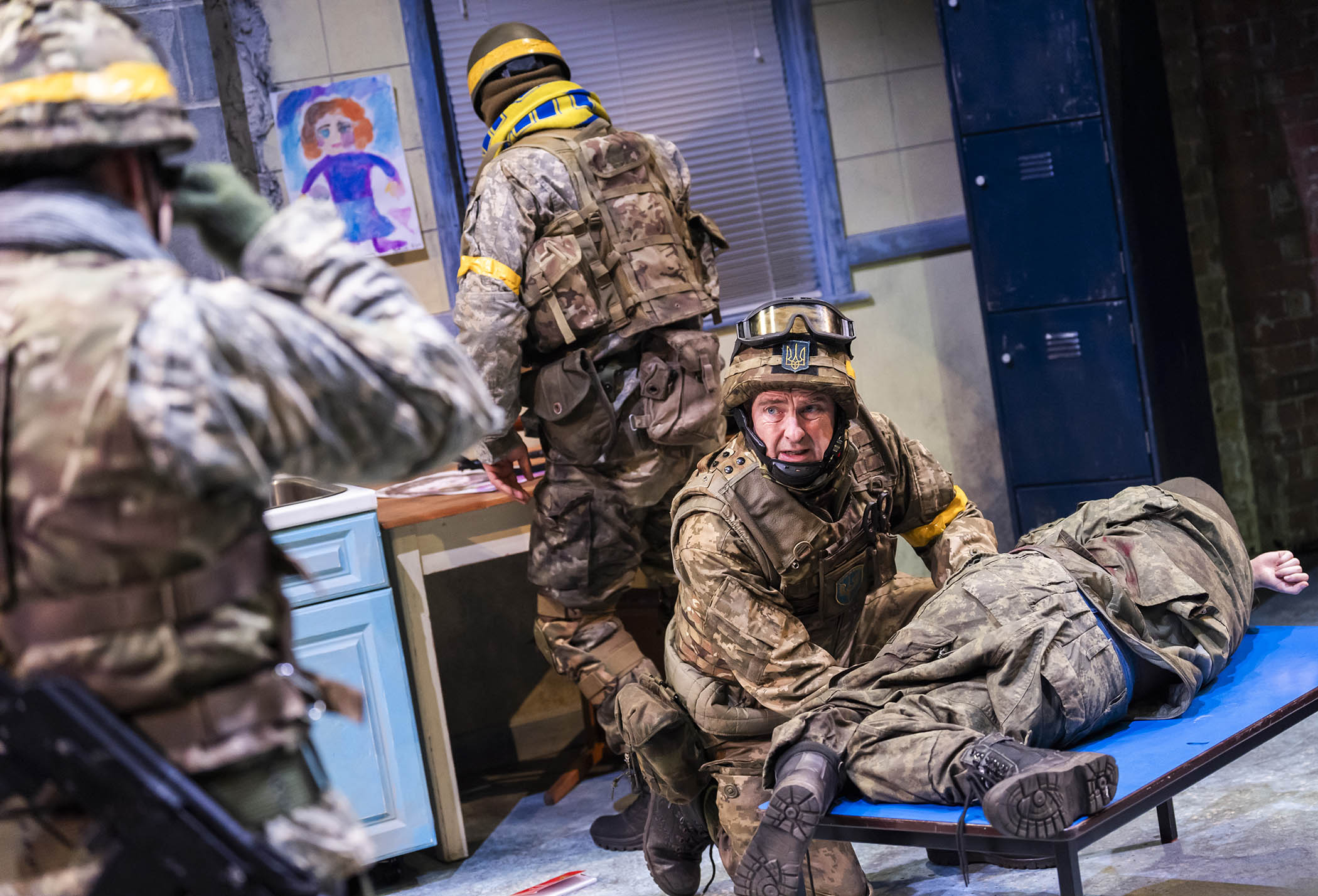

There is a line in Wretched Things – one of the short plays that makes up Nicolas Kent’s series on Ukraine – that reveals, unintentionally, the trouble of writing drama about a continuing conflict. It’s not the bloodshed, the bombs, or even the scale of the suffering – hard as these realities are to marshal on stage – but the fact that events move fast, while the theatre, from conception to presentation, moves slowly. In the scene, soldiers in military fatigues, crouching at a sink, find the water is running and drink in the luxury. “Feels like a five-star hotel in Dubai,” one says. A lot can happen in a fortnight – even dramatic irony.
Ukraine Unbroken is determined to meet the challenge of archiving in real time, and does so with conviction and urgency. It is theatre as newsreels: five plays – by four Britons and one Ukrainian playwright – focusing on five aspects of a conflict that began as a “five-day special military operation”. The dramas are sketchy and compressed, partly out of necessity. They are of mixed quality, performed by a consistent cast of six. Yet they serve to focus the mind at a time when it boggles at the state of things: so much war, all over, it is hard to know where it starts and where it finishes.
There are many empty seats in the house on the night I’m watching because this is not evening-out diversion but instruction: sit, watch, pay attention. Kent, for decades one of Britain’s leading directors of political theatre, has called this a “crusading play”. It asks moral questions loudly, sometimes with the subtlety of bombardment. But its money is where its mouth is: a quarter of the proceeds go to the children’s charity Save Ukraine.
The production is a small-scale version of Kent’s 2009 programme on Afghanistan, staged eight years after the US-led invasion began. The Great Game took over an entire theatre with art installations, film screenings and seven hours of short plays that could be watched over three nights or in an all-day marathon. It was epic, immersive. Ukraine Unbroken is fragmented, conservative. It responds to practical constraints as well as combat fatigue: 2 hours 40 minutes; for Ukraine, for four years of conflict. Any poetry is provided by the poignant musical interludes and storytelling by Mariia Petrovska, a refugee who plays the 56-string bandura, Ukraine’s national instrument, raised on a plinth above the banks of seats. Her voice is gentle, though it speaks of horrors. “Today is 1,476 of the war,” she says. We listen to her sing in the darkness of transitions as the stagehands enter, though it is her instrument – and our imagination – that do the scene-setting.
This is not theatre as diversion but instruction: sit, watch, pay attention
This is not theatre as diversion but instruction: sit, watch, pay attention
Ukraine Unbroken starts tentatively and gains momentum. The first play, Jonathan Myerson’s Always, imagines a Pinteresque scenario in which a husband and wife are trapped in a hotel room with two shady individuals dressed as waiters (is that a sniper I see in your serving trolley?) while their son takes part in a 2014 Maidan uprising protest. What might have been a domestic drama – should they save their son or let him save their country? – amounts to a history lesson, awkwardly told and acted. It insists on context where later plays trust the audience’s literacy: Mariupol, Kharkhiv, the massacre of Bucha, Yanukovych, Poroshenko, Zelensky. We know the names and places, and the statistics: 600,000 Ukrainian casualties; 30,000 children abducted by Russia. This should be an arena for human stories.
So from Cat Goscovitch there is a compassionate tale about a mother (Jade Williams, exhausted, desperate) reuniting with her 12-year-old daughter, snatched and re-educated at a Russian “holiday camp”. The girl (Clara Read) on the train ride back home with Mum is neither overjoyed nor mechanically hostile with brainwashing; she is a moody tween, angry, abandoned, who simply misses her boyfriend.
David Greig brings the frontline to a primary school classroom in which three Ukrainian infantrymen must decide what to do with the body of a North Korean soldier, lifeless but alive enough in the eyes of the Geneva conventions.
David Edgar, reuniting with Kent after The Great Game, returns with a black comedy that lacks biting humour but delivers on intrigue: Kremlin-friendly officials, gathered in a B&B, are prepped at the start of the “special operation” on how to form a puppet administration. They carve up their territory – sport, culture, finance – in a bubble of misinformation that bursts on contact with a forbidden smartphone: after five days, the “Jewish comic” is still in place. Nobody is laughing.
None of these plays could stand alone, but one stands out: Three Mates, a short monologue by the Ukrainian playwright Natalka Vorozhbyt, directed by Victoria Gartner and superbly translated by Sasha Dugdale. Ian Bonar (manic, in full motion) plays a 36-year-old insomniac awake during a Kyiv air raid. He is dodging conscription and confronting his shame: in bed, he looks up at the lampshade rattling above his head, casting a shadow like a target over him. He was a tenor in a choir; now he is nothing. His girlfriend is curled up soundly in the foetal position. How lucky that she, like so many of us, can sleep through anything.
Ukraine Unbroken is at Arcola theatre, London, until 28 March
Newsletters
Choose the newsletters you want to receive
View more
For information about how The Observer protects your data, read our Privacy Policy
Photograph by Tristram Kenton