

Factual drama, ripped from the headlines, moves fast, as demonstrated by Channel 5’s Power: The Downfall Of Huw Edwards.
The BBC newsreader was suspended by the broadcaster in July 2023. The following year, he pleaded guilty to making indecent images of children: Edwards received 41 images, seven rated category A (the most serious level), featuring children aged between seven and nine. He was given a six-month sentence, suspended for two years.
Now – whoosh! – here’s Mark Burt’s feature-length drama, starring Martin Clunes as Edwards. It focuses on the first story to emerge, for which no criminal action was taken. It concerns a teenager from South Wales, 17 at the time of their initial contact, whom Edwards allegedly paid tens of thousands of pounds for sexually explicit photos and videos.
Edwards has criticised the show, disputing allegations, stressing its impact on his mental health, saying he wasn’t consulted early enough. If this feels uncomfortable (isn’t it generally the victims or their relatives who object to such dramatisations?), Edwards has also hinted that his own account is under way. Oh dear.
Let’s deal with this one first. Does Power manage to transcend grubby sensationalism? Does it say anything new about such abuse cases, or how suffering can be exploited for public entertainment?
The drama is based on testimony from the groomed teenager “Ryan Davies” (a false name) and his parents (played by Sian Reese-Williams and Jason Hughes), as well as communications between Davies and Edwards, court proceedings, and input from the Sun newspaper, which broke the story.
Edwards is first shown announcing the Queen’s death in 2022. Then an affecting Osian Morgan, playing the insecure Davies, is put in touch with the Welsh newsreader by the same person who sends Edwards child abuse images. Soon, Edwards is paying Davies to strip on video. There is a meeting in a hotel. The older man is pompous (“Everything I have I’ve earned, including respect”), intimidating (“Earn your keep and know your fucking place”) and manipulative (“I’m disappointed”), sending texts about the need for secrecy: “I only ask one thing, Ryan: BE LOYAL!”
Clunes is the most counterintuitive casting of 2026 (playing a detective in Manhunt really isn’t equivalent to this). Edwards is shown masturbating in front of a screen, calling Davies “baby” and himself “daddy”. Power is strongest when plunging into the grim claustrophobia of long-term grooming, and deftly separates the issue of closeted homosexuality from Edwards’s abuse.
But elsewhere, the show is very uneven. Presumably wary of over-humanising Edwards, or protecting his family, the drama strips him of context: he is given no home life (he was a married father of five) and a solitary colleague. Similarly, Clunes’s portrayal verges on the mechanical, almost an AI generation of a flawed human. Royal associations are amplified. Even on-screen dates are royal-themed (“Two years before the death of the Queen”).The Queen’s death is used as a plot point, and it’s overplayed.
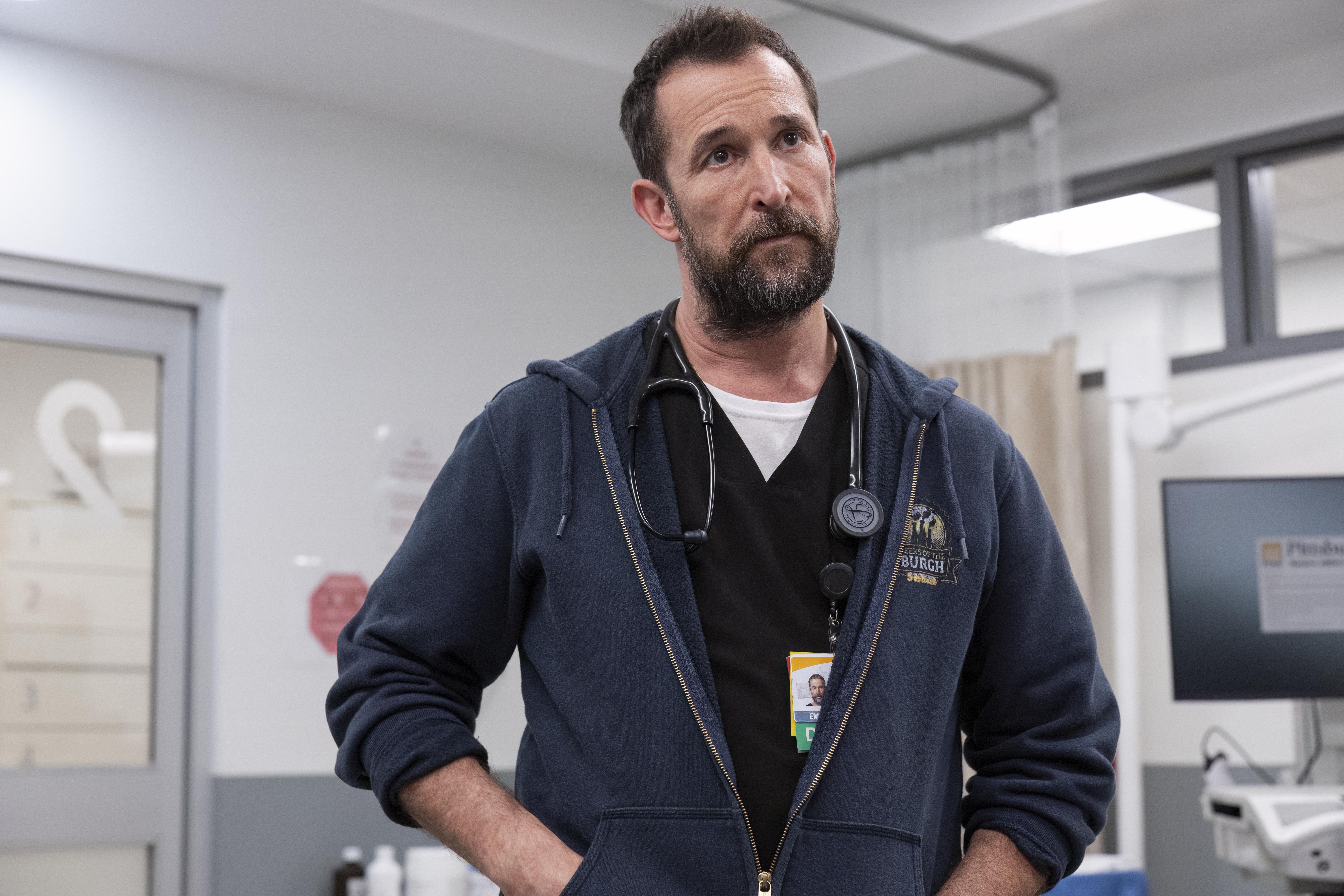
Noah Wyle stars in the ‘astonishing’ HBO series The Pitt
Even for those of us with a stomach for the genre, factual dramas – whether about Jimmy Savile or the former Prince Andrew – have a responsibility to move beyond scandalous headlines and justify their existence. Despite the royal overkill, there’s little sense here of a symbol of establishment power toppled. It makes an effort to be prestige, but the drama is ultimately brought down by its sensationalist instincts.
Newsletters
Choose the newsletters you want to receive
View more
For information about how The Observer protects your data, read our Privacy Policy
Finally, British viewers can watch The Pitt – the acclaimed medical drama that first aired in the US in January last year, drawing up to 21m viewers weekly – on the newly launched UK HBO Max.
Created by R Scott Gemmill, who wrote and produced on the 1990s medical drama ER, and executive produced by ER showrunner John Wells, it stars Noah Wyle (John Carter in, you guessed it, ER). A lawsuit from the ER creator Michael Crichton’s widow alleging that The Pitt is a reboot of the old medical drama is yet to be resolved.
Based at the Pittsburgh Trauma Medical Center (the “Pitt”), the series spans a single 15-hour shift, with each episode taking place as if in real-time. Lead medic “Robby” Rabinovitch (Wyle), colleagues (played by Patrick Ball and Katherine LaNasa, among others) and earnest rookies (Taylor Dearden, Isa Briones, Gerran Howell) deal with everything from fentanyl overdoses, burns and spider bites to the more topical issues of anti-vaxxers, the right to die, workplace addiction, and the funding and administrative pressures of the US healthcare system. Be warned, The Pitt is highly graphic: when the team aren’t spitting out complicated medical jargon they’re engulfed in blood and vital organs (and that’s before a mass shooting at the local PittFest).
You’ll need to suspend disbelief: this all happens on one shift? Despite caustic humour (“You’re moping around here like somebody gunned down your favourite K-pop band”), there are some syrupy moments and overblown lines: “It’s in our DNA. It’s what we do. We can’t help it. We’re the bees that protect the hive.”
But this is quibbling. The Pitt is an astonishing achievement, full of granular detail and stellar performances (Emmy/Golden Globe-winning Wyle has never been better). Along with fast cameras, harsh lighting and controlled chaos, there’s the time-honoured medical drama arithmetic of jeopardy plus adrenaline equals emotional hit. As with The Bear, there’s the sense of a dysfunctional workplace family, but here scaled up to an army-size cast. The Pitt doesn’t operate as a regular medical drama; more like a war movie in scrubs. It’s well worth the wait.
Photographs by ©Wonderhood Studios/Photographer: Matt Towers/HBO Max