
Everyone is high on something, the Dublin-based Irish composer Gerald Barry has said of his 2011 “opera of delirium”, The Importance of Being Earnest. Were he not such a disciple of Oscar Wilde, you could accuse him of shredding his fellow countryman’s perfect comedy to a heap of jumbled words and syllables, discarding half and detonating the rest as if from a confetti bomb, complete with smashed plates, jackboots and a dose of nitrous oxide. The question is whether you can embrace Barry’s riotous mangling as homage, or whether you remain merely cross.
Laughter, mercifully, was loud and frequent on the steamy first night of Garsington Opera’s new production, directed by Jack Furness (sets Francis O’Connor, costumes Hannah Wolfe, lighting Paul Pyant), which turns absurdity into a high art and treats irrationality as the norm. Barry’s strain of genius – a mix of playfulness, exaggeration and singular musical ingenuity – is not easy fare. This was a brave choice on the part of artistic director and conductor Douglas Boyd, who was comically duffed over by the two “heroes”, Jack and Algernon, at the start of part two. He dusted himself down and made it back on to the podium to great cheers.
In Wilde’s 1895 play, surface is all. Every facet gleams like a hall of mirrors that also distorts. Jack, Algernon, Gwendolen and Cecily talk nonsense to each other in perfect sentences until their entanglements are miraculously resolved. Wilde’s anarchy is taut, controlled and balanced. Barry calls the play’s bones “unshatterable”; his version is an X-ray. The opera was premiered in Los Angeles in 2011, conducted by Thomas Adès, and given a full staging at the Barbican theatre in 2016, immediately acquiring cult status. There is also a recording (on NMC) by Birmingham Contemporary Music Group, conducted by Adès. Without all the zany stage action, hearing the music alone focuses attention on Barry’s layered score, which mutilates deliciously Beethoven’s Ode to Joy and dispenses with any conventional notion of setting English syntax. It’s not like anything else. James Joyce would surely have approved.
The more trivial the exchange, the more raucous the music. Cucumber sandwiches? A low brass reveille. A furious argument over tea-time muffins? A full blast of Stravinsky-like counterpoint
The more trivial the exchange, the more raucous the music. Cucumber sandwiches? A low brass reveille. A furious argument over tea-time muffins? A full blast of Stravinsky-like counterpoint
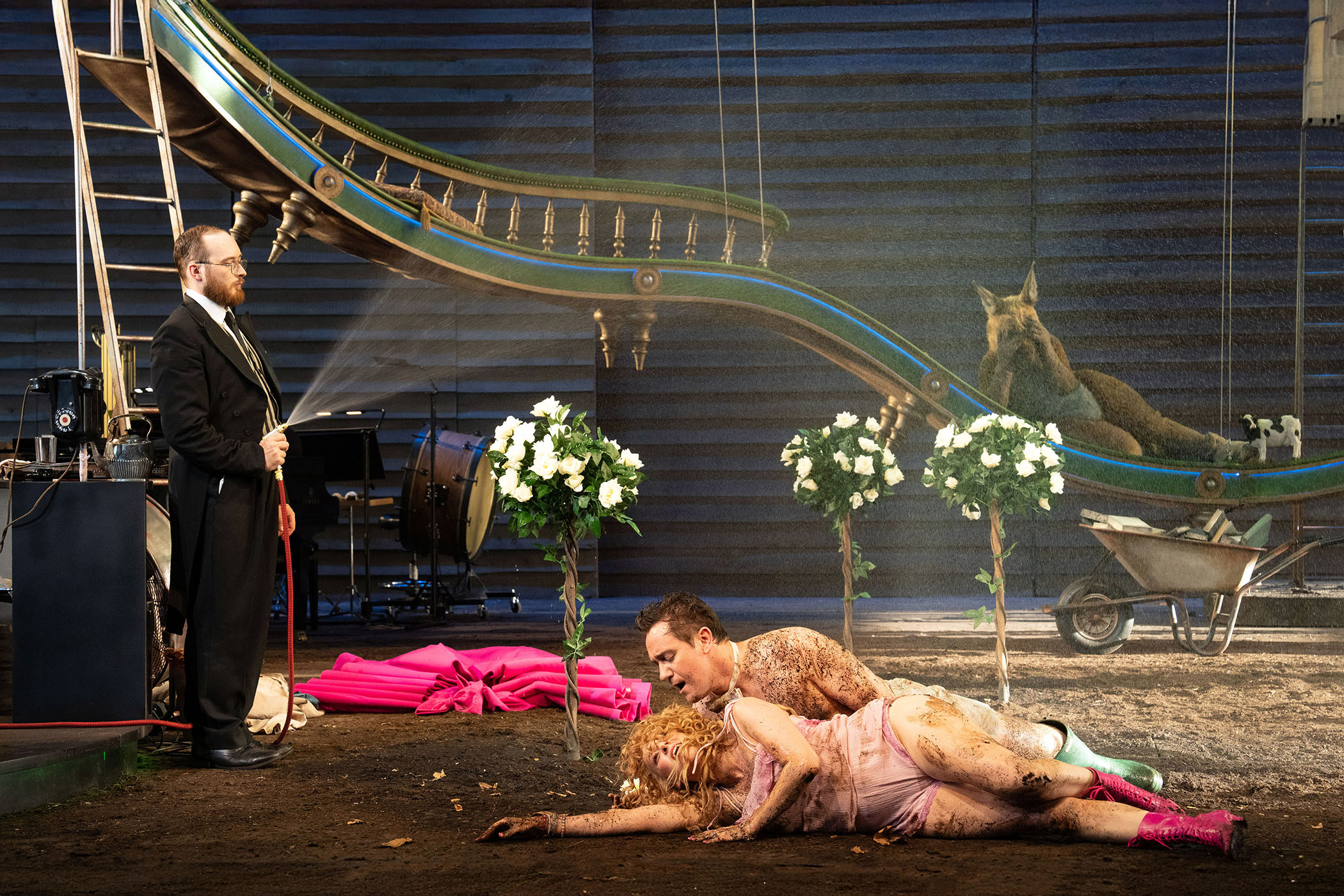
Furness’s staging revelled in the disturbing lunacy. I am no expert on funfair slides, but the structure that dominated the Garsington stage might be called a wavy chute. It snaked across the semi-open space from high to low, an apple-green neon strip light ensuring its contour was always eye-catching. The top was attached to a chaise longue, an indication that we were in polite society of a surreal kind. At times a trapdoor downstage swallowed or revealed characters. In her first appearance, Lady Bracknell rose up from below ground, robust and massive as a Wurlitzer (she is played, both fruitily and sternly, by the bass baritone Henry Waddington).
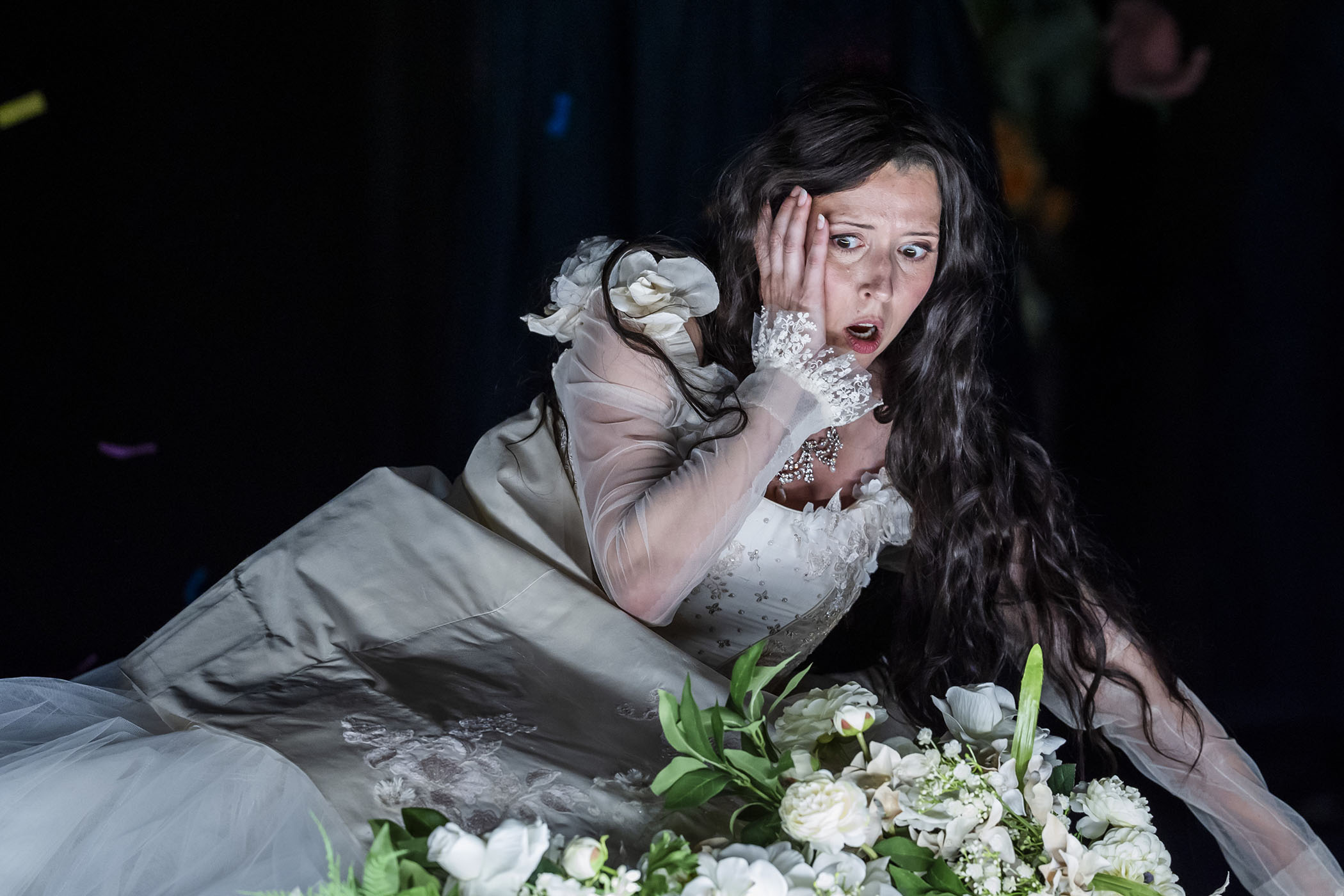
The work opens with a prerecorded piano mashup of Auld Lang Syne, a running musical gag throughout. To one side of the stage the orchestra – expert members of the Philharmonia – played, whistled, responded as required, an additional character in the drama. The more trivial the exchange, the more raucous the music. Cucumber sandwiches? A low brass reveille. A furious argument over tea-time muffins? A full blast of Stravinksy-like counterpoint. Cecily’s every utterance, winningly delivered by Jennifer France, is impossibly high, often underpinned by the lowest orchestral rumble: like filigree handwriting underscored with big smudges of charcoal. Together with France, Seán Boylan and Zahid Siddiqui, as Algernon and Jack, and Holly Brown as Gwendolen, were game as the quartet of lovers. Susan Bickley turned Miss Prism into a creature of unexpected appeal in this top ensemble cast. It they weren’t wrung out by the end, I was.
No antidote was needed but the Gesualdo Six, performing the last Wigmore Hall Monday lunchtime concert of the season, inadvertently provided one. This vocal group’s impeccable sound quality, unaccompanied, blended with precision, has no sharp angle, no explosions, no misrule. Their programme related to their latest album, The Wishing Tree, which takes its title from an energetic, multi-textured song by Joby Talbot.
In characteristic Gesualdo Six style, old and new met head on, with Byrd and Josquin des Prez alongside, among others, the traditional Irish ballad The Lark in the Clear Air (arranged by James Whitbourn). The Blue Bird, by Dubliner Charles Villiers Stanford, soared up in hushed close harmonies, as supremely heavenly as Barry’s fantasy is crazily earthbound and mortal.
The Importance of Being Earnest is at Garsington Opera, Stokenchurch, until 23 July
Gesualdo Six’s Wigmore Hall recital is available on BBC Sounds
Photograph by Richard Hubert Smith
Newsletters
Choose the newsletters you want to receive
View more
For information about how The Observer protects your data, read our Privacy Policy