
Paris, January 1835. Romanticism is in full flower. The craze for opera, specifically the Italian form known as bel canto, is at its lavish peak. Rossini, Donizetti and – the youngest of the three composers – Bellini unleash a thrilling vocal athleticism fit to challenge reason. This kind of opera, with its focus on beautiful singing, has lost some of its appeal today. Long, exquisite phrasing and virtuosic display takes priority over psychological depth. The Royal Opera House last presented Bellini’s I puritani in the early 1990s. Now the director Richard Jones (design, costume and lighting by Hyemi Shin, Nicky Gillibrand and Adam Silverman respectively) has staged a new production, honouring the work’s strong and direct emotions and avoiding reinterpretation.
Bel canto is full of tropes: a “mad scene”, a whiff of Walter Scott, a Scottish or English historical setting are desirable. I puritani scores on all. Action takes place in Plymouth, though not so as you’d know it, at the height of the English Civil War. That too is left vague, but there is enough of a warring mood in the air to warrant cries to battle and some dazzling, brassy military music, superbly played by the Royal Opera and Ballet (RBO) orchestra. They, and the chorus too, responded to this music’s immediacy and swift changes of mood, under the baton of the bel canto specialist Riccardo Frizza in his house debut.
The real issue with bel canto is the skill – remarkably rare – needed for the main roles. Great names of the past – Maria Callas, Joan Sutherland – made it their own. The Callas legend is built on recordings of arias we might not otherwise know. (Casta Diva, from Bellini’s Norma, was her signature, a version of which featured with Angelina Jolie’s hybridised voice in the movie Maria). In I puritani, the heroine is the puritan Elvira, who loses her mind when her royalist lover appears to have gone off with another woman. In fact, he is protecting Charles I’s widow, Queen Henrietta. Somehow, all ends happily. The Cuban-American soprano Lisette Oropesa is the Elvira of the moment. She recently triumphed in the role at the New York’s Metropolitan Opera.
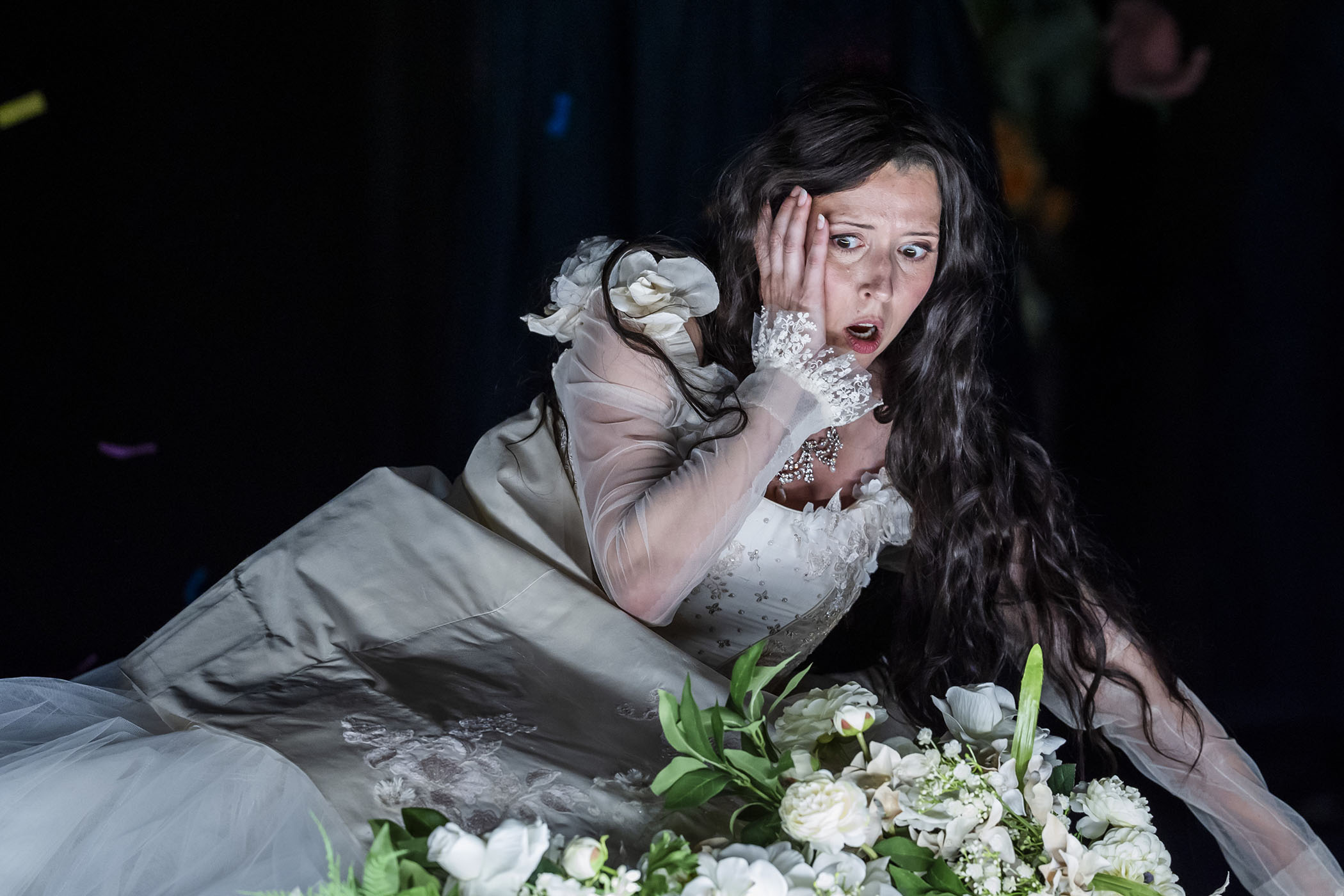
Oropesa has rock-like security of intonation. More robustness, as well as more fragility, would have given even greater variety to her gleaming, often magical tone. In Elvira’s mad scene, veering from high mood to low and looking alternately like Miss Havisham and a flower-adorned Ophelia in white rags, she variously perched on a window ledge like a cat or flopped back and forth rag-doll style. A marathon runner, Oropesa is well able to cope with exertion – this staging has much coming and going – but even she seemed momentarily breathless at the start of Qui la voce, the big hit number of the piece.
The Italian Francesco Demuro, singing Arturo, was nervous at the start, understandably, but showed his mettle once he relaxed. The role is not huge but much rides on it. If there are other operas requiring a tenor to sing a high F, I don’t know them. These vocal fireworks are what made women at the Paris premiere wave their handkerchiefs, men lift their hats. (They turn into doglike yelps if missed.) The Polish baritone Andrzej Filończyk was exemplary and golden-toned as Elvira’s jealous admirer Riccardo, with good support from the rest of the cast.
The look, embracing various time periods, is puritan sober, with some dandyish stripes and lace for the royalists. Pops of colour give definition to the brickwork and grey stone arches of the set. There are no big tricks, though flashes of Jones-style wit abound. The chorus, richly blended in their hymn singing, snake and reshape themselves elegantly (movement director Sarah Fahie), For someone who is not wholly attuned to this early 19th-century repertoire – a big influence on Wagner – I puritani has rewards as a collector’s item. If I didn’t faint, weep or wave a handkerchief, the failure was mine.
Low notes, sung or played, louring and dark, hold sway in Billy Budd (1951), Benjamin Britten’s opera based on Herman Melville’s novella. The setting is the HMS Indomitable during the French Revolutionary Wars of 1797. Michael Grandage’s staging for Glyndebourne, new in 2010, has returned in all its epic and harrowing glory, conducted by Nicholas Carter and revived by Ian Rutherford. The London Philharmonic Orchestra excelled, as did the chorus, singing their hearts and souls out in the big, surging ensembles. The all-male cast, which boasts eight baritones, a bass baritone and three basses, has no weak link.
An outstanding lineup, led with bright charm and assurance by 23-year-old Thomas Mole as Billy, included Clive Bayley, William Thomas, Dingle Yandell, Laurence Kilsby and more. Weeks after flooring us as Peter Grimes, the tenor Allan Clayton sang his first Captain Vere, tormented by his conscience into old age. Clayton has Britten in his veins. He distills a lifetime’s humility and shame into Vere’s lines.
As the depraved Claggart, master-at-arms, Sam Carl snarled with menace, the catalyst of the drama. The fact that the revered bass John Tomlinson, one of the definitive Claggarts of our time, who first sang the role in 1987, was in the first-night audience added a touch of operatic history and benign glamour.
I puritani is at the Royal Opera House, London, until 19 July. Billy Budd is at Glyndebourne, East Sussex, until 30 July
Newsletters
Choose the newsletters you want to receive
View more
For information about how The Observer protects your data, read our Privacy Policy
Photograph by Tristram Kenton