
You can make music “out of almost nothing”, György Kurtág once said. Not “anything”. Nothing. Almost. The great Hungarian composer, who recently celebrated his 100th birthday, does just that. Imagine a handful of seeds placed, with exactitude, on white marble. Some are solitary, others grouped, a wisp, a flurry. His ability to express a universe from a tiny scattering of notes grows more revered with every passing year. That was demonstrated in his home city, Budapest, last month with a fortnight of “Kurtág 100” events: concerts given by international musicians, conferences and seminars, birthday greetings on trains and trams. The thought.
Among the participants was the Icelandic pianist Víkingur Ólafsson, Kurtág advocate and friend. He saw the centenarian on the big day (19 February), frail but busy and mentally keen as ever, and made music with him, as the pair have done so often. Last Sunday, Ólafsson brought the celebrations to the UK, joining forces with members of the Philharmonia for a sold-out concert at London’s Queen Elizabeth Hall. (Ólafsson has around 2.4 million listeners on Spotify monthly, which may have helped get the word out to an audience of all ages. Kurtág is featured on his 2022 album From Afar).
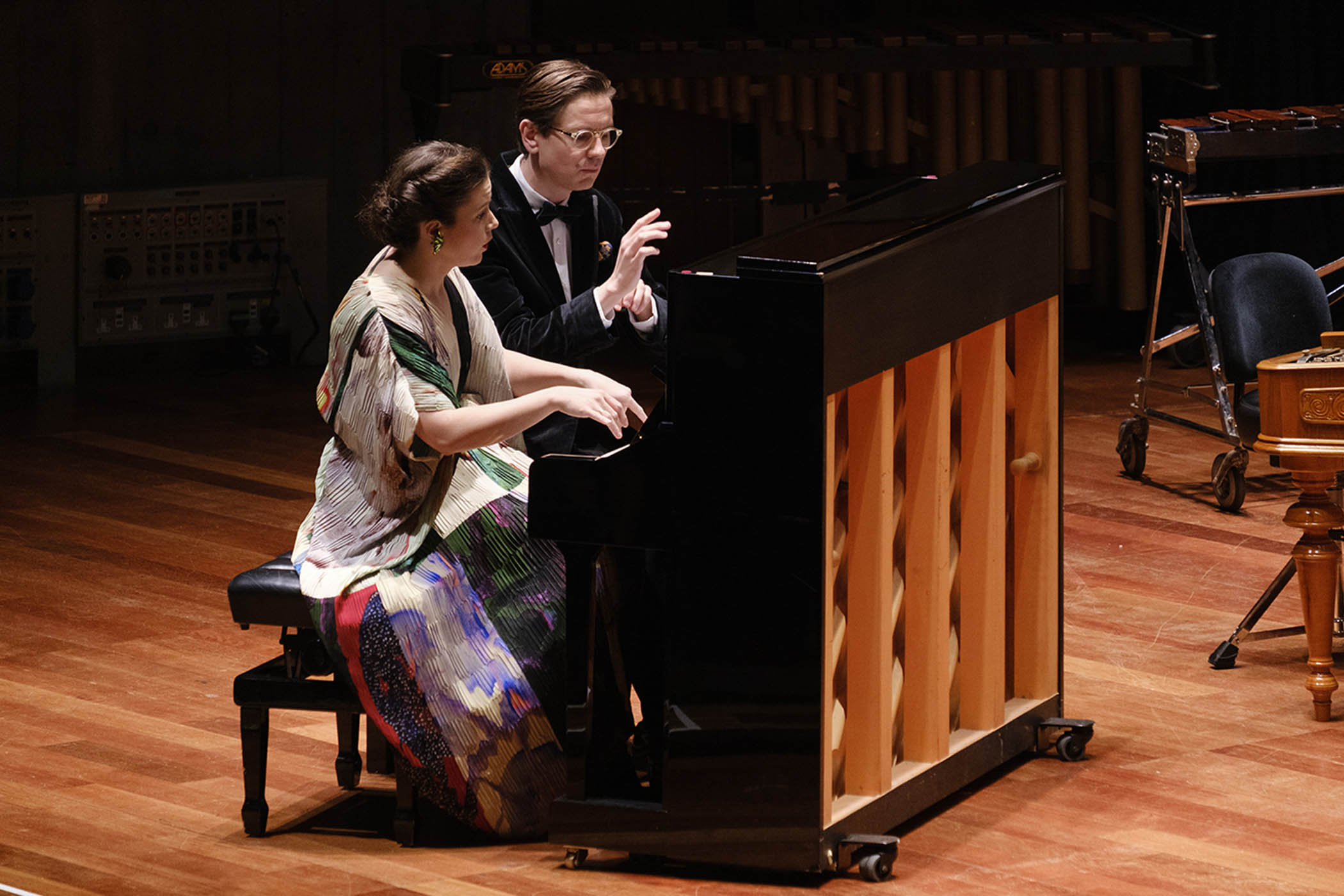
The programme, with some pieces conducted by Elena Schwarz, was typical Ólafsson: Kurtág alongside the Hungarian’s homages to other composers. In …quasi una fantasia…, Beethoven becomes fragmented and spatial, with musicians situated around the hall. Bach is pared back in the arrangement of Gottes Zeit ist die allerbeste Zeit. Kurtág wrote it to perform with his late wife Márta, sitting together at an upright piano. Ólafsson and his wife Halla Oddný Magnúsdóttir played it in that same, intimate way. Alongside these was Hommage à Kurtag (2016) by the British composer Mark Simpson (b.1988) for clarinet, viola and piano. It has all the gossamer, aerial quality of its dedicatee, yet remains distinctively Simpson’s.
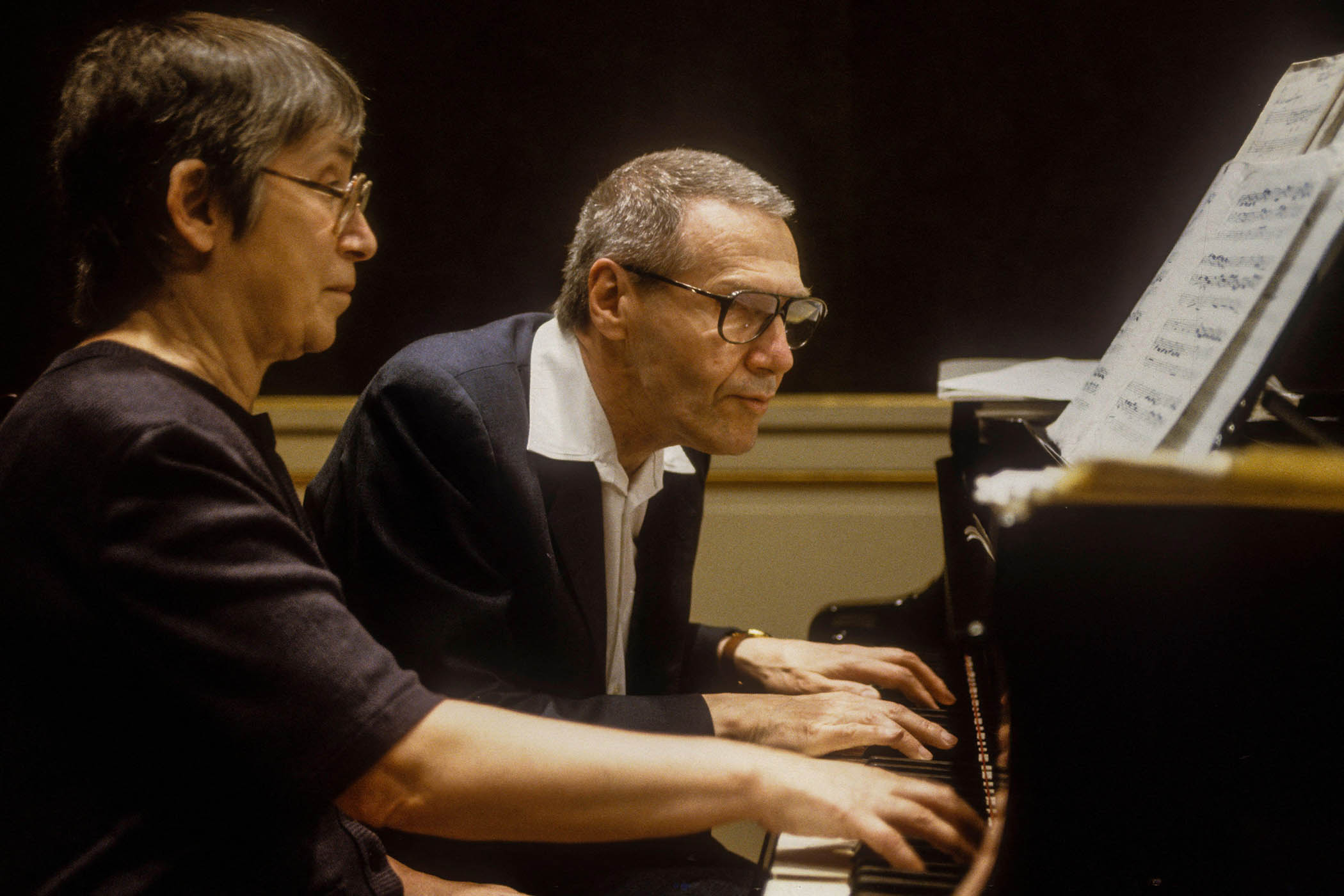
‘Played in that same, intimate way’: Kurtág and his wife Márta play at an upright piano in 1991. Main image: Víkingur Ólafsson and his wife Halla Oddný Magnúsdóttir perform Gottes Zeit ist die allerbeste Zeit in homage
Silence is key to any music. It might provide a dramatic pause between fortissimos as famously at the end of Sibelius’s Symphony No 5: massive chords; massive interruptions, like ravines. For Kurtág, silence is the vessel into which sounds are dropped, so quietly you almost struggle to hear them. You can see, as well as hear, this in the mesmerising physicality of Ólafsson’s playing. His delicacy is a hallmark. He bends his tall frame right down to the keyboard until his nose and glasses almost touch it, down, down, pearl fishing, or less fancifully, precious note-seeking. Kurtág is about discovery and listening hard. This concert, given by a changing ensemble of fine players, was a fitting tribute.
Kurtág studied and later taught at Budapest’s Franz Liszt Academy of Music, named after another Hungarian pianist-composer. Liszt was equally capable of spinning ethereal filaments of sound, but was in other respects an opposite: the greater density of notes the better. His fiendish Dante Sonata (1858) has to encompass heaven, purgatory and hell. That’s quite an ask. The Uzbek-born Behzod Abduraimov, a pianist new to me, negotiated the zigzagging leaps, mood swings from demonic to seraphic, crashing chords and angelic lyricism with fingers made of lightweight steel.
It takes stamina to play with this precision, no blurs or tricks, and to make sense of the work’s loopy narrative. Abduraimov’s manner is self-contained, flamboyant only in his prodigious virtuosity. His London recital included Debussy and Brahms and ended with Stravinksy’s orchestral ballet Petrushka. There’s a two-piano version, with four hands able to share the load. The one-person marathon chosen by Abduraimov is a study in dazzling pianism, highly effective when delivered with such brio. Abduraimov’s album Inferno, with the same music, is out in May.
In a week of maximal and minimal pianism, the circle was completed by a programme of music for two pianos in Sheffield’s Music in the Round series at the Crucible. The duo Tim Horton and Ivana Gavrić played works indirectly relating to war: Debussy’s late En blanc et noir, Ravel’s La valse and, the main work, Rachmaninov’s Symphonic Dances (1940). In a richly enjoyable performance of this work, these players showed their ability to conjure orchestral sound, from saxophone melody or variously pealing bells. Just as interesting was the way the piece, written in the US and full of glamour, changes mood entirely. For pianos alone it has a melancholy kinship to the composer’s Russian homeland, not to his country of exile.
Rachmaninov, himself a star pianist, performed in Sheffield in February 1939, months before the outbreak of the second world war and long before the Crucible was built in 1971. As a billiards player, he might have enjoyed the venue’s snooker connections. Pre-Gorton and Denton by-election, pre-US-Iran war, Keir Starmer was at the Crucible the same afternoon as Horton and Gavrić. Later he issued a statement in support of the venue’s right to retain the World Snooker Championship, following interest from the Middle East. That seems another era.
Photographs by © Philharmonia Orchestra/Alejandro S.Garrido/Alamy
Newsletters
Choose the newsletters you want to receive
View more
For information about how The Observer protects your data, read our Privacy Policy