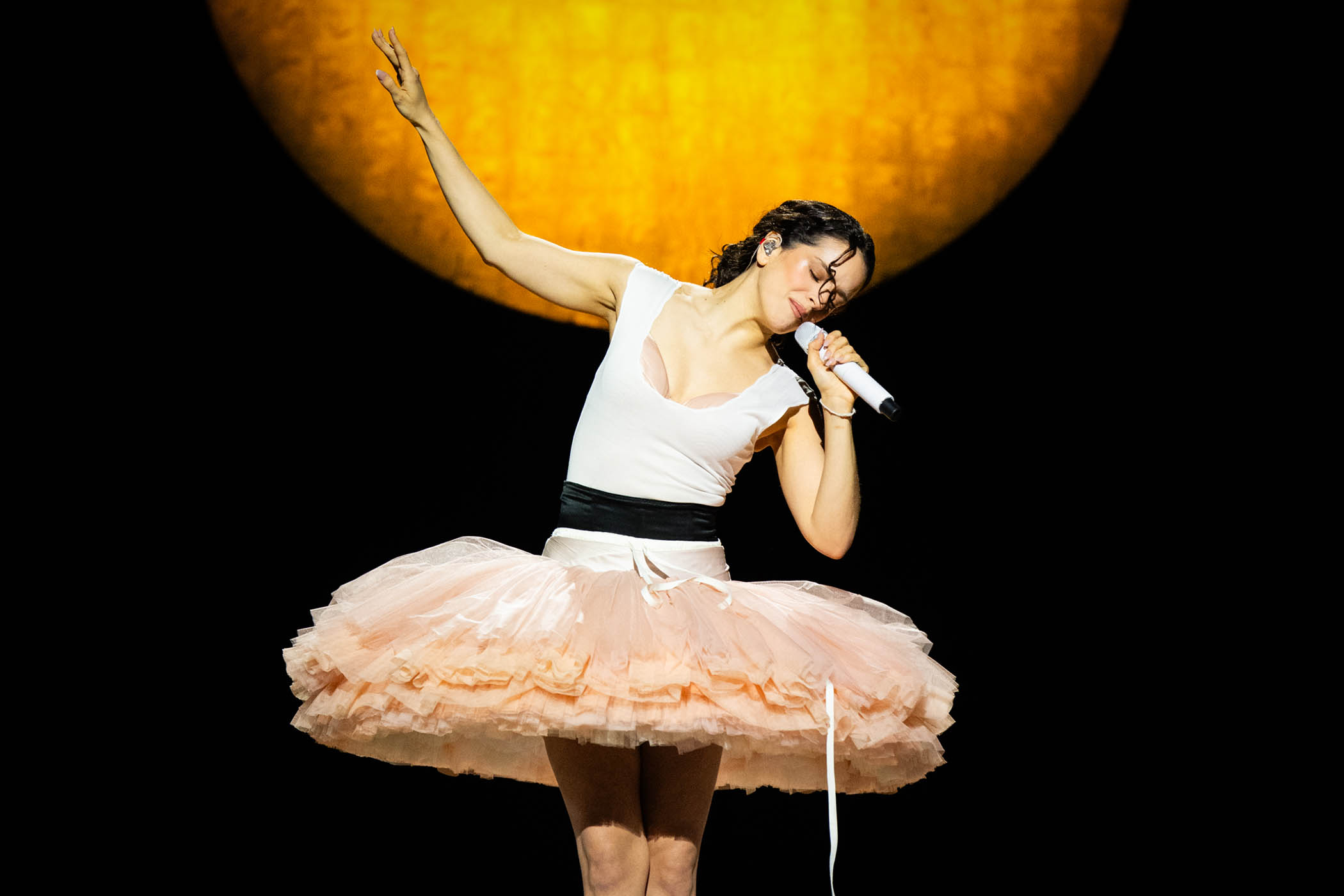

In terms of musical assurance and cathartic heft, Rosalía’s opening salvo in London outclasses most other artists’ encores. Dressed as a ballerina, accompanied by piano and live strings, the one-time flamenco artist sings in Spanish of being torn between heaven and Earth, between love of the divine and the everyday.
On the one hand, there’s “sex, violence and tyres”; on the other, “doves and saints” and the “weight of the scales”. Her aerated syllables swell and recede exquisitely with the enormity of the spiritual choice she faces. It’s operatic, but personal. There are English subtitles, so everyone knows what’s going on.
Lux, the album from which Sexo, Violencia y Llantas is drawn, was one of the standout achievements in pop last year – a record spanning neo-classical and rave culture, interweaving Rosalía’s own history with the fraught “herstories” of female saints and mystics. It might have single-handedly reset many listeners’ compromised attention spans.
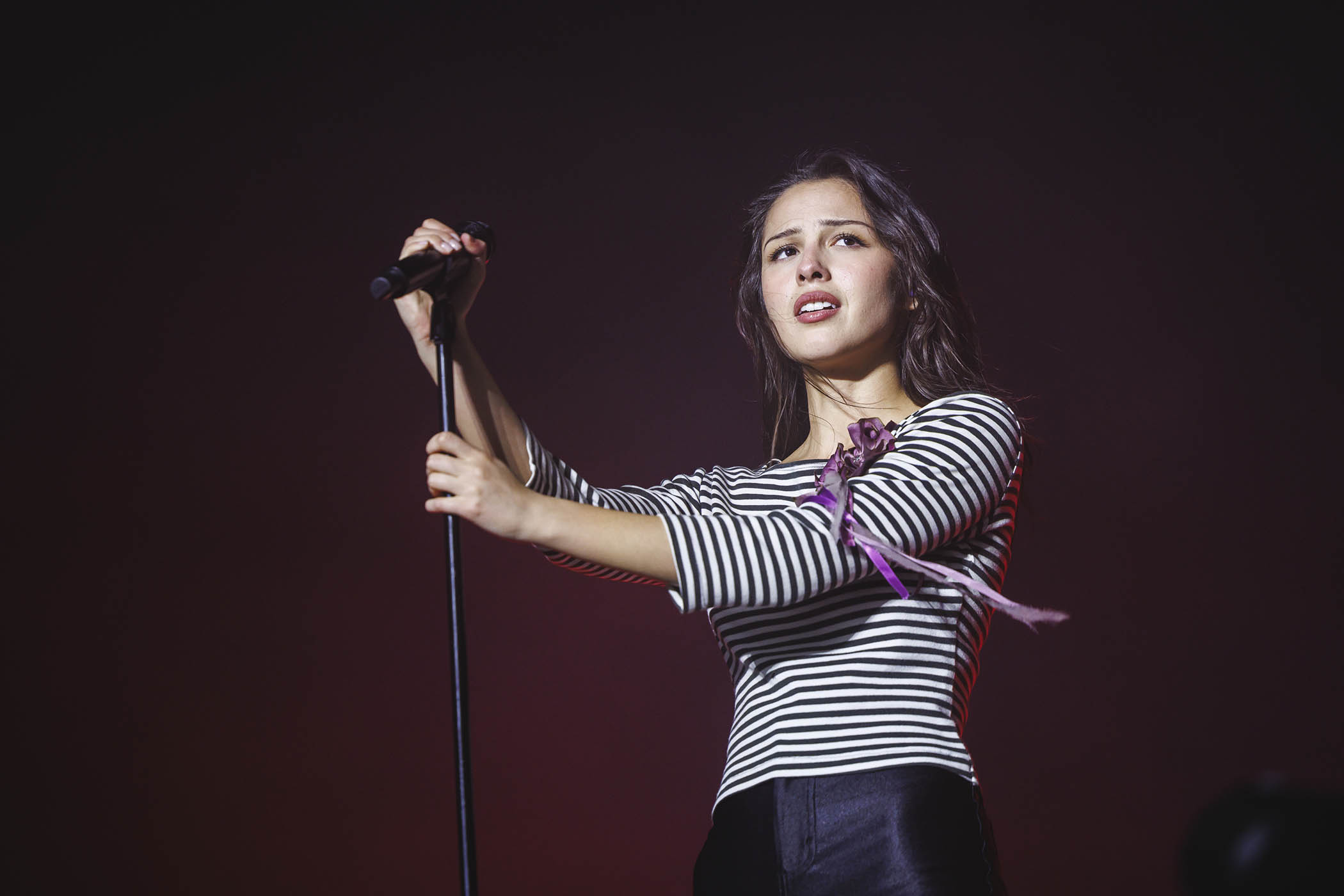
The celestial and the mundane are very much in dialogue throughout this bravura performance. Art, ballet, metaphysics, a giant swinging censer that doubles as a camera and strobe lights: nothing is off limits in Rosalía’s mashup of faith and passion. It all gets loud – wonderfully so – particularly the potent sub-bass. Throughout, Rosalía is chatty and personable, winking as she and everything around her shifts the Overton window of art pop a little further towards the sublime.
Rosalía’s interest in religious themes was present way back in her little-known first album, Los Ángeles, in 2017: witness tonight’s hard-hitting throwback El Redentor (“The Redeemer”) which depicts the humiliation and death of Christ. A few selections from her earthly 2022 album, Motomami, are also dispersed between the dominant Lux tracks, full of reggaeton beats, partying and name-dropping.
Rosalía wrote Lux in the wake of a called-off engagement and under a cloud of criticism about how this Spanish conservatoire-trained artist’s use of gritty Latin American street music might be construed as a colonialist’s cultural appropriation. Correlation or causality notwithstanding, on Lux Rosalía decided to delve deep into European traditions, determined to write arias, arrange orchestras, and pair them with digital music fanfares. She explored her interest in renouncing the worldly altogether; of being a bride of Christ, rather than of a mortal man. For another of tonight’s astonishing vocal performances, Mio Cristo Piange Diamanti (“My Christ Cries Diamonds”), sung in operatic Italian, she wears a simple wedding veil. On Yugular she sings partly in Arabic, inspired by the eighth-century Sufi mystic Rabia al-Adawiyya (AKA Rabia of Basra).
Art, ballet, metaphysics, a giant swinging censer that doubles as a camera: nothing is off limits in Rosalía’s mashup of faith and passion
Art, ballet, metaphysics, a giant swinging censer that doubles as a camera: nothing is off limits in Rosalía’s mashup of faith and passion
The album’s highlights are all here, as bombastic as you would hope. Berghain, Rosalía’s Wagnerian techno banger performed at the Brits in February, is a marvel: the Heritage Orchestra, who play in the middle of the crowd, pump their bows in the air while the conductor Yudania Gómez Heredia head-bangs. All the while, Rosalía’s voice reaches for the skies and her dancers replicate the vibes of Berlin’s most notorious techno dungeon.
In the preamble to the no-holds-barred La Perla, Rosalía guides the night’s non-singing special guest – British gen Z artist Lola Young – to a confessional booth. Young tells of a four-month hookup with a man that ended when she overheard him talking to his partner through a Bluetooth speaker; his unknowing wife was asking him to pick up nappies on the way home. It’s a terrific way to segue into Rosalía’s piquant waltz, a take-down of a cad who was “a walking red flag”, or in stronger terms, “an emotional terrorist, the greatest disaster in the world”. The internet is pretty sure that one is about her ex-fiancé, the Puerto Rican singer Rauw Alejandro.
There are a few missteps. A cover of Frankie Valli’s Can’t Take My Eyes Off You feels like a random cube of mild cheese mixed in with the sacrament wafers. Towards the end of Divinize, Rosalía quotes Dido’s 1998 song Thank You; a seemingly banal reference, given Rosalía’s wide and deep musical tastes.
But the wafers win the day. The 12th-century Sicilian Santa Rosalía escaped an arranged marriage to become a hermit, eschewing her family wealth. She is the inspiration for Focu ’Ranni, a powerful digital-analogue fusion that tells of a marriage that never went ahead. The “big fire” of the title means both a grand passion and, in the vernacular, lots of problems. “No one will throw rice to the sky” as confetti, Rosalía laments. But both she and her namesake have dodged a bullet: “I will be mine / With my own freedom.”
Newsletters
Choose the newsletters you want to receive
View more
For information about how The Observer protects your data, read our Privacy Policy
Wearing battered wings, Rosalía falls backwards offstage, returning for a single song encore – Magnolias – in which she imagines her own funeral and ascent to heaven. Never less than dramatic, she makes a big, dazzling night out of cerebral themes, feminist faith scholarship and heartbreak. In her, the earthly and the sublime happily coexist.
Photograph by Samir Hussein