

Last Sunday, for the first time, the US Super Bowl half-time show was sung entirely in Spanish. Bad Bunny’s set didn’t just provide a rousing party atmosphere: it was a politically charged display of Latino pride in the face of ICE raids on immigrant communities in the US, and uncompromising in its refusal to pander to anglophone needs. A week earlier, he won a trio of Grammy awards, including album of the year, making him the first solo Latino artist to do so.
Bad Bunny’s achievements are historic – but it’s worth noting that, just over 60 years ago, the 1965 Grammy album of the year was won by a bossa nova LP sung mostly in Portuguese. (Its best-known song, The Girl from Ipanema, won another Grammy for best record.) Getz/Gilberto – a collaboration between the American saxophonist Stan Getz, Brazilian singer-songwriter João Gilberto, the latter’s then wife, Astrud, and Antônio Carlos Jobim – marked the peak of the US enthusiasm for bossa nova (“new wave”), a Brazilian form of jazz informed by samba and other Afro-Brazilian polyrhythms. American jazz musicians, and then the wider English-speaking public, quickly fell for the sultry, classy new sound of sun-kissed Rio de Janeiro.
Bossa nova has since sometimes suffered an unkind fate, becoming a byword for breezily exotic easy listening. But its foundational tenets – a calm, unruffled manner underpinned by rhythmic complexity, a plurality of influences and vibrant cultural confidence – remain alive in the work of many musicians; not least Sessa (Sergio Sayeg), a terrific singer-songwriter from São Paulo who spent his formative years in New York.
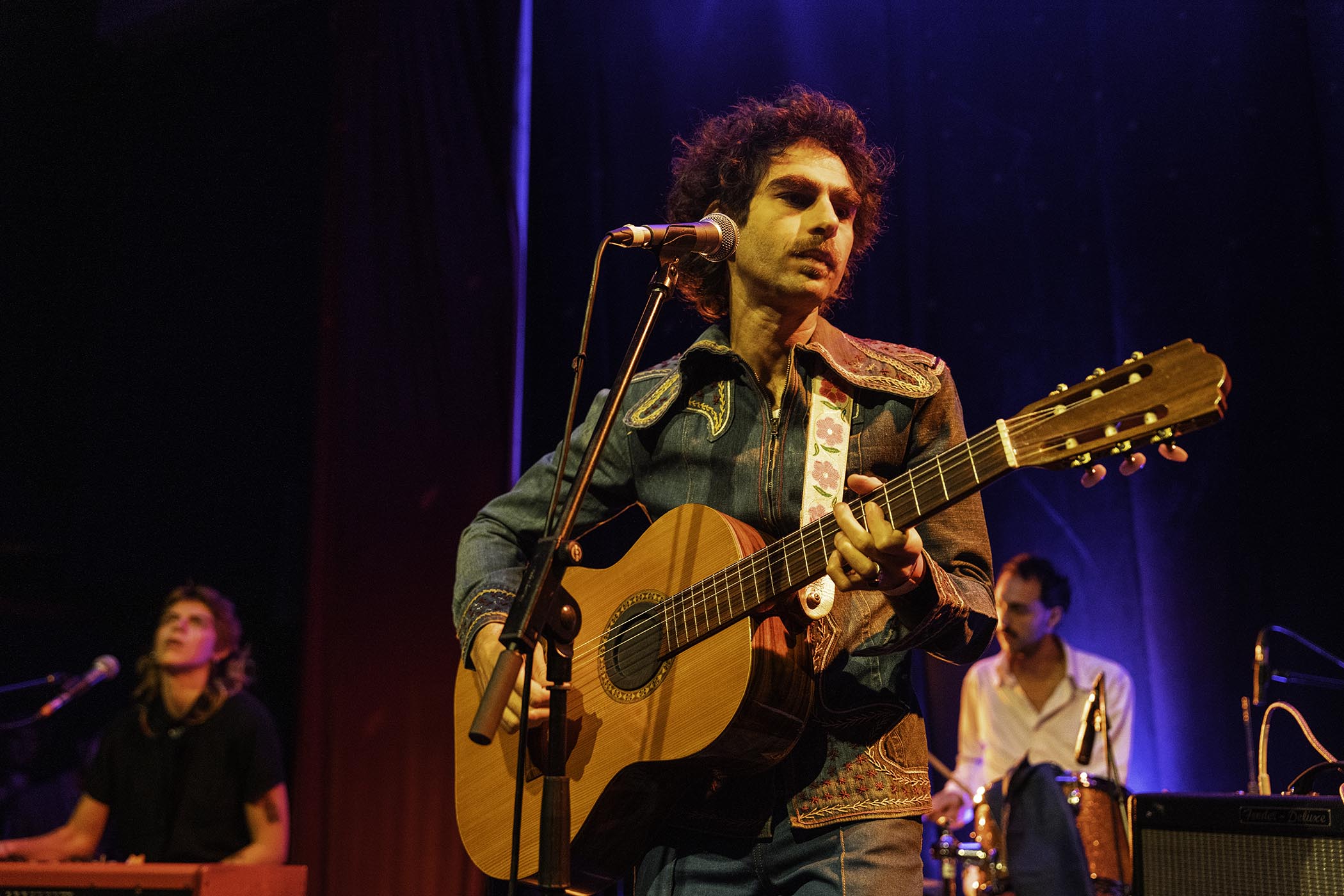
Dressed tonight in colourfully embroidered double denim, his flared trousers skimming white leather lace-ups, Sessa visually channels the bohemian late 1960s and early 70s as much as his music harks back to the era of electric pianos and internationalist outlooks. It is, of course, quite some distance from the Super Bowl to east London’s rainy Bethnal Green Road, where the 36-year-old musician and his tight band unfurl their bossa-adjacent songs to a partisan audience that spans crate-diggers, jazz aficionados and people keen to dance.
But Sessa’s music is also the kind that transcends linguistic barriers seemingly without effort: bossa and other Brazilian musical styles have an appeal to the hips and shoulders that doesn’t require Google Translate.
Almost immediately, Sessa unleashes his busiest and most atmospheric track, Nome De Deus, a pacy canter full of pert piano stabs, modal bass and slinky percussion courtesy of longtime co-conspirator Biel Basile on kit and conga. Sessa’s own intensity on vocals is offset by the keys player and backing vocalist Lê Veras, whose fingers and effects-laden sighs land just right all night. Sessa sings in Portuguese of his “overflowing love for the world” – despite the fact that it is “a paradise lost”.
Bossa and other Brazilian musical styles have an appeal to the hips and shoulders that doesn’t require Google Translate
Bossa and other Brazilian musical styles have an appeal to the hips and shoulders that doesn’t require Google Translate
A lot rests, elsewhere, on Sessa’s pillow-talk delivery and nylon-string guitar-playing, whose obvious precedents include the Brazilian Tropicálistas of the late 60s. Tropicália is reasonably well known to music fans in the UK, not just from the hipster revival of that genre in the 1990s, but from London’s pivotal role in the stories of Caetano Veloso and Gilberto Gil (from 1969, they spent three years in exile in the UK; Gil’s farewell tour is due here in July).
Although Sessa’s three top-notch albums are not anywhere near as appreciated as they should be, his music is still culturally familiar: seductively syncopated, humid, intelligent and nuanced – retro, certainly, but evergreen.
In Brazil, Tropicália made much of “musical cannibalism”; the idea that Brazilian popular musical forms, then the fiercely guarded object of nationalist pride, should gobble up outside influences – even US rock and funk. Sessa, too, is inspired by the “crooked translations music gets when it travels”, as he told an interviewer in 2022.
His love of Brazilian music was, ironically, cemented in Manhattan: he was a teenage rock fan before getting a job at a record shop called Tropicália in Furs in the East Village. Sessa drinks deep from all sorts of sources, then shapes it by his own priorities: on his earliest album, the focus is sensuality; on 2022’s Estrela Acesa (“Burning Star”), nature and cosmic fever dreams.
Newsletters
Choose the newsletters you want to receive
View more
For information about how The Observer protects your data, read our Privacy Policy
Sessa’s most recent album, Pequena Vertigem de Amor (“Little Vertigo of Love”), recorded at the studio he shares with Biel and released last November, dials up the orchestral soul in his music. Fans of our own bard of vintage sounds, Michael Kiwanuka, would feel right at home tonight, in Sessa’s sepia-tinged arrangements and unshowy guitar, which channel low-key psychedelic soul men as well as his own countryfolk. The set opens with the title track, a languid recliner of a song that describes the destabilising swoon of new fatherhood. Stress, it seems, forms no part of Sessa’s parenting experience.
Even more consolatory is Vale a Pena (“It’s Worth It”), another laid-back, exquisitely turned track, where Veras’s limpid tones join Sessa’s to grapple with matters both practical and existential. Despite the stones on the path and the dark nights of the soul, “living is worth it”, they sing; for love, for family, friends and fellow travellers. And tonight, it feels as though we are all those travellers; spiritual polyglots who are deeply OK with this transatlantic cultural exchange.
Photograph by Antonio Olmos for The Observer