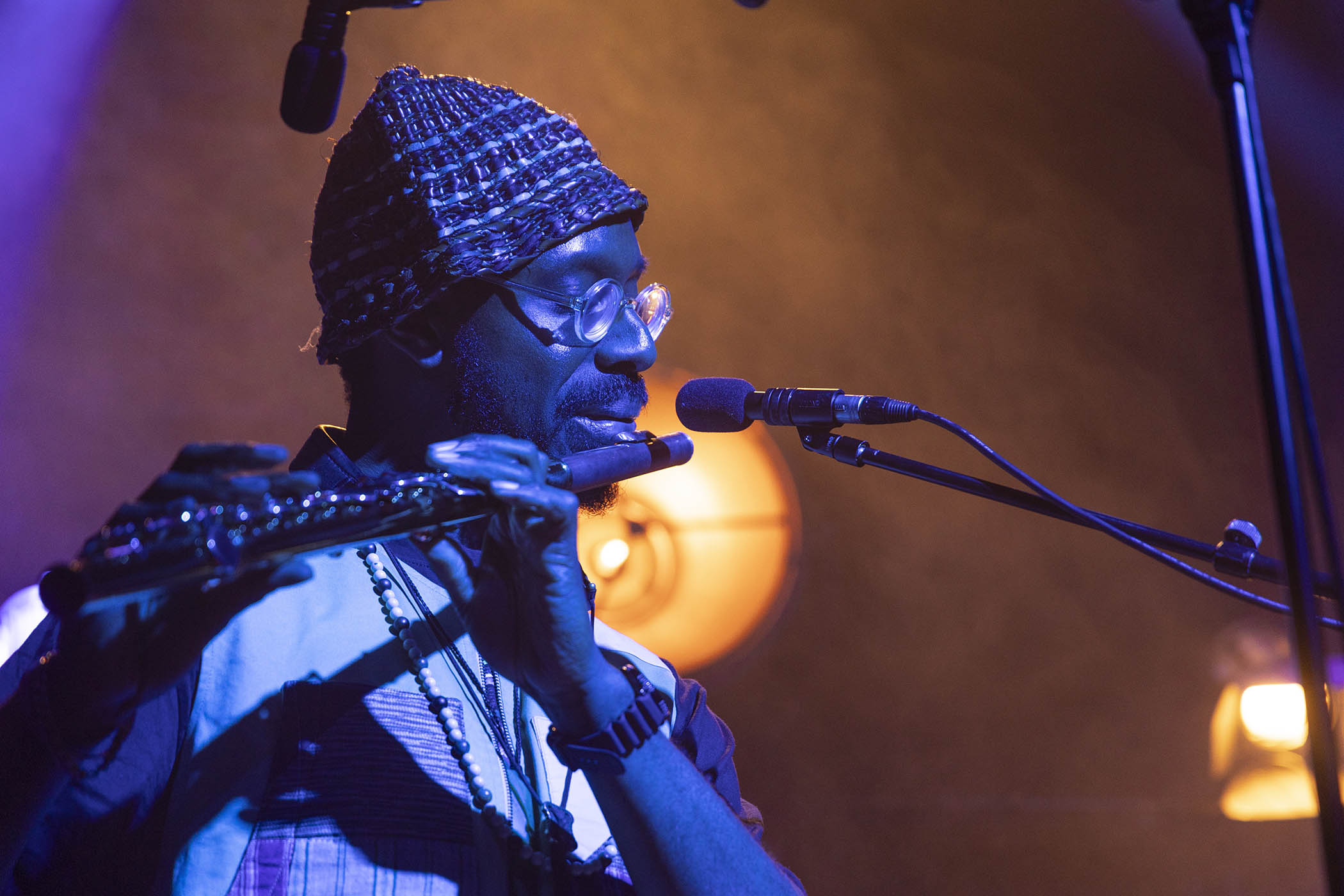
The latest evolutionary phase of the musician formerly known as Shabaka Hutchings begins simply tonight, as one long, sinuous, unaccompanied flute line. It’s faintly Arabic in lilt, zigzagging up a scale. We’re unanchored. No exact place, no exact time, liberated from genre but informed by many traditions; just how Shabaka – operating mononymously since 2022 – likes it.
Not long after, he brings out a saxophone, to whoops and cheers. It’s the instrument for which this foundational but restless UK musician is most famous; one that has sustained him as a linchpin of the London jazz scene for most of his career. Before Ezra Collective became the first British jazz band to win a Mercury (2023), sell out Wembley Arena (2024) and bag group of the year award at the Brits (2025), Shabaka and his cohort kicked the door down so that the African-Caribbean-influenced, conscious rave jazz of the past decade could romp free.
His versatile sax-playing stood in for that of the late, great Pharoah Sanders at a 2023 show in Los Angeles where Floating Points aired their 2021 collaborative album with the London Symphony Orchestra, Promises; Sanders died between recording it and the scheduled gig.
Shabaka also played tenor sax for what was then, apparently, the last time, in December 2023, covering John Coltrane’s A Love Supreme live before formally hanging the instrument up in favour of a new discipline – the flute – in all its forms. As a younger man, he came up through classical clarinet. His 2024 debut solo LP, Perceive Its Beauty, Acknowledge Its Grace, by contrast, heavily featured the Japanese bamboo shakuhachi, among an array of other woodwinds sourced from around the globe.
Tonight, Shabaka brings all of this inquiring mastery together in a new iteration. His first flurry of saxophone unfurls as a languid, exploratory melody, redolent of spiritual jazz. Later, as the evening hots up, he will reprise the boisterous party-sax tones of his best-known band, Sons of Kemet, an instantly recognisable blend of carnival jazz and get-up-off-your-feet exhortation. Towards the end of the first part of this extraordinary set, however, the musician plays cut-up tones on a clay triple Mayan flute, a ceremonial object whose original notes are lost to time, but whose staccato sounds this evening have an almost digital quality.
What plays out across this impossible-to-categorise gig is deeply impressive: analogue and electronic instruments, times and places, in dialogue. It’s all held together by the connective tissue of shimmering and clattering digital sound, with Shabaka triggering beats and accompaniments on drum pads and other bits of kit strung along the stage. The only other accompaniment is drummer Austin Williamson of New York’s Onyx Collective, fresh from partnering Shabaka on a handful of US dates.
Shabaka’s latest album, Of the Earth – his second full-length LP as a solo auteur – was released last month. It marked his return to the sax after years travelling and flute-making with artisan craftsmen. (As kismet would have it, rapper André 3000 also fell hard for the flute at the same time; the two have guested on each other’s records.)
The story, though, was more nuanced than that. Of the Earth saw Shabaka truly solo for the first time. Jazz is a naturally collaborative genre, and within it, he has been a particularly outward-facing artist. The new album found him playing all the instruments, recording everything and producing the record entirely on his own. As a consequence, it also saw him leaning heavily into electronics – mastering loop stations, samplers and various portable studio consoles – for the first time since his band the Comet Is Coming folded in 2023. The LP was released in partnership with Warp Records, the UK’s premier left-field electronic label.
Tonight’s show is less a set of tracks from it than an organic, remixed, partially improvised rendering, with familiar elements popping out from time to time as surges of sound ebb and flow. Shabaka revisits moments from Perceive Its Beauty, Acknowledge Its Grace but deconstructs them, or follows the spoken-word poetry of his father, Anum Iyapo, with his rap debut on Go Astray. (“If André 3000 can play the flute, then I can rap,” Shabaka has joked in interviews.)
To select specific highlights would be against the immersive, fluid nature of the evening. But when the busier passages arrive – where the exultant sax-on-flute-loop melodies of Marwa the Mountain evolve into the equally exhilarating, low-slung themes of Ol’ Time African Gods – it becomes clear why we are in a sweaty club, rather than a sit-down venue.
Newsletters
Choose the newsletters you want to receive
View more
For information about how The Observer protects your data, read our Privacy Policy
The next time Shabaka plays London, it may be stranger still: perhaps one of this pioneer’s most unexpected gigs to date will take place in June at London’s Southbank Centre, where he will join an array of artists under the umbrella of the annual Meltdown festival. This year, it is curated by one Harry Styles, whose latest album, Kiss All the Time. Disco, Occasionally, heavily features Tom Skinner, formerly of Sons of Kemet. Until then, Shabaka signs off with an unassuming, but resonant postscript: “All we can do is try new things.”
Photograph by Andy Hall for The Observer