

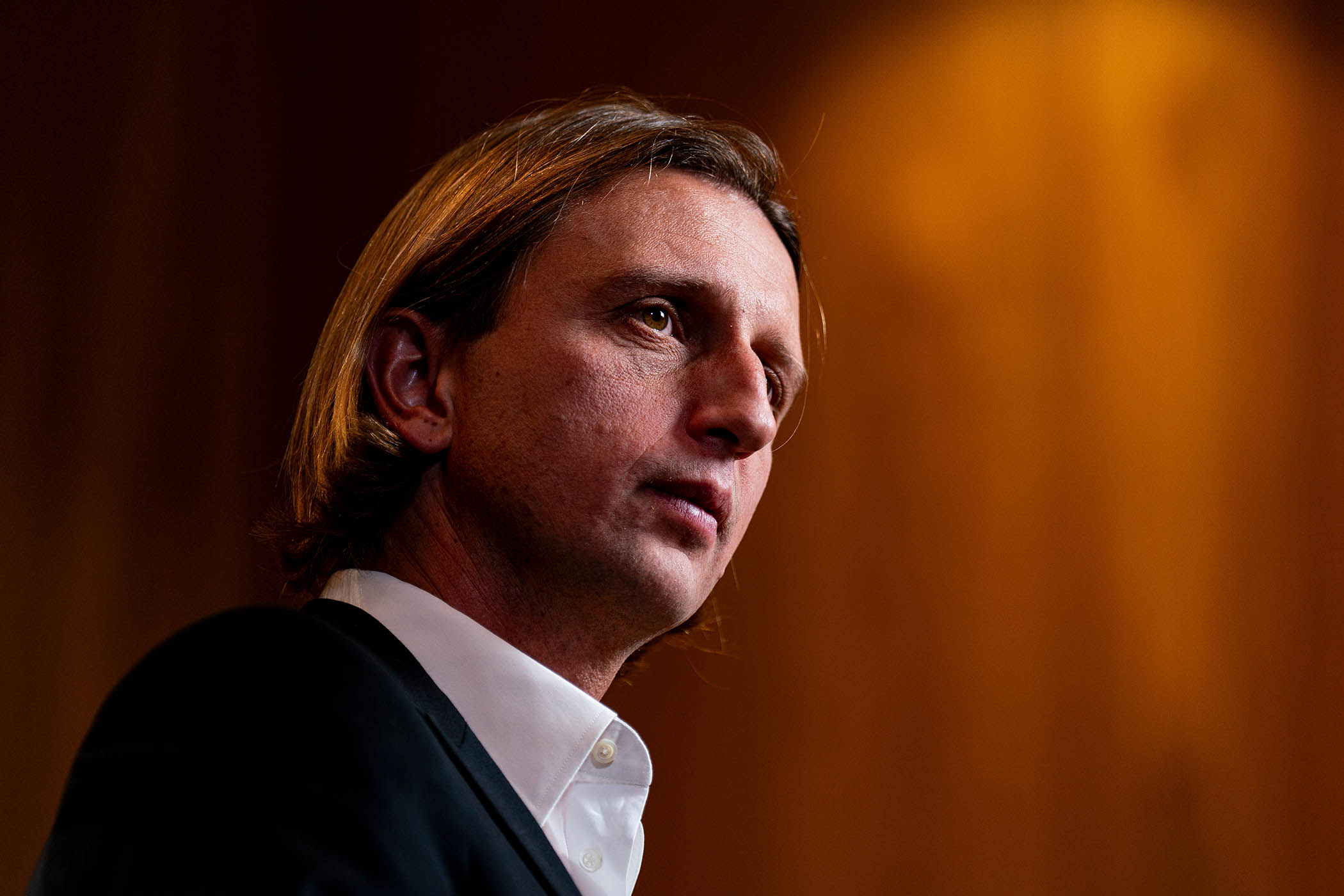
Rick Rieder, chief investment officer of global fixed income at BlackRock, has emerged as a leading contender to succeed Jerome Powell as Federal Reserve chair, with prediction markets showing his odds rising after his recent interview with President Donald Trump.
On Saturday afternoon, the prediction betting site Polymarket put Rieder’s odds to become Trump’s pick for the job at 53% , ahead of former Fed official Kevin Warsh, at 29%, and Christopher Waller, at 7%. Rieder is known for his market‑oriented views on interest rates, having publicly discussed the case for lowering rates under certain economic conditions.
Trump told reporters last year: “If I think somebody’s going to keep the rates where they are or whatever, I’m not going to put them in. I’m going to put somebody that wants to cut rates.”
Rieder is a Wall Street veteran. Having spent two decades at Lehman Brothers, he now oversees $2.4tn in bond strategies at BlackRock. Also in his favour: he has never worked at the Fed.
In recent months, Trump has launched a broadside against the independence of the central bank, attempting to fire governor Lisa Cook, and launching a lawsuit against Powell over cost overruns at the Fed’s historic buildings.
In 1978, as a protection from political meddling, the US Congress formally gave the Fed the dual mandate of maximising employment and maintaining price stability. It structured the institution to operate independently of day-to-day political control.
Rick Rieder is known for his market-oriented views on interest rates. Trump just wants someone willing to cut them
Rick Rieder is known for his market-oriented views on interest rates. Trump just wants someone willing to cut them
But Trump and his recent appointee to the Fed, Stephen Miran, believe that the bank is over-prioritising the second half of its mandate. There’s a willingness in the administration to tolerate higher inflation in exchange for near-term economic growth, stronger employment and lower borrowing costs. Cheaper credit supports asset prices, and reduces debt pressure for households and the US government.
But it could also exacerbate already widening wealth inequality in the US. Rate cuts are often followed by asset price booms that tend to disproportionately benefit older, wealthier consumers who own more stocks.
The Fed and Powell, by contrast, are wary of easing policy too quickly while inflation remains above target. Policymakers argue that premature or aggressive rate cuts could allow inflationary pressures to re-accelerate. There have been episodes, notably during the 1970s under President Richard Nixon, when political pressure on monetary policy contributed to sustained inflation and ultimately higher long-term borrowing costs.
The US Consumer Price Index rose at an annual rate of 2.7% in the final month of 2025, above the Fed’s target of 2%, underscoring the inflationary pressures.
Newsletters
Choose the newsletters you want to receive
View more
For information about how The Observer protects your data, read our Privacy Policy
The Fed’s next FOMC (Federal Open Market Committee) meeting and interest rate decision is due on Tuesday/Wednesday: market participants are expecting rates to be held steady, with an emphasis on a cautious, data-dependent approach to any future easing.
“[Cutting rates] could be a real boost to the stock market in the very near term,” said Mark Spindel, a senior adviser at Washington-based investment firm F/m Investments. “It’s a dangerous game – a sugar high – and it’s not without costs, real inflationary costs.”
The economy is a major focus for Trump before the midterm elections in November.
The stakes are heightened by timing. Powell’s term as Fed chair expires in May 2026. It is the sitting president’s job to nominate a successor. However, the nominee will still require confirmation by the US senate.
Thus far, Trump’s assaults have yet to tilt the playing field. The US supreme court gave hints last week that it was sceptical of Trump’s attempt to fire Cook, the first Black woman to serve as a Fed governor. Justices from the political left and right questioned why the process should be sped up, with Brett Kavanaugh asking: “What’s the fear of more process here?”
The supreme court held the hearing to decide whether Trump’s attempt to remove Cook from the Fed’s seven-member board of governors, citing alleged mortgage fraud, was legally sound. The Federal Reserve Act allows a president to remove a Fed governor only “for cause”, which is traditionally understood to mean serious misconduct or neglect of duty, rather than for policy disagreements or actions before appointment. The court’s ruling is expected in late spring or summer.
The administration’s push goes beyond Cook herself. Current Fed chair Jerome Powell has frequently found himself in Trump’s crosshairs. Earlier this month, Powell confirmed that the Department of Justice had served the Federal Reserve with grand jury subpoenas and threatened a criminal indictment tied to Powell’s congressional testimony regarding cost overruns in the remediation and renovation of the Fed’s headquarters. No formal charges have been filed, and the investigation is ongoing.
Powell called the threat of criminal charges by the White House “pretexts” aimed at pressuring the Fed to set interest rates according to presidential preferences, rather than its own assessment of what best serves the public interest. “The threat of criminal charges is a consequence of the Federal Reserve setting interest rates based on our best assessment of what will serve the public, rather than ... the preferences of the president.
Market leaders have corroborated those concerns. “Everyone we know believes in Fed independence,” said JPMorgan Chase CEO Jamie Dimon at the bank’s fourth-quarter earnings call, earlier this month. “Anything that chips away at that is probably not a good idea. In my view, it will have the reverse consequences. It will probably raise inflation expectations.”
International central bankers have also weighed in. Leaders including European Central Bank president Christine Lagarde and Bank of England governor Andrew Bailey co-signed a letter expressing “full solidarity” with Powell, underscoring the global stakes of the health of the US economy. Where Rieder stands on the issue is not known.
Photograph by Al Drago/Bloomberg via Getty Images