
It was a hot, boring Washington afternoon in mid-July 1973 – Friday the 13th for the superstitious – when the right question was suddenly asked of the right person and an honest answer brought down a dishonest president.
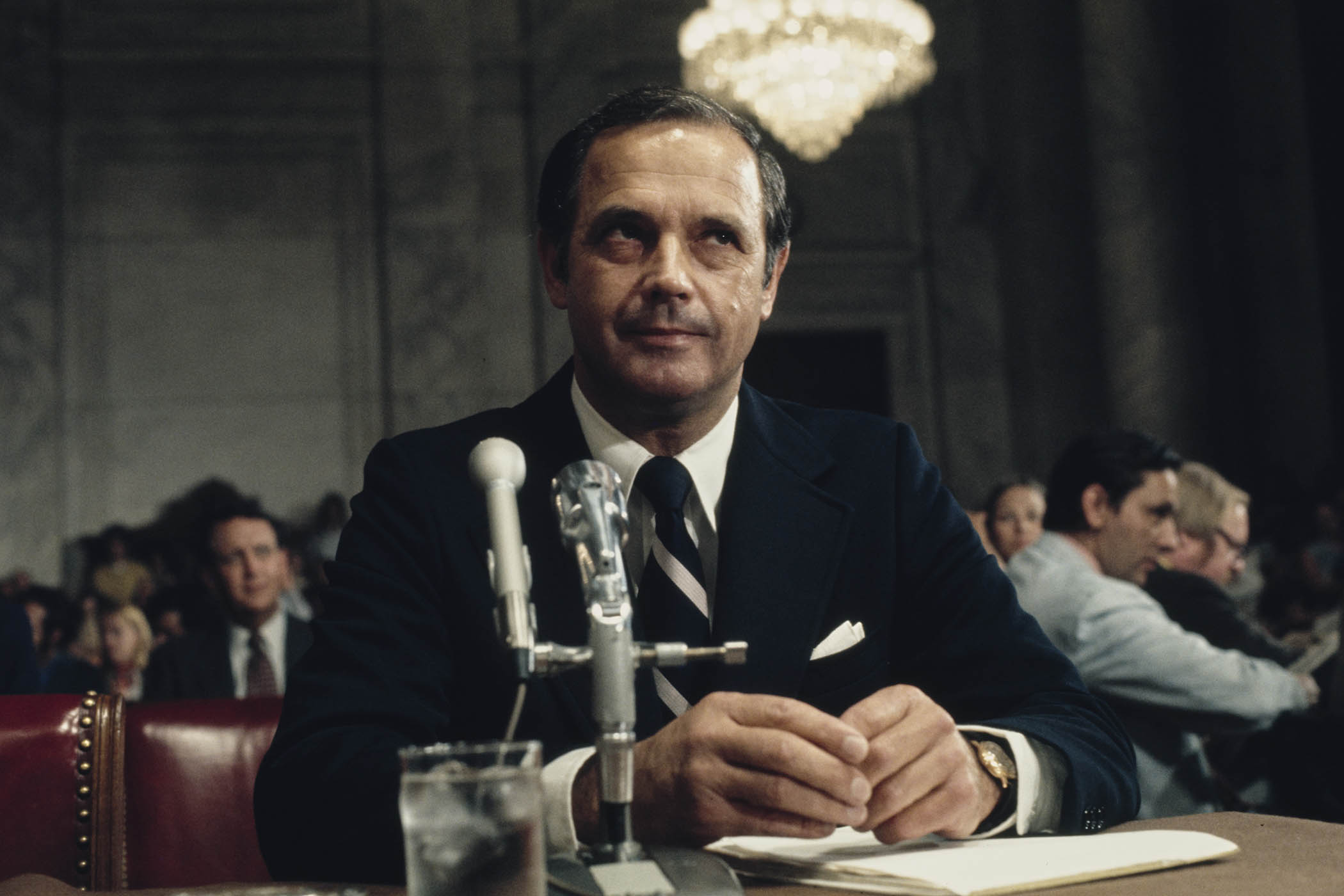
Alexander Butterfield, a former aide in Richard Nixon’s White House, had spent three hours being questioned by four members of the Senate Watergate Committee in private when one had a hunch.
He asked Butterfield about the surprising amount of detail in the memo of a meeting between Nixon and his White House counsel to discuss a break-in at the Democrat headquarters in the Watergate complex. The aide said there had been no stenographers and the president’s memory was good but not that good. Asked where the information had come from, Butterfield said: “Let me think about that awhile.”
The interview continued until Don Sanders, a former FBI man turned lawyer, found the words to express a question that had been, to use an apposite word, bugging him. Was it possible, he suggested, that the president’s conversations had been taped?
Reports differ on what Butterfield replied. It was either “I was hoping you fellows wouldn’t ask that”, or “I was wondering if someone would ask that”, but he did confirm what only a few knew: that for two years, on Nixon’s command, every conversation with the president in the Oval Office, cabinet room, Eisenhower Executive Office Building and at Camp David had been recorded by hidden microphones.
When they parted an hour later, Butterfield, who was then head of the Federal Aviation Administration (FAA), asked if this revelation meant he couldn’t now attend a conference in Moscow. Three days later, he was summoned to repeat his evidence in a live committee broadcast. It was an electric moment that would prove fatal to Nixon. Compelled by subpoena to provide the transcripts, the president first gave a doctored version – the phrase “expletive deleted” became part of the political lexicon – and was forced to hand over the tapes. They revealed he had conspired in a huge cover-up. Nixon resigned on 9 August 1974.
Alexander Porter Butterfield was born a century ago in Florida, the son of a US navy pilot. He attended the University of California, Los Angeles, but dropped out to join the Air Force in 1948. He served in an aerial acrobatics team in Germany and then with a fighter squadron in Japan. Butterfield flew 98 combat missions in Vietnam and became a colonel on moving in 1967 to Australia as representative for the head of US Pacific Command, John McCain Sr, father of a future presidential candidate.
Butterfield was in Papua New Guinea in 1968 when he read in a newspaper that HR Haldeman had been appointed as the incoming president’s chief of staff. Butterfield had known Haldeman at UCLA and wrote to him asking for a job. Three days after Nixon’s inauguration, he was appointed deputy assistant to the president.
Butterfield spoke of Nixon as a man who was so socially inept he could not make small talk unless he was provided with lines
Butterfield spoke of Nixon as a man who was so socially inept he could not make small talk unless he was provided with lines
The relationship took a while to develop. Butterfield didn’t meet the president for almost a fortnight and when Haldeman first left him in charge of the private office he reportedly found Nixon rude and almost resigned. Gradually, however, they got to know each other and Butterfield became closely involved in daily White House operations as well as taking responsibility for the first lady’s office. He later described Pat Nixon as a “borderline abused” wife.
On 10 February 1971, Butterfield was told the president wanted a voice-activated recording system in the Oval Office to assist him with his eventual memoirs. He got the secret service to install microphones and said their existence was known to only seven or eight people. Two years later, he left to run the Federal Aviation Administration (FAA).
Newsletters
Choose the newsletters you want to receive
View more
For information about how The Observer protects your data, read our Privacy Policy
After Nixon resigned, members of his administration were asked to leave. Butterfield initially struggled to find work but ended up in the aviation industry in San Francisco as well as studying for a master’s degree in history. In 1949 he had married Charlotte Maguire, with whom he had a son and two daughters. They divorced in 1985 and he remarried in 2021.
In 2015, Butterfield revealed more about what he called the “cesspool” of Nixon’s presidency to the veteran Washington Post reporter Bob Woodward for his book The Last of the President’s Men. He spoke of a man who was so socially inept he could not make small talk unless he was provided with lines. On one occasion, Butterfield had told Nixon to wish Spiro T Agnew, his vice-president, a happy birthday and was asked to provide a briefing. He wrote back with the words to the song Happy Birthday, adding after the second line: “Happy birthday dear [point of decision] a) Ted, b) Spiro, happy birthday to you.”
Butterfield also provided Woodward with a top secret memo on developments in Vietnam from 1972, on which Nixon had scribbled that years of bombing had achieved “zilch”, days after he had praised its success on TV. Reflecting on Nixon’s denial to the American public, Butterfield said that in his view he certainly was a crook.
In 1974, Butterfield watched as his former boss gave a farewell speech to sobbing White House staff. “I could not believe that people were crying in that room,” he told Woodward. “It was sad, yes. But justice had prevailed. Inside, I was cheering.”
Alexander Butterfield, White House aide, was born on 6 April 1926, and died on 9 March 2026, aged 99
Photograph by UPI Color/Bettmann Archive/Getty Images