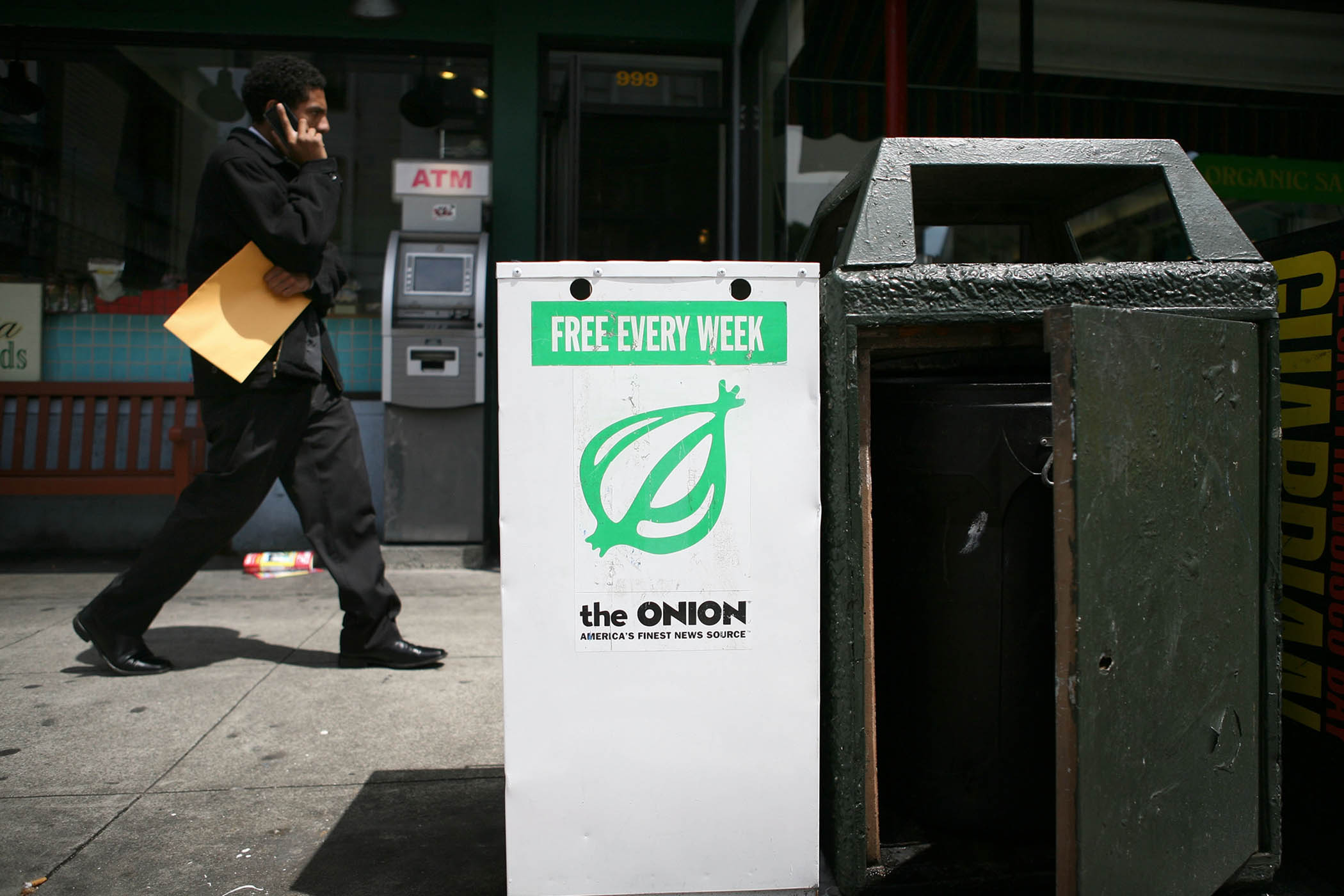



If the Onion has a God, its God is the Onion. “Because we grew up reading it and want to be stewards of the institution, we have this shared reference point of the Onion as a voice,” says Mike Gillis, the publication’s head writer. “We can always appeal to that in the room to mediate disputes – or to figure out what gets in and what doesn’t.”
There is plenty that doesn’t quite cut it. Even for established contributors, the publication rate is only 3%. Gillis won’t name any of the high-profile comedians who have been turned down. But he admits that they are “weird rejection letters to send”.
It is not a paper of record peering over its spectacles but as a jokester cut with sly irreverence
It is not a paper of record peering over its spectacles but as a jokester cut with sly irreverence
Founded in a University of Wisconsin-Madison dorm room in 1988, “America’s Finest News Source” has guided the country through seven presidents and nearly four decades of national buffoonery and bloodletting. It has done this not as a paper of record peering over its spectacles but as a jokester cut with sly irreverence. Its motto: Tu stulte es – you are stupid.
That has sometimes felt directed at the news business. In 2002, when serious publications were helping George W Bush lay the groundwork for his war on terror, the Onion was running headlines such as: “Bush seeks UN support for ‘US does whatever it wants plan’.” When America invaded Iraq, the Onion punctured any claims to moral righteousness with six words: “Dead Iraqi would have loved democracy.”
Aesthetically, the Onion website today looks like it could have been lifted from a younger version of the internet. Divided into sections, some headlines lead to full satirical pieces or videos, but many don’t. (In those cases the joke is fully told in the headline.) There are also recurring formats such as American Voices and Fact Checks. Nearly every piece of content on the site — even those advertising commercial opportunities — is delivered in its signature deadpan tone.
For all its eccentricities, the Onion looked like it was going the same way as other media organisations. At its high-water mark in 2000, it had a weekly circulation of half a million copies. But then the internet remade the world and in 2013 the print edition was no more. The Onion briefly opened an ad agency to try to shore up its revenues. The publication passed into the hands of a Spanish-language media giant followed by a private equity firm.
More than 60,000 people are now members, paying up to $9 and giving the Onion the same print circulation as the Chicago Tribune
More than 60,000 people are now members, paying up to $9 and giving the Onion the same print circulation as the Chicago Tribune
Then came a miracle. Two years ago, under new ownership and against its better judgment, the Onion relaunched its paper. More than 60,000 people are now members, paying up to $9 and giving the Onion the same print circulation as the Chicago Tribune. It has readers in all 50 states and, with the recent addition of Antarctica, every continent.
From marauding immigration agents to alarming threats over Greenland, the US does not meet 2026 in a happy state. When real life is becoming indistinguishable from a Michael Bay script, satire is indispensable. There is a reason why “not the Onion”, a Reddit forum for true stories that could be mistaken for parody, has 25 million subscribers. And a reason why the Onion too is thriving, not in spite of Donald Trump but because of him. It is a form of catharsis. For those who fear our darkening world, it is the last refuge of the damned.
The Onion was the brainchild of college student Tim Keck. A member of a Chicago media family, he wanted to make some money and came up with a quaint solution: a newspaper. It was printed in black-and-white, local to the Wisconsin town of Madison, and run by 20-year-olds. Its campus humour, disseminated with the help of the free coupons it featured on its front page, soon caused trouble. “From the first year, there were people calling the office in outrage,” says Christine Wenc, an original staff member and former roommate of Keck. “The Onion almost got someone elected to the University of Wisconsin student presidency. It was supposed to be a joke, and I do have some memory of people being freaked out. That was one of the earliest times when the Onion crossed over into real life. It was like: ‘Wow, there’s a power in this medium that we didn’t realise was there.’”
Newsletters
Choose the newsletters you want to receive
View more
For information about how The Observer protects your data, read our Privacy Policy
It basked in the absurdity of an America that was rapidly changing but in its element
It basked in the absurdity of an America that was rapidly changing but in its element
The Onion honed its satirical voice in the 1990s when it expanded nationwide and began publishing online. It basked in the absurdity of an America that was rapidly changing but in its element; nuclear fears had faded, television was king and the scandal of the day was Bill Clinton’s affair with Monica Lewinsky. “We did not have sex, we made love,” said Clinton, fictionally, in the Onion. “This was more than just the intertwining of two bodies. It was the union of two souls.” Not everything was political. Here’s one headline: “Restaurant cited for serving dead chickens.” And here’s another: “Jurisprudence fetishist gets off on technicality”.
Some 30 years later, America is in a scarier place, but the tone of the Onion is much the same. A recent headline shows its enduring capacity for silliness. “Wedding planner gingerly asks Taylor Swift if she’s considered dance lessons.” The basic principle is that everything it publishes should be funny, even if the laughs come from the gallows. Current one-liners on the site include “Hospital accused of faking cancer wing for attention” and “JD Vance claims Renée Good had no authority to be alive in the first place”. For readers in no mood for humour, these may be jarring. But the Onion is willing to face the world, however bleak, with the faux-seriousness of an AP news alert. This approach was set 25 years ago.

“I remember me and my then girlfriend, Carol Kolb, who went on to become the editor, in the car on the way to New York,” says Todd Hanson, who wrote for the Onion for nearly 30 years. He moved to the east coast in 2001, when the publication relocated there from Wisconsin. “We left Madison on the very first day of the 21st century. It felt symbolic: the end of one century, the beginning of the next phase of our lives. It was really exciting to be there in New York. That lasted for, well, about nine months.”
By September 2001, the Onion was ready to distribute its first print issue in the city. It was a huge moment. “ We felt like we’d arrived,” says John Krewson, who was a longtime writer. After finishing the inaugural edition in the office, the team walked a mile or so over to the Bowery Ballroom. “We all had a good time and drank too much. A friend of mine proposed to his girlfriend that night… We thought the future was possible, you know, and like everyone else we were unprepared for what was about to happen.”
Krewson woke up the next day, slightly hungover, and switched on CNN for headline ideas. At the bottom of the screen, below the American football analysis, he spotted an on-screen banner, or chyron, about a nearby airline crash. “ The picture in my head was one of those small two-seater single-engine Cessnas that they used for postcard photography.” Krewson turned to the window. “The only Manhattan building visible is the World Trade Center. So I look over and there’s a giant smoking hole in the side of it.”
‘We deliberated whether it was possible to write comedy about 9/11. I’m not ashamed to admit I didn’t think it could be done’
‘We deliberated whether it was possible to write comedy about 9/11. I’m not ashamed to admit I didn’t think it could be done’
John Krewson, Onion writer
The distribution plan was, of course, cancelled. “You’re just walking around and you’re seeing the posters of people looking for their missing loved ones and the little pieces of paper flying around,” says Kolb. “It was absolutely horrific.” Staff sat with their grief like every other American. But after a few days, attention turned to how the Onion, a satirical publication, should respond to the deadliest attack on US soil since Pearl Harbour in 1941. “We deliberated whether it was possible to write comedy about this sort of thing,” says Krewson. “ I’m not in the least bit ashamed to admit I didn’t think it could be done.”
It was done – to astonishing effect. Released two weeks after 9/11, the entire issue was dedicated to the tragedy. Its lead headline spoke to the futility of the moment: “US vows to defeat whoever it is we’re at war with.” Some readers said it was the first time they laughed since before the Twin Towers fell. But the issue made people cry too. Several staff members say the best piece was from Kolb, who became a writer on the TV shows Community and Brooklyn Nine-Nine. “I was invited over to someone’s house and a woman had brought an American flag cake,” she says. “It was symbolic to me of how things had changed in an instant. This is someone who would never have unironically made this cake, but she did want to form some kind of unity with other people.” The resulting headline took up a small corner on the front page: “Not knowing what else to do, woman bakes American-flag cake.”
As thousands of letters flooded in from New Yorkers, the predominant emotion among staff was relief. But time allows for more reflection. “The edition made us realise that we could speak to bigger issues,” says Krewson. Wenc, who has written a book about the history of the Onion, draws a parallel between the publication’s response to 9/11 and how it confronts the world now. “I feel like the Onion is taking on its 9/11 persona in a way,” she says. “Things are pretty dark here and it’s important to have a place which can remind you to laugh at something and give you that bit of relief from the anxiety and the horribleness.”
This tone, knowing and only funny in the darkest of ways, has become more familiar in recent years
This tone, knowing and only funny in the darkest of ways, has become more familiar in recent years
Nothing encapsulates the cathartic spell that the Onion can cast more than a headline which it runs after every mass shooting, shared so widely and frequently that the publication has become a sort-of first responder for some Americans worn down by gun violence. “‘No way to prevent this,’ says only nation where this regularly happens.” This tone, knowing and only funny in the darkest of ways, has become more familiar in recent years. Gillis is sanguine about the task of finding ways to poke fun at Trump, even as the president tries to upend the world order. “It’s really keeping with the tradition of satire,” he says. “Mocking the powerful for the traits that he exhibits in spades.”
The Onion has so far avoided the wrath of Trump, the president. But he is aware of the publication. In 2013, a senior staffer at the Trump Organization threatened legal action on his boss’s behalf over a satirical piece headlined: “When you’re feeling low, just remember I’ll be dead in about 15 or 20 years.” It is still online. The Onion is not known to have ever been successfully sued, but perhaps it is only a matter of time before it is back in Trump’s crosshairs. His second term, as told by the publication, reads like a diary of delirium, with satire only a footstep behind the truth.
The Onion is today owned by Global Tetrahedron, named after a joke written by Todd Hanson in a bygone era. “ I thought it was funny because the tetrahedron is not global,” he says. “I mean, it’s literally not a globe.” Its CEO is Ben Collins, a childhood fan of the Onion who used to be a disinformation reporter for NBC. It was Collins who made the bet on print, telling Rolling Stone of his mission to “make people believe that good things are possible, that you’re not going nuts, that things are actually quite exactly as bad as you think you are”.
Private Eye, which outsells every other news magazine in the UK, seems to have capitalised on the absurdity of the moment
Private Eye, which outsells every other news magazine in the UK, seems to have capitalised on the absurdity of the moment
He appears to have found a winning formula. As well as healthy print numbers, the Onion said its social audience had grown by 100% in the past year. Collins has relaunched the Onion’s parody news network on YouTube, hired a bunch of new staff, and started a creative agency for self-aware brands to call on writers to guide their campaigns. Like other publications such as the New York Times and the FT, the Onion is reaping the rewards of a mixed business model. And like satirical equivalents such as Private Eye, which comfortably outsells every other current affairs news magazine in the UK, it seems to have capitalised on the absurdity of the moment. The Onion expects to have turned over $6m (£4.5m) in revenue in 2025 — up from less than $2m in 2024 — and hopes, this year, to make a profit.
This is not to say that the Onion is always well-received by everyone – or always gets it right. In 2013, the publication’s then CEO apologised for an offensive tweet in which it called a nine-year-old actor the c-word. That same year, an Onion article that said Subway was introducing a 9/11-themed deal outraged the fast food chain. In 2017, wrestling fans were hurt – the Onion had run a piece claiming Big Show had been killed by WWE after a child wandered into his steel cage during an event.
All in all, this isn’t a bad run for a publication that is nearly 40 years old. But one open question is whether its appeal is limited to liberals of a certain stripe. Does it merely comfort and amuse people in a particular bubble? The publication’s marketing team said they don’t ask readers for their political affiliation, but told The Observer they have heard that their members “can find common ground” with their families across the divide. The political positions of their writers aren’t publicly known either, but most are thought to come from the Onion’s (fairly well-salaried) fellowship scheme.

Whatever its exact demographic, Hanson is unsurprised that so many readers are happy to part with their money to search for humour in the abyss. “The only reason any comedian makes any joke is they’re trying to process the inherent absurdity of the human condition,” he says. If that is the case, then the world is giving the Onion lots of material. Material to make people laugh, but also to generate that half-smile of sadness, fear and at least a small piece of hope. Kolb’s story in the 9/11 edition ends with her cake maker, Christine Pearson, sharing the fruits of her work with a neighbour. It shows the Onion when it’s at its best, landing on some essential truth.
“I baked a cake,” said Pearson, shrugging her shoulders and forcing a smile as she unveiled the dessert in the Overstreet household later that evening. “I made it into a flag.”
Pearson and the Overstreets stared at the cake in silence for nearly a minute, until Cassie hugged Pearson.
“It’s beautiful,” Cassie said. “The cake is beautiful.”
Photographs by Justin Sullivan / Getty