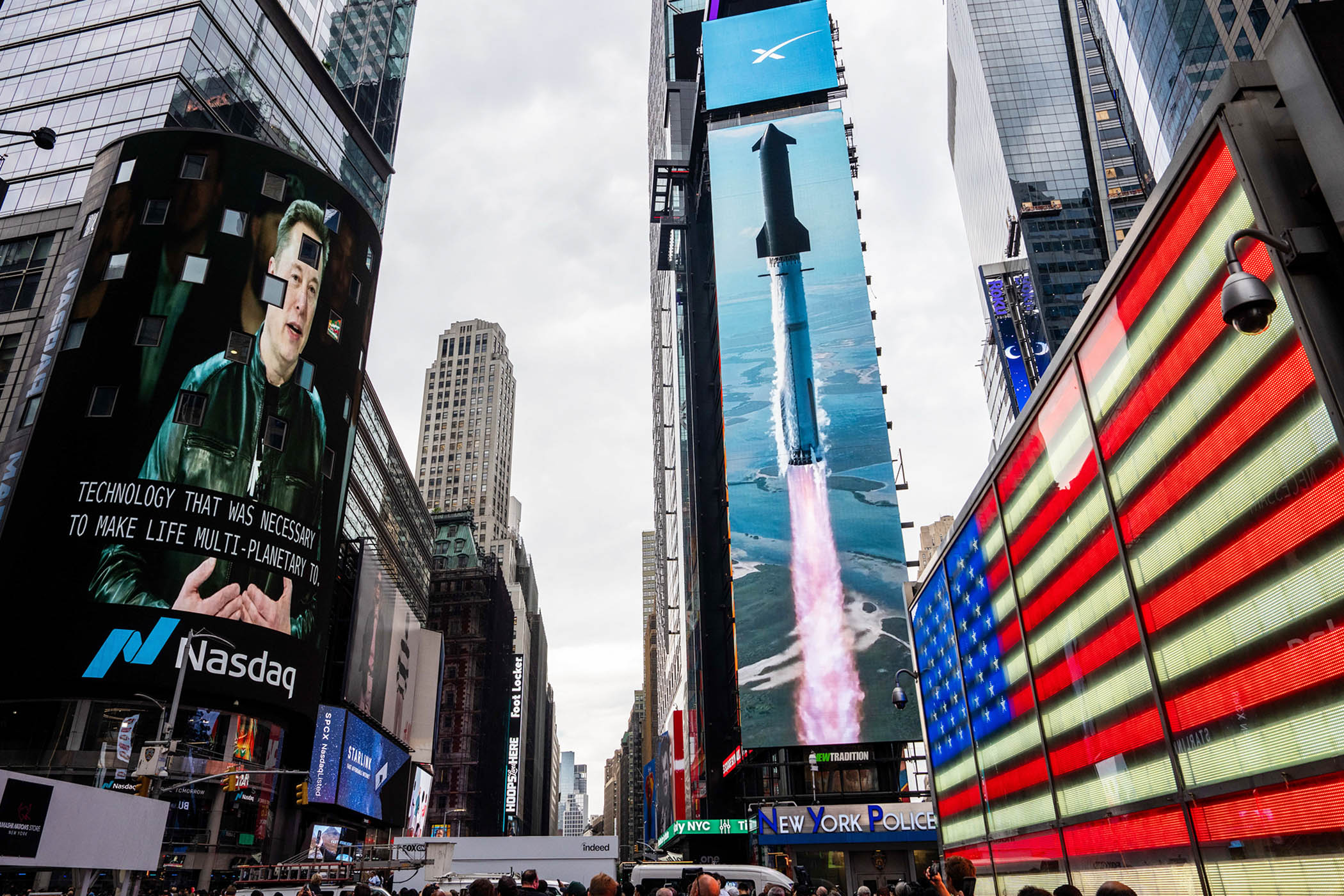


SpaceX shares dropped further below its IPO price of $135 on Friday after the company aborted a second test flight of its Starship V3 rocket and was hit by a global sell-off in tech stocks.
In just over a month since its record-breaking stock market debut, Elon Musk’s space company has shed roughly $1tn in value, plunging last week to lows of $122 a share. Analysts expect further volatility in early August as “lock up” restrictions on insiders selling shares begin to lift, potentially flooding the Nasdaq with up to $123bn worth of additional stock.
Engine failures on the 124-metre (400ft) tall Starship rocket, which had its first test launch in May, have dented investor confidence in the ambitions SpaceX laid out in its glitzy IPO prospectus, which rely heavily on building a rocket robust enough to carry data centres into orbit.
Geopolitics also hasn’t helped. An investigation by Insider, Der Spiegel, and Le Monde revealed that Russia and China are seeking to build up capabilities to disable SpaceX’s Starlink satellite network, which Ukrainian armed forces depend upon to launch drone attacks.
However, none of these pressures seem to have much affected the upbeat outlook of analysts at Wall Street banks. Of the 32 banking analysts covering SpaceX only one has published a “sell” rating and all 15 of the banks that underwrote the IPO are, perhaps unsurprisingly, “buy”.
But that optimism could vanish if SpaceX is unable to live up to its core promise of becoming a leader in AI infrastructure, on Earth or in orbit. “Everyone got excited about rockets, but what’s become apparent when you look at the analyst research is how much more important AI is to the valuation than space,” says Dan Coatsworth at AJ Bell.
Since the IPO, Musk’s own net worth on paper has declined from north of $1tn to around $833bn, according to the Bloomberg Billionaires Index. But concerns about AI spending are not his to bear alone.
The Nasdaq-100 fell 2% on Friday as a rout in chip stocks deepened and investors questioned the reliability of future revenue from huge AI investments. Nvidia briefly lost its crown as the world’s most valuable company to Apple. IBM had its worst ever day of trading after it warned in advance that sales of its software had “faltered” last quarter. An index tracking major US chip companies fell 8.5% last week – its steepest drop since Donald Trump’s “liberation day” tariffs.
“It’s a very bifurcated, K-shaped equity market,” says Sebastian Raedler, head of European equity strategy at Bank of America. “A powerful sorting into losers and winners, where the winners are very stretched and the losers are very beaten up.”
The sell-off has been fuelled by mounting worry about when, exactly, AI might pay off. Torsten Slok, chief economist at Apollo, wrote in a recent note that the consensus expectation is for free cash flow for the hyperscalers – big tech’s heavyweight firms – to more than double over the next couple of years.
Newsletters
Choose the newsletters you want to receive
View more
For information about how The Observer protects your data, read our Privacy Policy
But if outperforming Chinese models, like Kimi K3 released by startup Moonshot AI this week, keep gaining and pushing down the price of tokens (the consumption-based pricing system used by many generative AI models), Slok said that expected cash flows may prove too optimistic. The troubling upshot could be a sell-off by the magnificent seven – Nvidia, Microsoft, Alphabet, Amazon, Meta and Apple – that, according to Slok, “takes the market with it”.
Some bearishness is also due to fears about depreciation – the possibility that hyperscalers are stretching accounting assumptions about the useful lifetime of data centres, for example, from three to six years, in order to defer cost and flatter margins in the near term.
“It’s a curious situation where the consensus is pricing record corporate margins for years to come, even as a key part of the market moves into an asset-heavy model where you typically get depressed margins because of depreciation,” says Raedler. “You’re just hoping the usual laws of gravity do not apply.”
After a torrid week, SpaceX investors may be hoping for the same.
What are your thoughts on this? Send us a letter to letters@observer.co.uk
Photograph by Adam Gray / Bloomberg via Getty Images