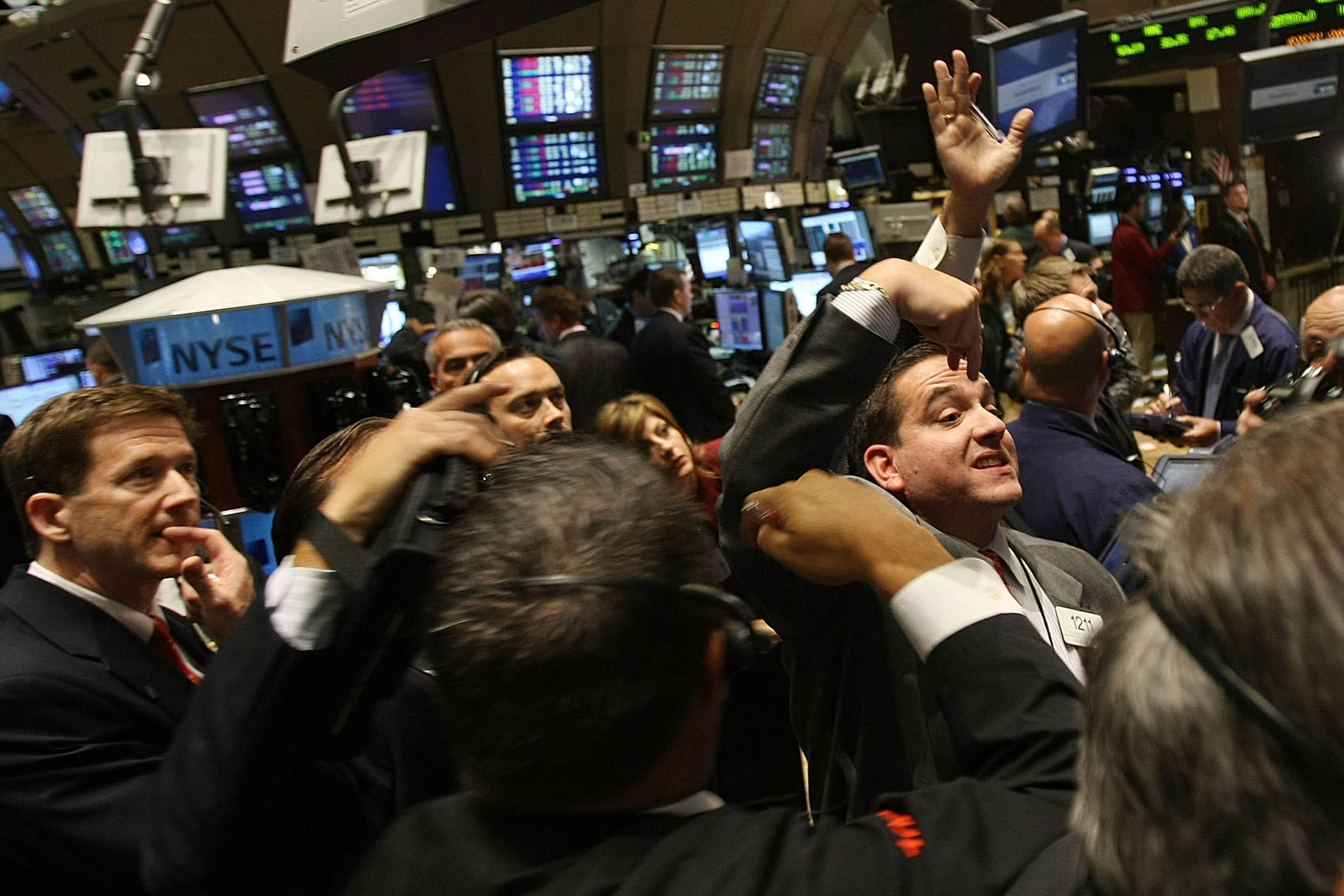


Investors are on the hunt for new ways to protect their portfolios if the AI bubble pops. Trades of financial products that pay out if US tech companies default on their debts have increased 165% since August, according to clearinghouse DTCC.
But these products, known as credit default swaps, aren’t new. Michael Burry, the contrarian investor portrayed by Christian Bale in The Big Short, used them to bet on the collapse of the US housing market in 2008.
Finding a “clean” hedge against AI in 2026 isn’t easy. Tech accounts for roughly a third of the US stock market, which itself represents more than 45% of global equity value. But getting out now risks losing out on future gains. The best most investors can do is to ride along, while keeping an eye on the vulnerabilities that have historically preceded a crash. Here are a few:
Overvaluations
At the peak of the dotcom bubble in 1999, the Nasdaq was trading at a price-to-earnings (P/E) ratio of 72. That means buyers of the stock were paying $72 on average for every dollar of profit at that time. Valuations these days aren’t quite as stretched. The Nasdaq is currently trading at a P/E of roughly 34.
That’s still very high and investors are asking whether, and when, all that promised revenue will actually materialise. They’re already exerting some discipline: shares in tech giants Oracle and Meta took a dive at the end of last year, largely driven by concerns over massive AI-related capital expenditures.
Cracks in credit
The last major economic crisis, in 2008, started in the banking sector. “You can have a really calamitous event somewhere else in the system, and so long as it doesn’t take the banks down with it, that event will be contained,” says Dr Jon Danielsson, director of the Systemic Risk Centre at LSE.
Banks aren’t overly exposed to AI. But a major difference between now and 2008 has been the explosion of private lending. Tech giants are increasingly using loans from private credit companies to finance data centre expansion, allowing them to move around $120bn of spending off balance sheet. This boom is no longer being funded via free cash flow: Microsoft had 30% more cash than debt before the launch of ChatGPT. Now it has almost 20% more debt.
For some, this spells trouble: “Using private markets, there is less transparency, more risk taking,” says Piero Novelli, former co-president of UBS’s investment bank. “So it’s not difficult to foresee a credit freeze at the same time as we realise the monetisation of these AI tools is elusive at best.”
Passive players
Another huge trend has been the rise of passive investing. Think of it like putting money on autopilot: instead of picking individual stocks, passive investors buy a slice of everything within an index and delegate the decision making to a money manager like Vanguard or BlackRock.
But those firms, in turn, outsource voting on companies to proxy advisors. The result, Novelli says, is that “no one is paying attention and no one is doing the homework”. Markets are at risk of tracking the volume of passive money pouring into them, rather than the fundamentals of the assets underneath. What happens if that goes into reverse?
Newsletters
Choose the newsletters you want to receive
View more
For information about how The Observer protects your data, read our Privacy Policy
Metal madness
Gold has been a safe haven for investors for about 5,000 years – but it’s tipped to break records in 2026. Last year saw the biggest annual gains in gold prices since 1979, when a spike was driven by high inflation, geopolitical tensions and a weak US dollar. Sound familiar?
“The problem with gold is that it's a bet on something ending up being terrible,” says Danielsson. “Then, when the gold price goes up, we assume that must be right, and we continue buying gold. It’s a narrative that feeds on itself.”
Black swans
Market crises are almost always preceded by a trigger event. In 1929, it was a sudden wave of margin calls on Wall Street after weeks of declining prices. The 1997 Asian financial crisis kicked off once Thailand abandoned its dollar peg. In 2008, it was the failure of Lehman Brothers that “broke the buck”.
So far, 2026 has already had a fair number of “black swan” events. And yet, Wall Street’s traditional gauge of market panic – the VIX index – is only at 15 points (above 20 is generally considered trouble territory). Investors, at least in equity markets, seem unfazed by Donald Trump’s boat-rocking. So what will it take? That’s a multi-trillion dollar question.
Photograph Mario Tama/Getty Images