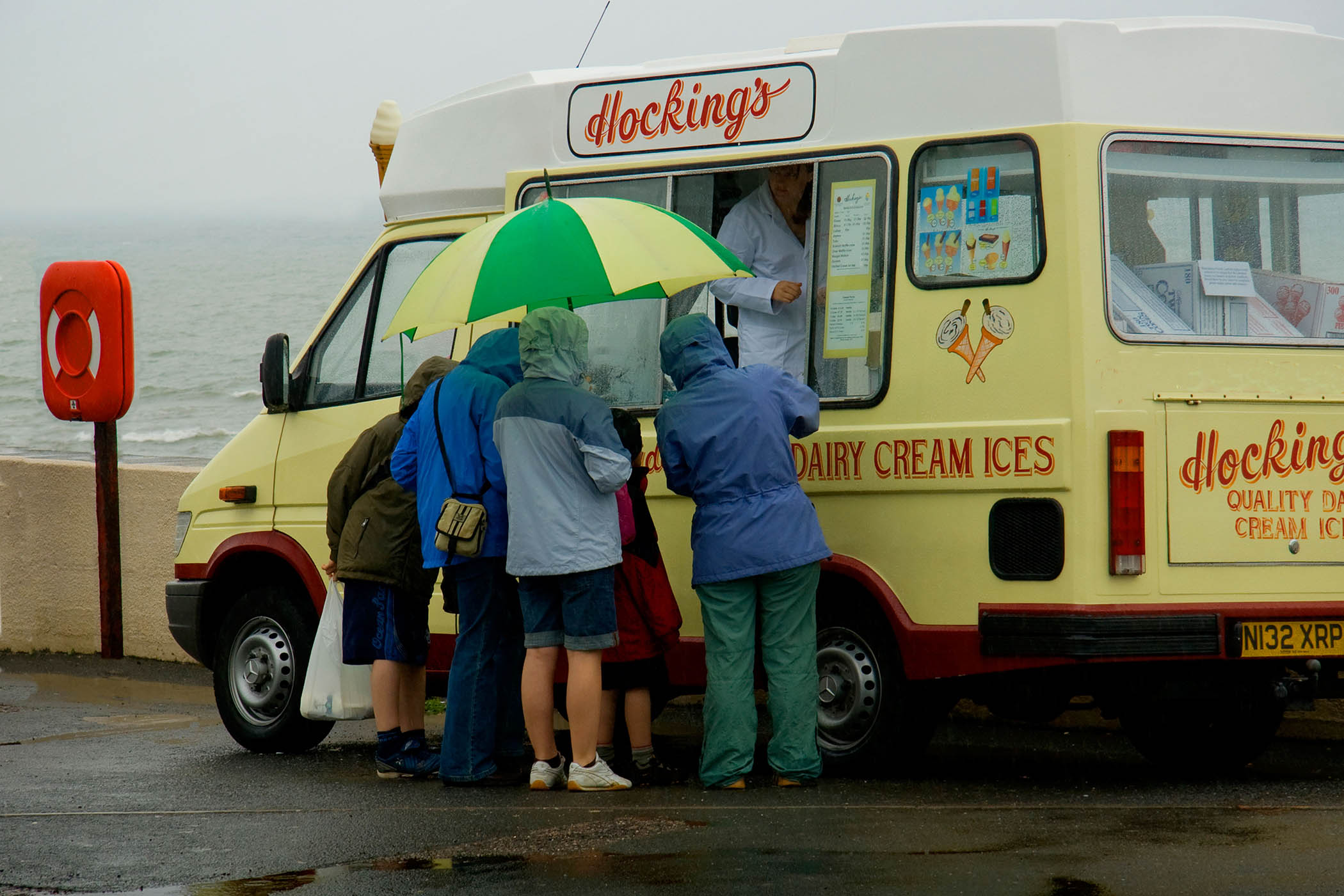


Ever since the British invented the seaside resort in the 18th century, Americans have been dropping by to comment on it. “I have never felt more alien in Britain than when I was watching people enjoying their sort of seaside vacation,” wrote Paul Theroux of Morecambe in the 1980s. Here’s Bill Bryson: “Blackpool is ugly, dirty and a long way from anywhere … its sea is an open toilet, and its attractions nearly all cheap, provincial and dire.” Last week an American comedian called Russell Hicks spent a day in Brighton. “There was no sand, just rocks and glass while everybody sat in knitwear crying in the rain.”
Brits like to defend their sideways wind, leaden skies, sandy hard-boiled eggs and ancient pirate-themed arcades. Morecambe came up with bingo, lettered rock and the helter skelter; Margate first trialled the deckchair; the first beach huts appeared on Scarborough’s south beach in the early 19th century. Southend, Clevedon and Brighton are known for their Victorian piers (now slightly worse for wear). And unsurprisingly, the threatened strip of land around our coast – Dover was bombed almost daily during the second world war – contains some of our most patriotic citizens.
We think of the seaside with affection and nostalgia, but a swathe of new statistics tells us we are in reality catching up with the opinions of our American friends. Given the option to sit on warmer, sunnier beaches, many Brits are taking it. Coastal resorts have been in decline since the package holiday became popular in the 1970s, and ever-cheaper flights have accelerated the trend. It was briefly arrested by the pandemic; now it looks terminal. The UK lost some £640m in domestic tourism spending between 2024 and 2025 – and is down £1.4bn since 2022.
This is very bad news indeed for seaside towns, where tourism is just about the last remaining industry. Stuck on the periphery in every way, these areas are among our most neglected. The most deprived village in England and Wales is Jaywick, near Clacton in Essex – represented in parliament by Nigel Farage – and our lowest-ranking ward is Bloomfield, just behind the Blackpool seafront. Neighbourhoods on the coast are 42% more likely to be in the worst decile for deprivation, their crime rates are 12% higher and their residents are 15% more vulnerable to premature death.
It is getting worse. Seaside towns are in a doom spiral due to an exceptional combination of trends. Most work is seasonal, poorly paid and increasingly precarious. These places have also long attracted retirees, who contribute less to local economies and often need care; the care industry, too, is scantily paid. Schools underperform, mostly because they struggle to net good teachers, as rising deprivation makes living there less attractive. In Hastings and Rye, the absence rate is almost 50% higher than the national average, and 60% of children leave school without English and Maths GCSEs. Then, too, seaside towns attract a working-age population that is less likely to be in work.
“When times get tough in the city, people might go to their nearest seaside, which is much cheaper. So if life goes wrong in Manchester, you might end up sharing a house with lots of others in Blackpool, in a street with lots of shared houses – often former bed and breakfasts,” says Madeleine Bunting, author of The Seaside: England’s Love Affair. These groups might include people fleeing domestic violence, and those struck down by illness or disability, as well as ex-prisoners and drug addicts.
Adding to the numbers of vulnerable people are a higher than average rate of children’s homes, which may be set up in disused hotels. Blackpool has one of the highest rate of children in care – one in every 52 – in England. Communities that include those freshly out of prison make a bad match.
As these areas decline, they start losing their charm, which then means fewer visitors. In Portsmouth some 25 historic sites are “at risk”. Blackpool once hosted party conferences – but politicos have gone elsewhere, to the modern, well maintained environs of Birmingham and Manchester.
A few of these towns and cities have been reinvented, at least on the surface. Those with good railway links to rich cities have a head start. Brighton, Hove, Whitstable and Folkstone – all close to London – are success stories, as is Margate, which was also subject to an expensive regeneration project. But amid the gentrification is extreme poverty, as locals are priced out of the housing market, and shoved away from prettier coastal areas. In Margate there has been a near 50% rise in rough sleeping between 2024 and 2025. “There is a lot of resentment in those towns. Some children who live in Folkestone have never been to the beach because they can’t afford the bus fare,” says Bunting.
Coastal towns – recently nicknamed “the sea wall” – represent a simmering threat to mainstream politics, but have been steadily ignored. When then Ukip politician Douglas Carswell won the Clacton byelection in 2014 he announced it represented “something new, something different” – much to the amused mockery of Westminster. Although impoverished seaside constituencies overwhelmingly voted for Brexit, with shares surpassing 60%, it was seats in the north of England that attracted political attention and became the focus for “levelling up”. In July 2024, Reform finished second in 17 coastal seats – yet another warning. Still, seaside towns are yet to become a firm focus for Labour.
Newsletters
Choose the newsletters you want to receive
View more
For information about how The Observer protects your data, read our Privacy Policy
This may be because coastal problems are particularly tricky to solve. Inland urban areas – denser and with younger people – are likely to offer a bigger return on investment. Even so, Brighton, which boomed in the 1990s, shows one way it may be done. A new university and a population of students led to a resurgence in the arts, which spilled first into Hove and then Worthing. Building faster train links would encourage tourists and commuters; new, affordable housing would help locals not to get priced out. Brits are not good at this sort of planning. But it might be necessary to stop seaside towns sinking altogether.
Photograph by Photolibrary Wales / Alamy