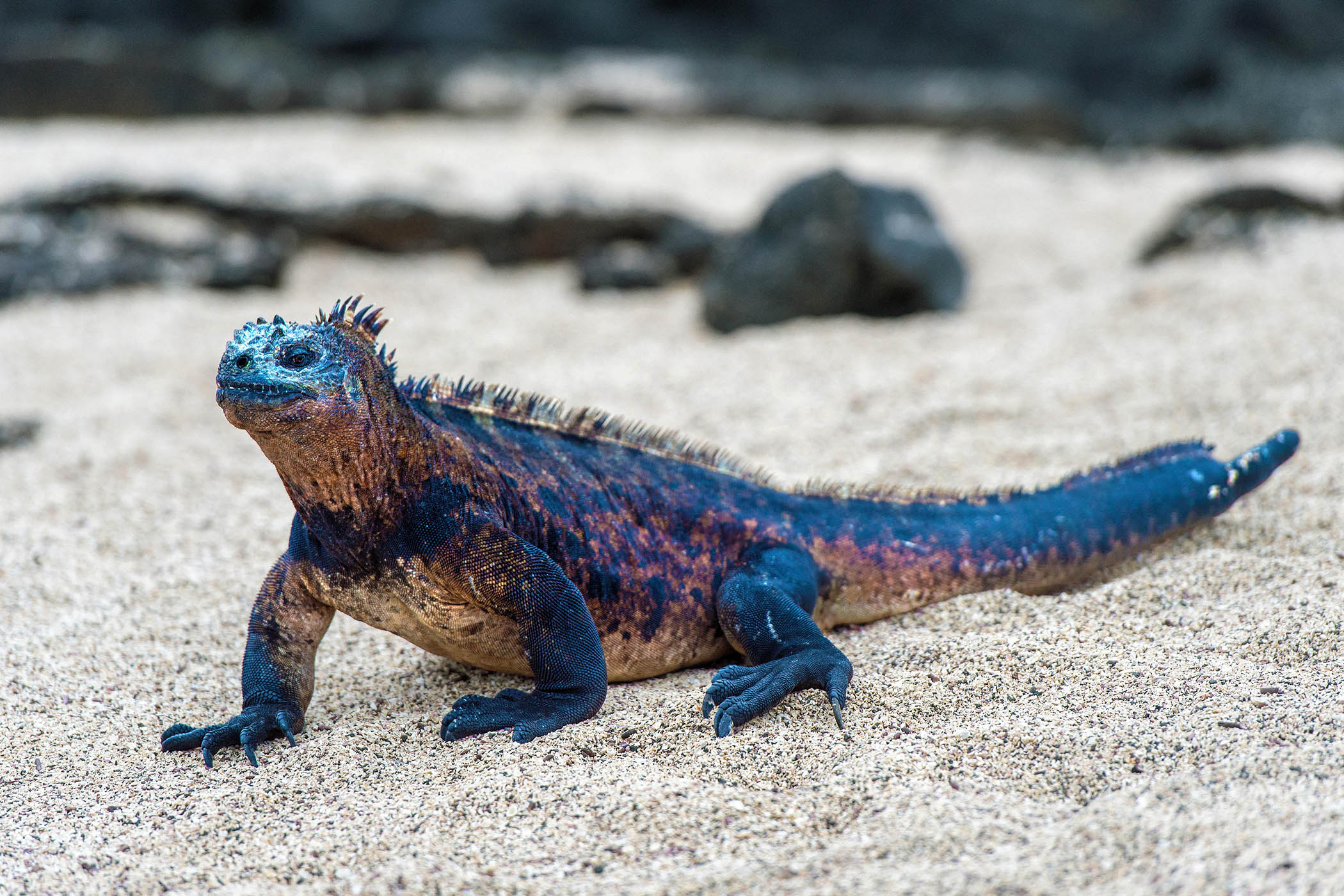

I’ve got a great deal of time for Charlie Darwin. He got an awful lot right. But he’d have got it right a whole lot quicker if he’d paid more attention to us when he visited the Galápagos Islands. Instead of writing us off as “disgusting clumsy lizards” he could have looked at us a bit more closely. He’d have had his great idea there and then.
Monday
The story has gone into marine iguana folklore: the day when Charlie was a bit bored and whiled away the afternoon by chucking one of my ancestors into the sea. He did it again and again: every time the poor creature got back to shore, he picked it up again and chucked it back in. Just the sort of behaviour you’d expect from a rich kid on a five-year-long gap-year.
Tuesday
Charlie failed to appreciate our quite devastating uniqueness while he was travelling on HMS Beagle. We’re the only sea-loving, sea-feeding lizards. I dive into the waves and browse on seaweed. It’s bloody cold down there and when I come up again I have an urgent need for heat. Every day is a rhythm of bask and plunge.
I like to think that we iguanas were sleeping influences on Charlie’s great idea
I like to think that we iguanas were sleeping influences on Charlie’s great idea
Wednesday
Charlie was a thoughtful bloke even when he was mucking about. Not thoughtful as in considerate, as my ancestor would have told you, but thoughtful as in filled with thoughts. He wondered why the iguana kept coming back to the shore to be tossed once again, instead of staying out in the sea. Then he cracked it. Of course he cracked it. He always did.
Thursday
Related articles:
“This reptile has no enemy on shore whereas at sea it must often fall a prey to the numerous sharks.” Got it in one, Charlie: we enter the sea for business, not pleasure. Feeding is necessary but dangerous. We come to shore for both safety and warmth. He made guesses about “a fixed and hereditary instinct”. So far so good. But he missed the big one. At least, he did then.
Newsletters
Choose the newsletters you want to receive
View more
For information about how The Observer protects your data, read our Privacy Policy
Friday
In a way you can’t blame him: thanks to someone else’s error he thought there were more marine iguanas in Mexico. So he missed our uniqueness. Had he not, he might have guessed that our distant ancestors came to these islands after making accidental journeys on floating vegetation, and from them sprang two quite different species, both of them unique to these islands: us lot, and those Galápagos land iguanas. That’s evolution, that is. The key was in his hand, but he chucked it out to sea.
Saturday
All the same, I like to think that we iguanas were sleeping influences on his great idea. Certainly it was the special nature of island species like us that got things rolling in that mind of his. And so, as one of those Darwin’s finches drops down to remove a tick from my basking body, I can reflect on the part that we marine iguanas played in the greatest revolution in the history of earthly thought.
Marine iguana (Amblyrhynchus cristatus) CV
Lifespan 12 years is average, 60 is within our scope
Eating habits seaweed with salt
Hobbies basking, deep thoughts
Sexual preferences female marine iguanas are neither disgusting nor clumsy
Photograph by GFC Collection/Alamy