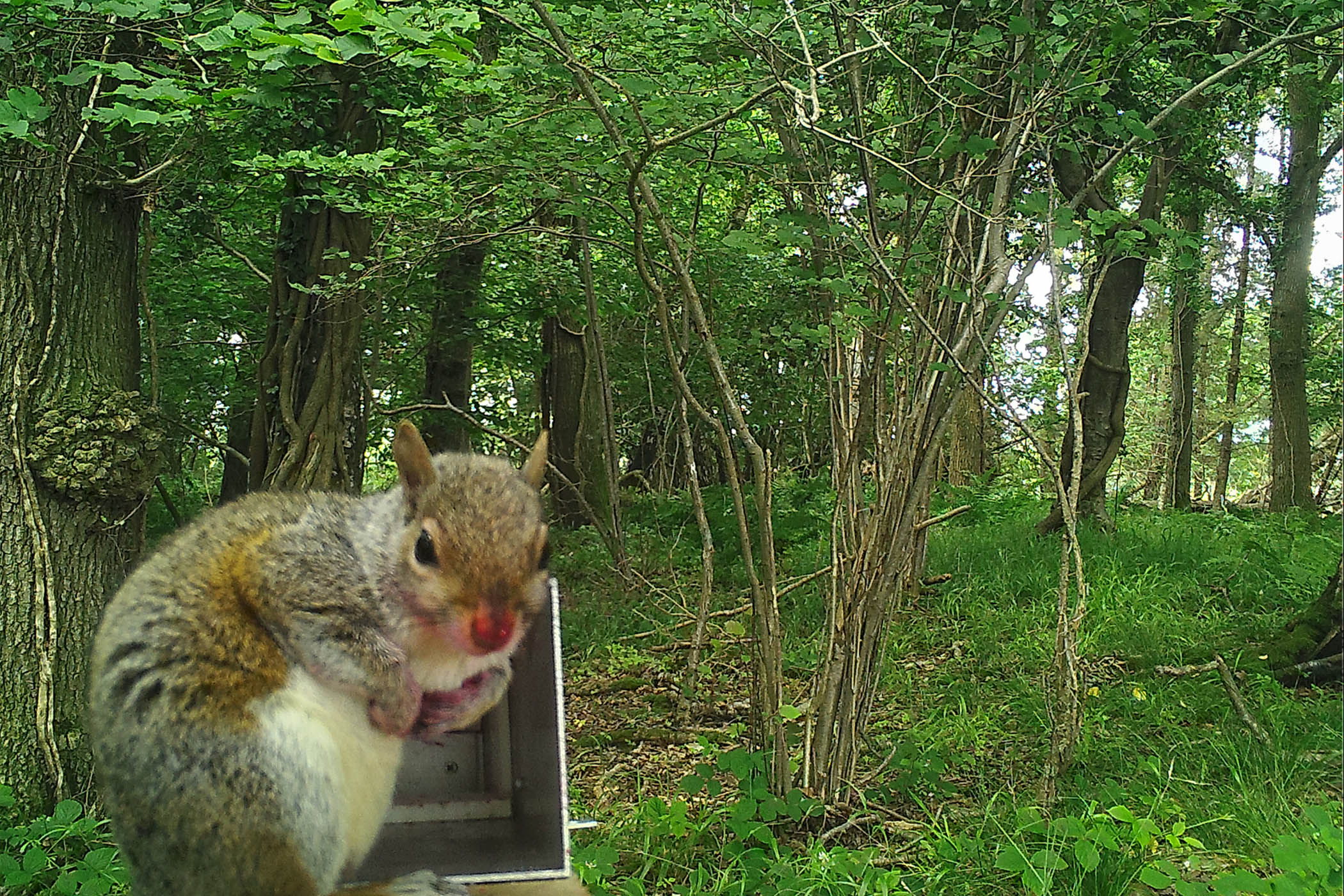


Throughout the squirrel wars, there have only ever been two sides: the invading greys and the native reds. But the battlefield now has new colours – shades of fluorescent pink.
In their efforts to cull the expanding grey squirrel population, scientists have been researching ways to sterilise them en masse using baited traps. To tell which ones have taken the bait they lace it with a harmless chemical that turns the rodents’ fur a shade of fuchsia. Once the scheme has proved successful, an oral contraceptive will also be added.
“When the squirrels eat it, their hair fluoresces pink,” said Sarah Beatham, a senior mammal ecologist at the Animal and Plant Health Agency (Apha). “If they eat a lot, they look pink themselves. So we have little pink squirrels running around the woodland. It's a really nice way for us to safely estimate how many would actually take bait from the feeders.”
In the 150 years since American grey squirrels were introduced to Britain, red squirrels have been all but eliminated from England and Wales. Squirrel Nutkin’s red descendants are now competing for territory with greys from the Scottish borders to Dundee, and the larger and bolder invaders are winning. A key weapon for the rodent conquistadors is squirrelpox, a disease that does not affect greys but is lethal for most reds.
Greys are also a serious threat to British woodland, Apha says. Research sampling 26 broadleaf woodlands in England found 45% of trees had been damaged by squirrels. Their habit of stripping bark from trunks , particularly oak, hazel and beech had harmed the health of nearly two-thirds of woodlands – costing £37m a year in England and Wales, according to the Department for Environment, Food and Rural Affairs (Defra).
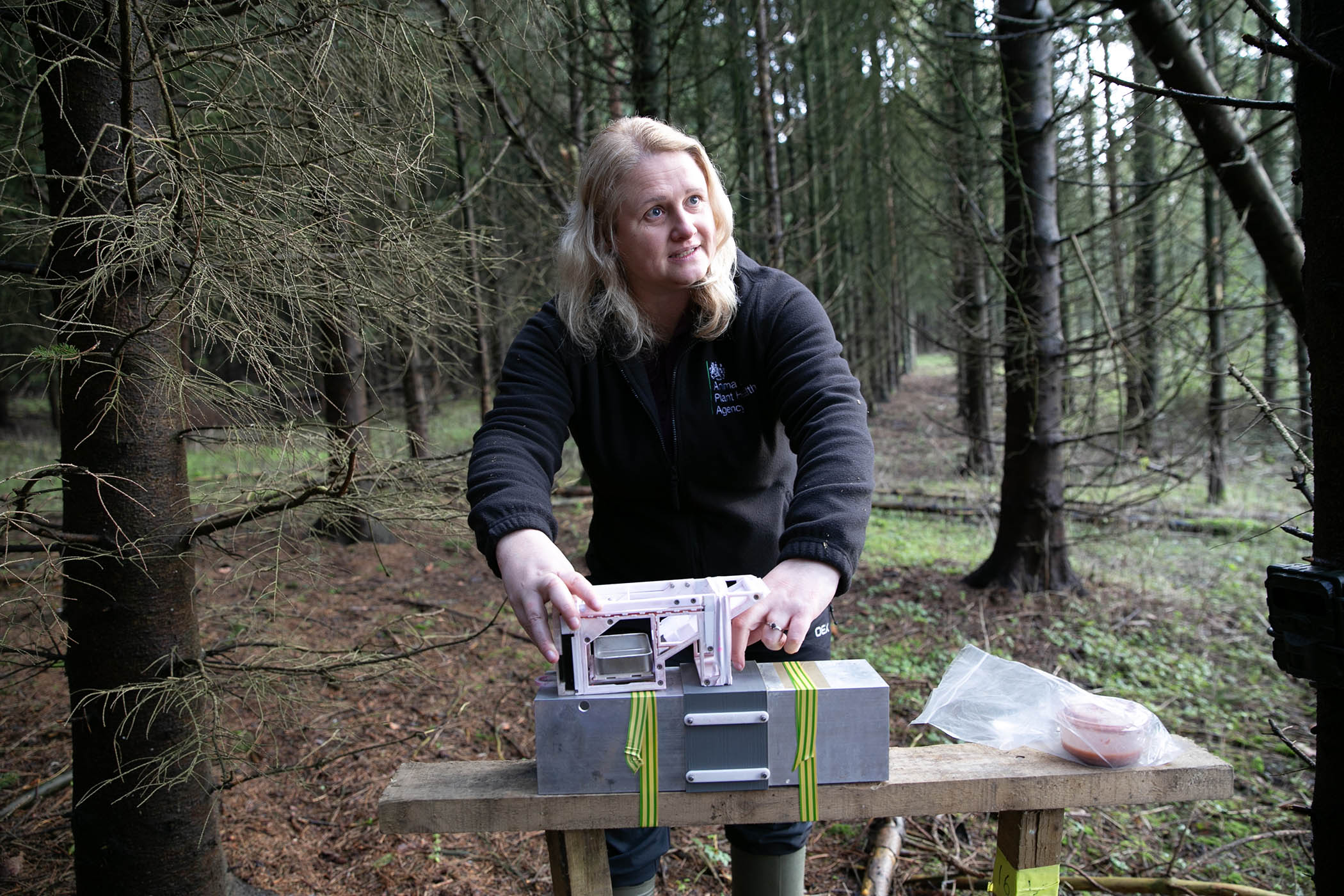
Senior mammal ecologist for APHA, Sarah Beatham, demonstrates how the feeding hopper works in woodland near York in North Yorkshire
In 2017, Apha began looking at new ways to cull the grey population with the support of the UK Squirrel Accord, a group of 47 conservation and forestry organisations that includes red squirrel advocates.
Squirrel hunters do operate in some areas, but landowners can be reluctant to allow people with guns into their woodlands, and the 2.7 million greys now in Britain – about 10 times the number of reds – would take a much larger army of volunteers than currently exists to be effective.
Sterilisation is seen as more humane way of dealing with the invasive species, and the trap-neuter-return method has been used on stray dogs and cats in places including Greece, the US and Thailand, as well as donkeys in Kenya and monkeys in India.
But these schemes are costly and time-consuming and don’t always work. Delhi’s 30,000 rhesus macaques have been known to maraud government offices in the Indian capital, but official attempts to sterilise them have been unsuccessful.
So Beatham’s colleague Bex Pinkham, mammal subject lead for Apha’s wildlife team, has been developing an oral contraceptive vaccine, which they believe is the first of its kind. “We’ve been getting some really good results in rats,” Pinkham said. It targets GnRH, a hormone that stimulates squirrels to ovulate or produce testosterone. They are still refining the vaccine, but so far have established that the vaccine does produce anti-GnRH antibodies in squirrels and has made them infertile.
The problem is that the immuno-contraceptive is effective against all mammals. Simply leaving it in bait in British forests would wipe out vulnerable and endangered species. So Apha has been creating baited traps that only greys can access.
‘When they eat the bait, their hair goes pink – we have lots of little pink squirrels running around’
‘When they eat the bait, their hair goes pink – we have lots of little pink squirrels running around’
Sarah Beatham, Apha
In a patch of private woodland on the outskirts of York, Beatham demonstrates the trap – a square metal tunnel on top of a wooden rail, about 1 metre off the ground. The bait – hazelnut butter mixed with rhodamine B, the dye that turns their fur pink – is inside a hopper that the squirrels lift with their noses to get to. It’s too heavy for any other animal able to fit into the tunnel that might be attracted by a hazelnut butter feast. “We’ve had 19,000 visits by grey squirrels and nine by mice,” Beatham says. “That was the only other visit by non-target animals and the wood mice nudged it open but didn’t actually manage to get to the bait.”
How to keep the smaller red squirrels out? The team has developed a more complex feeder with a pressure pad that only unlocks the hopper if the animal is heavy enough to trigger it. That means reds and juvenile greys cannot get to the contraceptive.
The feeders are set to be tested on a larger scale in Cumbria, Northumberland, Lancashire and south Scotland as part of a £4.86m project led by the Red Squirrel Recovery Network and Northumberland Wildlife Trust.
Pinkham is examining how effective the contraceptive might be, based on their data so far. The Apha modelling suggests that the grey squirrel populations in large areas would drop by half within six years if the vaccine is effective on 75% of greys.
It depends how many squirrels take the bait and what proportion are affected by the contraceptive.
“When you get down to really low densities of squirrels, it gets much harder to remove them. With all sorts of invasive species eradication programmes, you get a steep drop off to start, then there’s this really long tail.”
Beatham and Pinkham expect their research to be completed by 2028, with work still needed to optimise the contraceptive and run further tests on squirrels. T he drug needs to be approved by the Veterinary Medicines Directorate. Then the red squirrel recovery will be able to begin.
Photographs by Department for Environment, Food & Rural Affairs, Richard Saker / The Observer
Newsletters
Choose the newsletters you want to receive
View more
For information about how The Observer protects your data, read our Privacy Policy