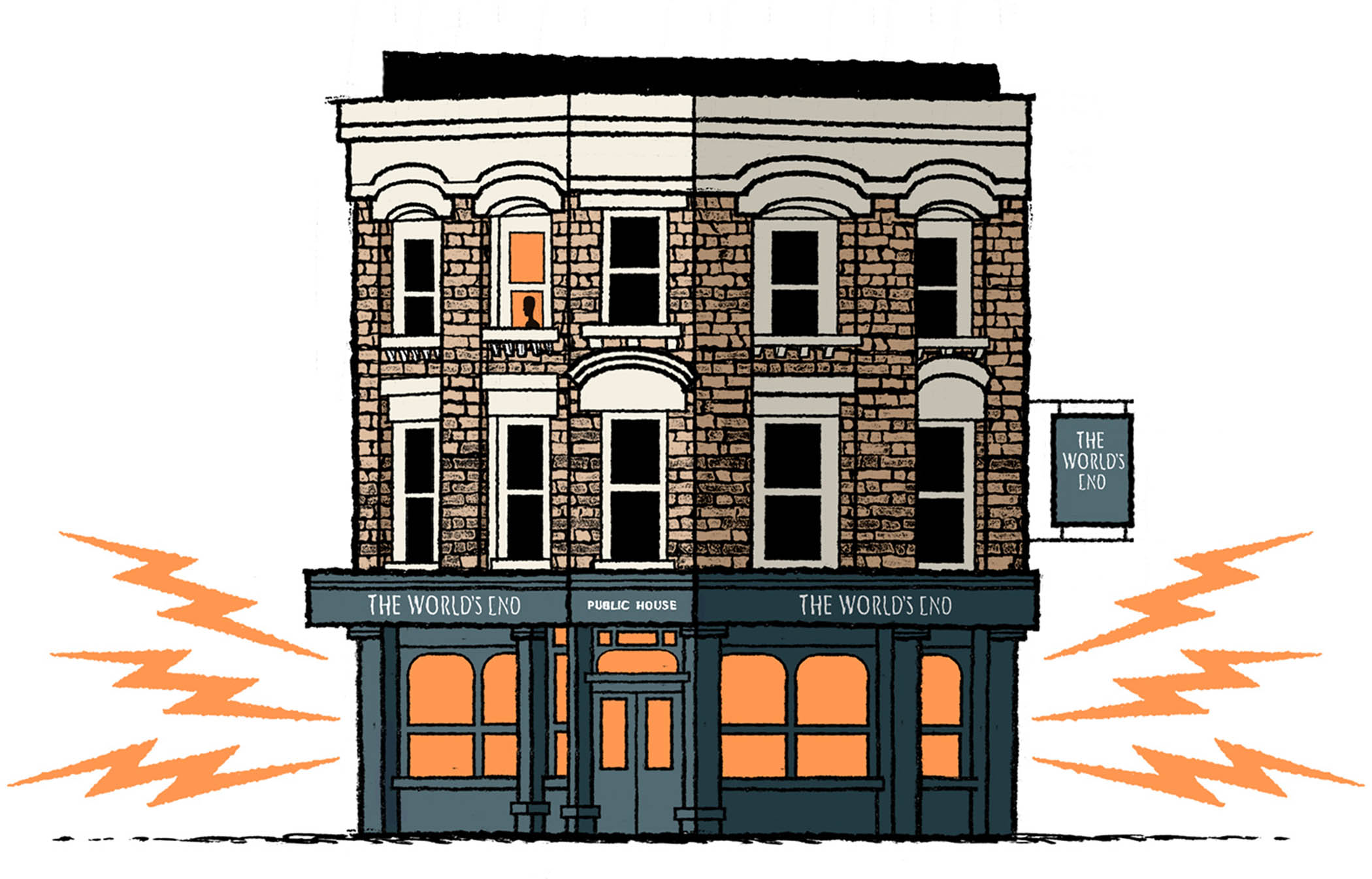



Illustration by David Foldvari
For more than 150 years, a pub has stood on the corner of Stroud Green high street, a busy main road in the Finsbury Park area of north London. Since 2009, that pub has been the World’s End. It always shows the football, it has a great pub quiz, and plenty of famous musicians have played there. Mumford & Sons once played an acoustic gig, and Ed Sheeran wrote the song The City after sleeping in the pub’s cellar – but I won’t hold either of those facts against it.
Before the pub was the World’s End, it was the Earl of Essex. I can’t speak for the credentials of the Earl of Essex, but I can for those of its replacement. I go to the World’s End a lot, even though it is a barbecue pub and I don’t eat meat, and that it is an Arsenal pub and my boyfriend is a masochist (which is Latin for “lifelong Tottenham Hotspur fan”). I was among the 200 Finsbury Park residents, alongside local community groups and Islington North MP Jeremy Corbyn, who came to the pub’s defence when it was threatened with closure.
You see, a couple of years ago a man named Axel Guillemot bought a flat next to the World’s End, which is, just to reiterate, a pub on a busy high street in north London, a 15-minute walk from the Emirates stadium, which regularly hosts 60,704 Arsenal fans. Axel was shocked to find that his new property was in a quite rowdy area, which was frequently full of Arsenal fans. Who could have predicted this?
Well, not Axel. Over the next two years, he mounted a concerted campaign against the management of the World’s End, seeking to have the pub’s licence revoked and, you would assume, driving several local council employees to the brink of insanity with constant emails complaining about noise. There was “excessive amplified music”, said Axel, who bought a property which shares an adjoining wall with a pub. It was disturbing his quality of life, said Axel, who presumably viewed his property with a potential purchase in mind while wearing a blindfold and earplugs. People outside were even, horror of horrors, smoking weed!
In one email, sent on a Saturday night, Axel called out of hours noise complaint officers to grumble that he could hear the pub over the sound of his TV, which he was watching, inside, on a Saturday night. It was causing, he said, “significant disturbance to my property”. Finally last month, Islington Council published its 812-page response. In it, the council largely sided with the landmark pub, preserving its licence while advising the owners to install noise insulation and banning them from playing music after 11pm. (In a new, decidedly 12A-ification of London nightlife, now next to nothing is open or lively past 10.30pm thanks to exactly these kinds of licensing disputes.)
There are plenty of places to buy property in if you find Finsbury Park, or London, a bit rowdy
There are plenty of places to buy property in if you find Finsbury Park, or London, a bit rowdy
Like many of the thousands of others who reacted to this report on social media, I support the council’s decision. As the journalist Helena Horton noted: “If you buy next to a pub you should expect noise!” It doesn’t surprise me that not a single person, including other neighbours on the same street, sent in a complaint about the World’s End. Online and offline, the general sentiment was the same: if you don’t like it then move.
I don’t have any particular personal vendetta against Axel Guillemot. What annoys me is what he represents, which is the individualistic hubris and the selfishness that defines the London property market. I spend, in my defence, quite a lot of time thinking about the London property market. I spend so much time thinking about it that last year I published a novel, I Want To Go Home But I’m Already There, in which the protagonist is driven slowly insane by the London property market. (It’s coming out in paperback in a couple of weeks, actually – Axel might enjoy reading it.) I am interested, too, in the psychology of believing that just because you have invested several hundred thousand pounds in owning a small part of an area, you get to decide exactly how that area behaves.
It would be more acceptable if this meant that all homeowners – particularly all London homeowners – were deeply invested in community building. If it meant that they supported local businesses, attended local council meetings, donated to local charities, voted in ways which made sure their locality was represented fairly in Westminster. But sadly the psychology of a city homeowner doesn’t (always) work like this. Instead, it manifests itself as a march towards gentrification. It’s a psychology that says: “Forget what Finsbury Park was like when I moved in. Now I am here, I want it to suit my lifestyle and mine alone. I want the bit close to me to be cleaner, nicer, better, quieter, and I deserve to make these demands because I have invested money in living in a small part of it.”
Obviously, everyone should be able to live peacefully. I have sympathy for people who choose to buy or rent a property only to find that they’re suddenly surrounded by things they never anticipated; by constant construction work building luxury flats nobody will ever live in, for instance. Or noisy neighbours who have just arrived on the scene, who you could never have known about before moving in. Or genuine antisocial behaviour that amounts to more than daring to smoke a blunt on a street corner while watching Tottenham lose 4-1. But I don’t have much sympathy for Axel, or indeed for anyone who buys a flat next to a historic pub on a busy high street and then finds it’s a bit rowdy.
There are plenty of communities to buy property in if you find Finsbury Park, or indeed London, a bit rowdy. If you, unlike me, value rolling bucolic green fields, Jam and Jerusalem, silent elderly neighbours, quiet time for your baby and nobody else’s, and Blytonesque socials at the church fete, then it shouldn’t be controversial to suggest that London, a capital city of about 9.1 million people, is perhaps not the best place for you to settle down. You could, for example, be back home, safely ensconced in the home counties, warmed by the glow of your parents’ Aga, by half-time at the Emirates.
Newsletters
Choose the newsletters you want to receive
View more
For information about how The Observer protects your data, read our Privacy Policy