Kira Freije is on the shortlist for this year’s Turner prize. This is unexpected, as she is not a name on people’s lips. At 40, the London-born artist is a late starter, only completing a postgraduate course at the Royal Academy Schools in her 30s. Unspeak the Chorus is her first substantial exhibition.
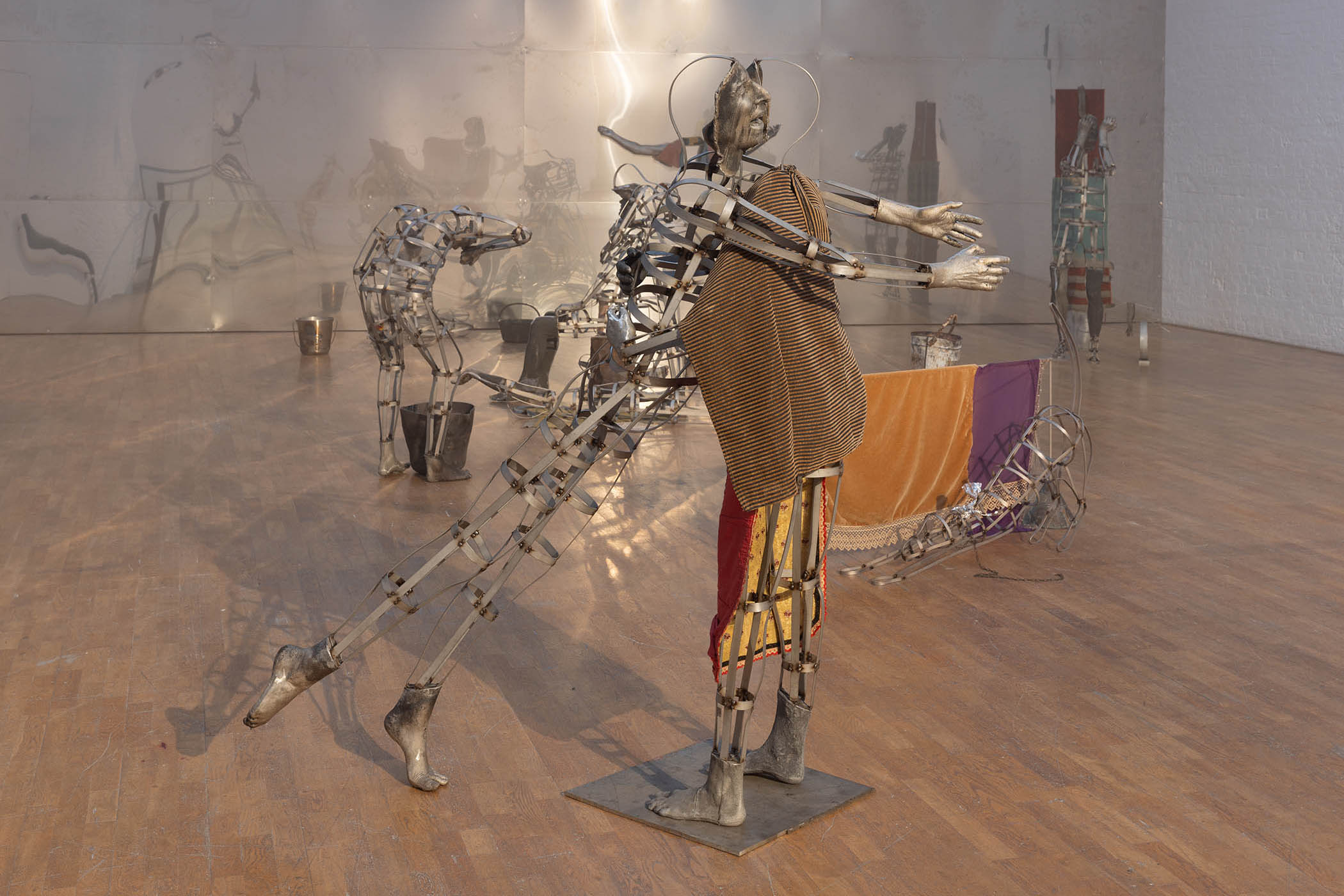
And what a show it is: insistently figurative, unapologetically theatrical, expressive in its every scene and gesture. All of Freije’s sculptures – men and women, dogs and birds, sofas, pans and buckets – are the size of life and poised in some deep human drama. The people have solid metal hands and feet, cast from the faces of relatives, friends and the artist herself, always with their eyes tight shut like a Messerschmidt head. Their bodies are entirely skeletal, welded out of metal strips. A torso can look like a medical corset; arms and legs like one of Leonardo’s anatomical drawings translated into stiff ribbons of steel.
It is the kind of approach favoured by Antony Gormley: reconstruct the mortal being as a unit of aluminium, iron or even lead, so that it becomes another kind of body form altogether. Except that Freije is after something closer to drawing – and all the eloquent nuances of an outstretched armed, bowed head or clenched foot – than Gormley and his dumb sentries all over the world. Her figures are actors on a gallery stage.
The set is misty, the lighting atmospheric, shifting as the day passes so that the figures throw ever-changing shadows on the floor. One is alone, bent low over a heavy bucket, nearly broken in body or perhaps soul. Two are embracing, or is it that one is catching the other, flying into her arms like a Chagallian lover? Three are grouped in some enigmatic narrative of sorrow and comfort, a female figure bending over what appears to be a grieving male and his despairing companion.
A couple draped in old fabric are stumbling ahead, feeling their way, like the blind leading the blind. Or is it that the man is helping a poor bewildered woman along? With their eyes closed, meaning is occluded. You must study the tilt of a head or the splay of a foot to guess at what haunts them.
Freije’s art has its parallel in our daily existence, glancing at our fellow beings on the street, on the bus, in a shop or passing crowd, catching a trace of another person’s life that lingers in the mind and eye. It calls upon our curiosity and concern. A figure on the ground, flat out, needs to be helped up. A male figure seems to be doing this, or is he in some way culpable? Beside them, a curtain strung between two metal poles has discs and misshapen triangles cut from its cloth. Look at them again, through these holes, and they become leads in a stage play. Circle them once more and it seems as if they are ballet dancers.
A scene can be overloaded – too many people, for instance, complicating a scenario – or the individual expressions overdetermined. A wince of pain, internal or external, is too explicit for the imagination. Veins of silver in the metal, along with calliper legs and cast-metal faces, can mount up into kitsch.
But Freije has a true gift for three-dimensional form, for the figure that changes character as the viewer circles. A figure lying curled on the floor, foetal on an old rag, turned out to be entwined with something quite other than poverty, homelessness or inebriation. Up close, over the crook of an arm, a dog becomes suddenly visible below, like a valley on the other side of the hill. This is a sculpture about love.
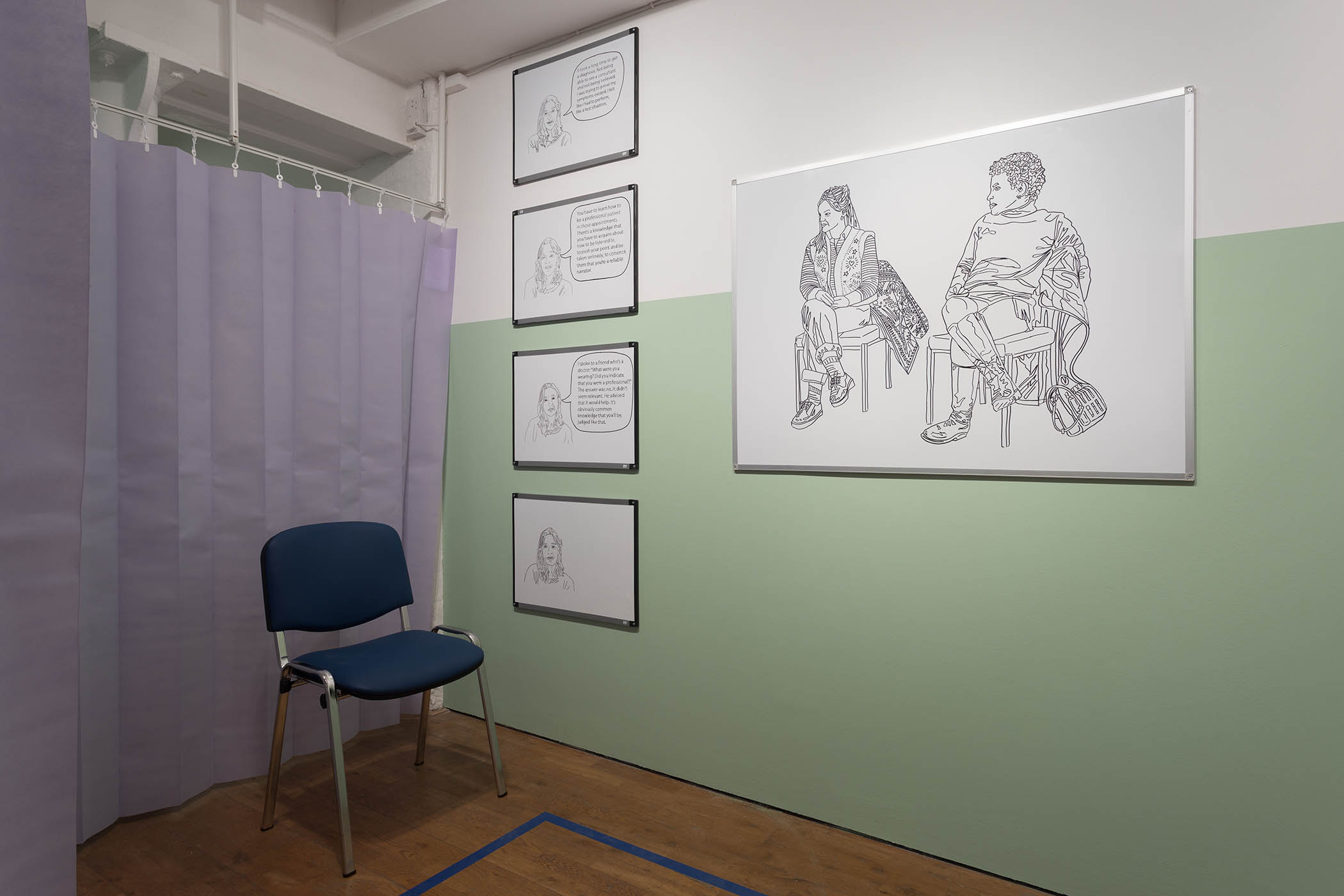
‘This is no better, indeed considerably less useful, than journalism’: Olivia Plender at Modern Art Oxford.
Freije’s art makes its appeal to the heart using the most old-world methods – drawing, casting, welding, sculpture – that it seems the very opposite of Turner prize art. There is not a whisper of issues, theories, politics, concepts. It makes no argument, is without agenda. And as if to sharpen the point, Modern Art Oxford is showing Olivia Plender’s investigations into women’s health alongside.
Hospital screens are drawn around whiteboard drawings of women who were ignored by male doctors. Endometriosis, vaginismus, epilepsy drugs that endanger the unborn baby, disabled women who were ignored, non-binary patients who couldn’t get a proper hearing: their testimony is carefully transcribed below each image. This is no better, indeed considerably less useful, than journalism.
Newsletters
Choose the newsletters you want to receive
View more
For information about how The Observer protects your data, read our Privacy Policy
Watercolours show the many abortifacients to which women have resorted down the centuries – fennel, St John’s wort – while books borrowed from the Bodleian tell of medieval women’s complaints; the very complaints that are unheeded even now.
If you do not already know all this, have never met a single person who has spoken of misogyny in the NHS, or read the papers, then hasten to Oxford for some consciousness-raising. Plender has a strong exhibit of words plus images – scrubber, skank, slut, below a cheery textbook image of a woman sweeping, bird, chick, hen beneath a fowl – but otherwise this show lives, and dies, as rote data.
Kira Freije: Unspeak the Chorus is at Modern Art Oxford until 16 August
Olivia Plender: Little Fennel’s Complaint is at Modern Art Oxford until 16 August