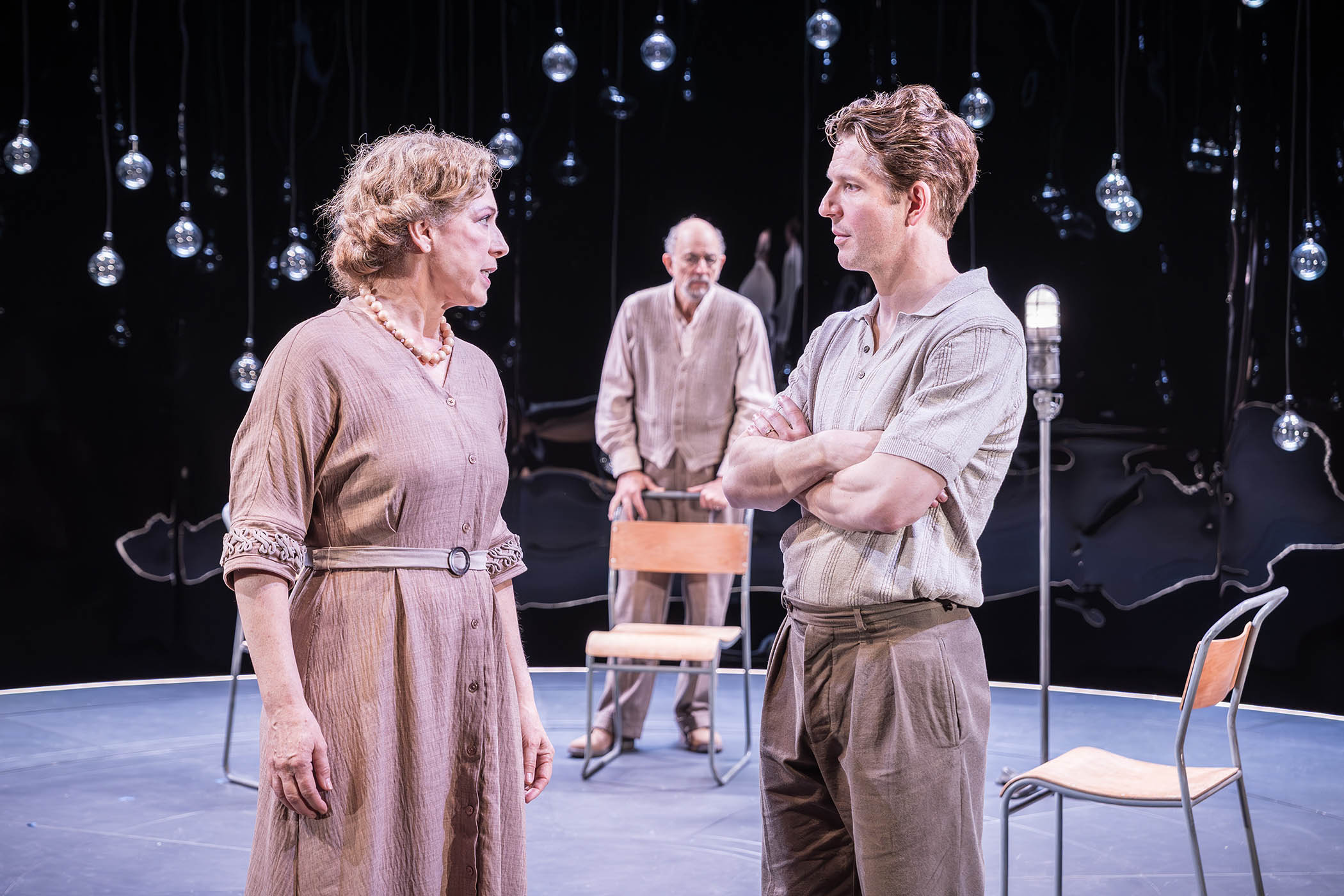
We headed off to London’s Swiss Cottage to see the last night of Michael Frayn’s Copenhagen at the Hampstead theatre. Earlier this year, 92-year-old Frayn – formerly of this parish, as we are always proud to note – revealed that he was hanging up his pen at last. “It’s a very full-time occupation being old,” he said. The play examines the mysterious meeting in 1941 between physicists Niels Bohr and Werner Heisenberg, formerly teacher and pupil, and the latter an almost surrogate son. The world is at war; the atomic bomb and nuclear power are in the offing. Bohr would later work at Los Alamos; Heisenberg served the Nazi regime. In Michael Longhurst’s production, Heisenberg (Damien Molony), Bohr (Richard Schiff) and Bohr’s wife Margrethe circled around Joanna Scotcher’s effective, atom-like set debating what we can know and what we can’t: you’ll remember Heisenberg’s famous uncertainty principle, a cornerstone of quantum mechanics. I first saw Copenhagen in its original 1998 London production – remember back in the 1990s, when we thought history had all been wound up and we didn’t have to worry about anything any more? Turns out we were wrong, and Frayn’s play seemed positively radioactive with relevance.
I was delighted to chair an event in celebration of the Women’s Prize at The Observer last week. We had two judges, Cariad Lloyd from the fiction prize and Thangam Debbonaire, chair of the non-fiction prize; we had three authors, broadcaster Lyse Doucet, shortlisted for the nonfiction prize for The Finest Hotel in Kabul; Jane Rogoyska, shortlisted for Hotel Exile; and from team fiction Rozie Kelly, for her debut novel Kingfisher. You could say it was a night of poachers and gamekeepers, but for the fact it was all so supportive and amenable. Comedian and actor Cariad, whose podcast Weirdos Book Club is a big hit, spoke of her shock, and frankly not a little initial dismay, at receiving huge boxes of books, which she hid under her bed until she could face them. A joke, but as with all the best jokes revealing something serious underneath: a sense of responsibility, given the time and effort writers put into their work. Thangam championed the nonfiction prize, first awarded in 2024: go into any bookshop, she said, and count the balance between male and female authors of nonfiction and you’ll understand that a balance needs redressing. We had a question from the audience as to whether or how much AI would change writing and publishing. For my money, that was answered simply by listening to our three authors delineate the the curiosity, hard work and passion they put into the strange, compelling – and often years-long – process of writing a book. As to who the winners of each prize will be: mark your diary for 11 June. You’ve got 12 terrific books to get through before then.
A confession: I’m one of those annoying “inbox-zero” people. You do you, folks, but a zillion unread messages is not my style. Gradually, as I delete what I don’t want (most of it) I’ve been getting rid of additional junk: I axe a few more messages than actually arrive each day. This means a kind of travelling back in time — and now, thanks to my steady-eddy erasing, I’ve hit the messages I got in 2020 at the height of the Covid pandemic. For instance: a promo email from the editor of the New Statesman updates me on the race for the Covid vaccine. Jason Cowley is no longer editor of that fine magazine, and we’ve all had our jabs. But my odd little morning ritual dropped me into a brief memory-hole of horror, the days of wiping down my light switches and standing in line, with a mask on, to enter Tesco. We like to pretend, I think, that none of it happened. But it did. It did.
Photograph by Marc Brenner
Newsletters
Choose the newsletters you want to receive
View more
For information about how The Observer protects your data, read our Privacy Policy