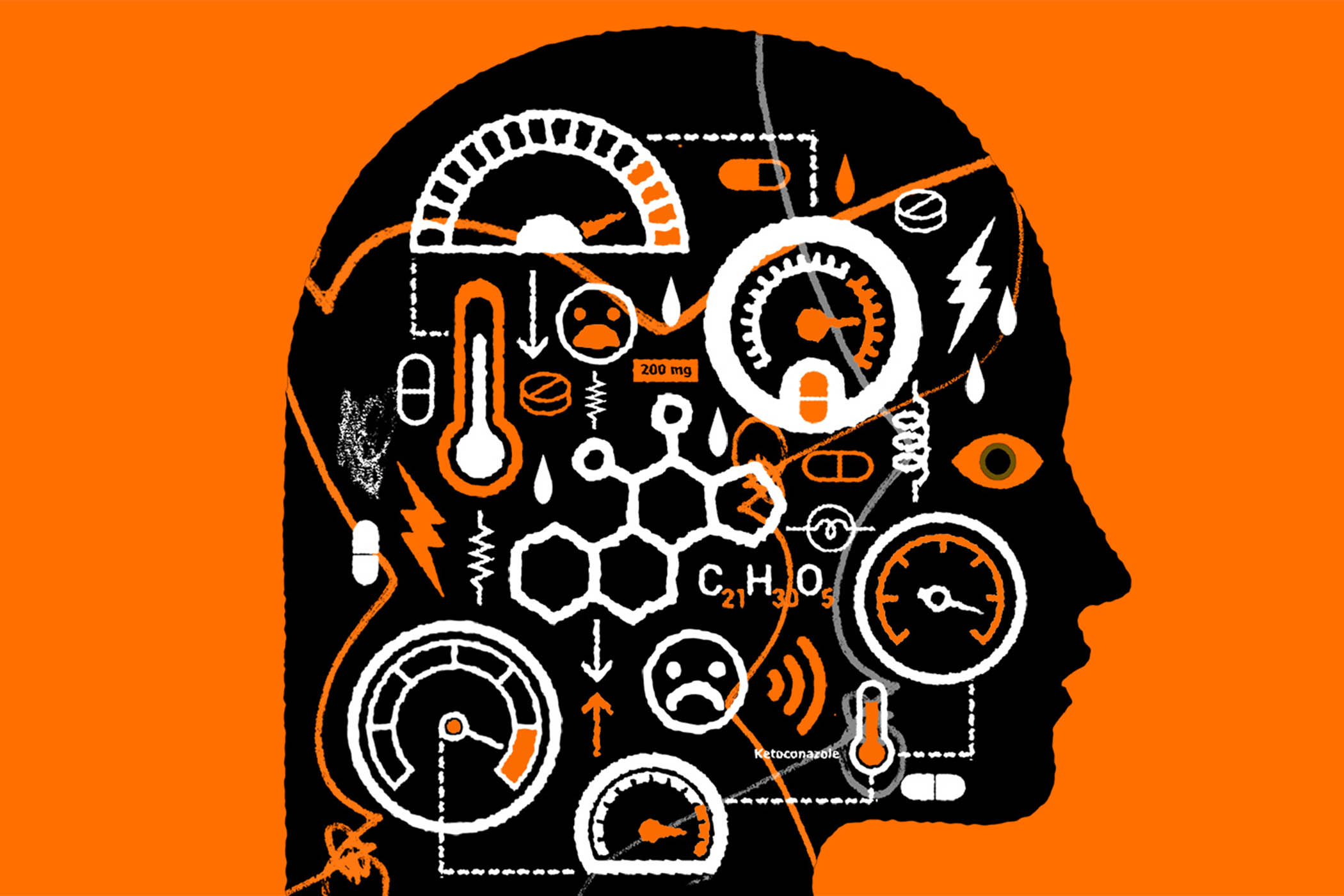


Illustration by David Foldvari
Is your cortisol spiking right now? Mine is. I’m writing this after escaping being stuck underground on the tube at King’s Cross because someone got hit by a train at rush hour. The man next to me kept hissing swear words under his breath and a woman was sobbing on the platform. My cortisol is through the roof.
But yours might be too, even if you are reading this while tucked up in bed with a cup of tea. Actually, if you believe the influencers, a cortisol spike can happen anywhere, as a reaction to any stimuli, and look like anything. Some of the tell-tale signs include: weight gain, bad posture with a humped back, brain fog, reduced libido, irritability, anxiety, depression, blotchy skin, stretch marks, insomnia, joint pain, headaches, signs of ageing, caffeine addiction. And anything could be spiking your cortisol to unhealthy levels, from commuting to work every morning to having a shitty boyfriend.
At this point, I should probably explain what cortisol actually is, for those who only vaguely remember it from GCSE biology. Cortisol is an essential stress hormone. Our bodies use it to regulate everything from metabolism and circadian rhythm to blood pressure and fighting infection. Cortisol is produced by the adrenal glands, tiny triangular organs that sit on top of your kidneys. And you probably haven’t given it much thought recently. I didn’t either, until social media and targeted advertising started telling me it was the source of all my holistic woes.
Yes, cortisol is a stress hormone but we need stress hormones to get us out of bed in the morning
Yes, cortisol is a stress hormone but we need stress hormones to get us out of bed in the morning
If you’re reading this and thinking: “I am an adult living in 2026. I have a stressful job and sometimes I forget to text back. Donald Trump keeps bombing Iran. I wake up at 2am because I can’t remember if I turned the straighteners off. I still can’t perfect the tittibhasana firefly pose. Of course I am stressed.” Then you’re not alone. Your cortisol is probably sky high, but luckily for you, the global wellness industry – a sector expected to be worth $9.8tn by 2029 – has the answer. The answer, obviously, comes in the form of buying things.
You can adopt a “low cortisol diet” or drink special cortisol-busting cocktails (which are basically made up of orange juice, coconut water and sodium). You can check yourself into a Vogue-certified “cortisol detox” retreat at a five-star Ritz-Carlton hotel in Los Cabos, which hosts a programme including “one-on-one coaching with a mindset guide”, yoga classes, “functional fascia work” (your guess is as good as mine), spa treatments and “biofeedback tools to explore your body’s stress responses” (again, no idea). There is a whole section of the self-help book industry dedicated solely to cortisol lowering, from Marilyn Glenville’s Mastering Cortisol: Stop Your Body’s Stress Hormone From Making You Fat Around the Middle to Hannah Alderson’s Everything I Know About Cortisol (intended as a sequel to Dolly Alderton’s Everything I Know About Love, presumably).
I am, in case it wasn’t already obvious, a bit suspicious of cortisol mania. I am sceptical firstly because the wellness industry always needs to tell people – mostly young women – that there is something inherently wrong with them that only money can fix. Replace cortisol with protein intake, or fibre intake, for instance, and you get the same outcome: a wave of products nobody needs, targeted at people who believe they will make them feel better. I’m also sceptical about cortisol mania because it seems to have hardly any medical basis at all. Yes, cortisol is a stress hormone, but we need stress hormones to get us out of bed in the morning. While genuinely having excess cortisol in your body can lead to serious medical complications and illnesses, such as Cushing’s syndrome, the current cortisol mania doesn’t actually care about these things. Scratch the surface and it becomes less about health and more about youth and thinness.
Newsletters
Choose the newsletters you want to receive
View more
For information about how The Observer protects your data, read our Privacy Policy
The supposed premature ageing effects of raised cortisol are rarely spoken about in the context of what it’s doing to our livers or our hearts, but instead focus completely on the external. If you don’t want grey hair and static lines in your forehead, you’d better figure out how to lower your cortisol, ladies. And the exercises that social media keeps telling you are “raising your cortisol” are just using that as a euphemism for “making you look puffy”, which is just a euphemism for “holding on to weight”, which is just a euphemism for “fat”. The same wellness creators and life coaches who tell you this will in the next breath redirect you towards more “cortisol lowering” exercises which could, as luck would have it, also change your body type to something more “feminine”. Out with HIIT-style workouts, which might make you muscular and bulky, and in with expensive pilates classes, which might help you become toned and tiny.
Cortisol mania is just the most recent manifestation of society’s obsession with women’s hormones – one that feels about as fascist as the craze for getting “pilates arms” at expensive fitness studios. It comes from the same school of thought that tells us that women need to do everything differently to men because we’re biologically wired differently, whether that means we’re acting like feral cats thanks to our ovulation cycles or emitting powerful pheromones that lure unsuspecting males towards us. The idea that women are dictated by our inability to control our own hormones feels reductive and archaic, but with things such as the cortisol trend, those conservative ideas can be repackaged as pseudo science or wellness, and sold back to us.
All of this, by the way, ignores the fact that cortisol spikes aren’t even actually that bad for you in the first place. Even Hannah Alderson, of Everything I Know About Cortisol fame, admits as much. In an interview last year, she spoke about the benefits of cortisol and how it plays a “vital role” in regulating our blood sugar and keeping our immune responses in check. Wellness girlies might evangelise about eliminating your “cortisol face” or your “cortisol belly”, but realistically our ability to manage rising and falling stress is an essential part of managing life itself. And if you genuinely can’t manage either, please get yourself an endocrinologist, not a TikTok influencer.