

Alex Cooper has always insisted she can talk to anyone. “I can literally talk to an acorn outside,” she once said, explaining the instinct that would turn her scrappy, sexually explicit chat show into one of the most powerful platforms in modern media. That instinct made Call Her Daddy a juggernaut, once second only to Joe Rogan in the global podcast charts. Cooper, now 31, became a new kind of media figure, a confidante for celebrities and the ringleader of a vast, digitally native sisterhood.
But the same force that built her empire is now under scrutiny. This week, former employees of Cooper’s production company, Unwell, accused her and her husband, Matt Kaplan, of presiding over a “hostile work environment”, describing a workplace where staff were yelled at, production staff allegedly threatened to walk regularly, senior figures cycled through rapidly and crying in the office was not unheard of.
Unwell, Alex Cooper and Matt Kaplan were contacted for comment.
The allegations emerged alongside a simmering public feud between Cooper and one of her former collaborators, Alix Earle, a fellow influencer. Cooper produced Earle’s podcast Hot Mess until it was abruptly dropped last year without explanation. Now Earle has been telling the Wall Street Journal it was a “hot mess” behind the scenes too. “Say what you got to say about me,” Cooper fired off in a TikTok viewed by millions. “There’s no NDAs here!” Earle replied, with equal theatricality: “On it!”
For her fans – who call themselves the “Daddy Gang” – Cooper is a cultural anchor, someone who has made talking about blowjobs and ambition feel equally permissible. For critics, she embodies a troubling shift in the attention economy, where journalism is blurring into entertainment-driven PR, producing interviews that are certainly intimate, but frictionless and uncritical.
When Kamala Harris appeared on the show during her 2024 presidential campaign it prompted unease in the political world as well as among Cooper’s listeners. Why, many wondered, was a major political figure choosing a platform better known for discussing sex positions than policy? But the choice demonstrated Cooper’s reach: Call Her Daddy is the most listened to podcast for women. “I couldn’t see a world in which one of the main conversations in this election is women, and I’m not a part of it,” Cooper said to defend herself at the time.
According to analytics firm Podscribe, Call Her Daddy attracts 13.3m downloads a month, dwarfing other interview shows, most of which struggle to reach six figures. The imbalance underscores the central reality: whatever the internal challenges, Cooper remains the engine of her own enterprise.
Her ascent has been swift. Born in Pennsylvania, Cooper grew up in a middle-class family with a father who was a television producer for hockey games, which she described as “the most magical thing in the world”, in her 2025 documentary Call Her Alex. Badly bullied at school, she fell in love with playing soccer, where she was immersed in a world of nice girls who finally wanted to have sleepovers. By the time she went to Boston University she was one of the best college soccer players in the country, competing in nationwide tournaments on a full-tuition athletic scholarship. But at university, her documentary claimed, Cooper was subjected to a years-long campaign of sexual harassment by her coach, Nancy Feldman. She told the school, but says it protected Feldman, and Cooper ultimately quit the team. It devastated her and fuelled her ambition. “I never wanted to be silent again,” Cooper said, “so I never was.”
She first gained attention through Barstool Sports, the frat-adjacent media company whose founder, Dave Portnoy, built a provocative media empire which used Call Her Daddy as its closest thing to a feminist credential. Early Call Her Daddy episodes were a double-act, featuring Cooper and her good friend Sofia Franklyn. They were a charismatic duo who leaned heavily into explicit sex advice and shock-value confession. But in 2020, after a fallout over their contracts, Cooper and Franklyn split.
Alone, Cooper’s audience grew. In 2021 she secured a lucrative exclusivity deal with Spotify reportedly worth $60m, and another in 2024 worth $125m with SiriusXM. Finance expert Edwine Alphonse says such figures are unprecedented for women in the industry. Cooper’s interview style changed from frank discussions about her own life to more polished conversations about her guests’ lives. She dressed her guests in her branded joggers and offered them a glass of wine to sip on. PRs were allowed in the building, but not, she said, in the room itself. Her setup worked: celebrities knew they were in safe, uncritical hands and in return they would open up. Michelle Obama talked about her marital problems with Barack, Jane Fonda about her bulimia, Kim Kardashian dished on Kanye, Gwyneth Paltrow compared her ex-boyfriends Brad Pitt and Ben Affleck.
Newsletters
Choose the newsletters you want to receive
View more
For information about how The Observer protects your data, read our Privacy Policy
Kate Lindsay, who hosts the culture podcast ICYMI, thinks of it as a kind of “everybody wins” scenario. “They know they’re not talking to a real journalist, who might push back on them,” she said, “so they’ll offer up something that’s actually different.” Lucy Hunt, the head of podcasts at Shameless Media, agrees. “There’s a reason the biggest names in the world invariably choose her for their interviews,” she said. “They trust her.”
It is that trust that breeds weekly headline-grabbing confessions. The journalist EJ Dickson, who profiled Cooper for Rolling Stone, was wowed by her ability to get her guests to open up. “If Alex Cooper had a representative for the Federal Aviation Agency on Call Her Daddy,” she quipped, “her audience would know the exact coordinates of Malaysia Airlines Flight 370 within the first five minutes.”
Eliciting other people’s confessions is one thing, and confessing yourself is another. Lindsay said Cooper’s current feud may be a “clever PR stunt”, but accusations of a toxic workplace will be harder to shake. Cooper now faces the rarer test of managing her own story when she is no longer the one asking the questions.
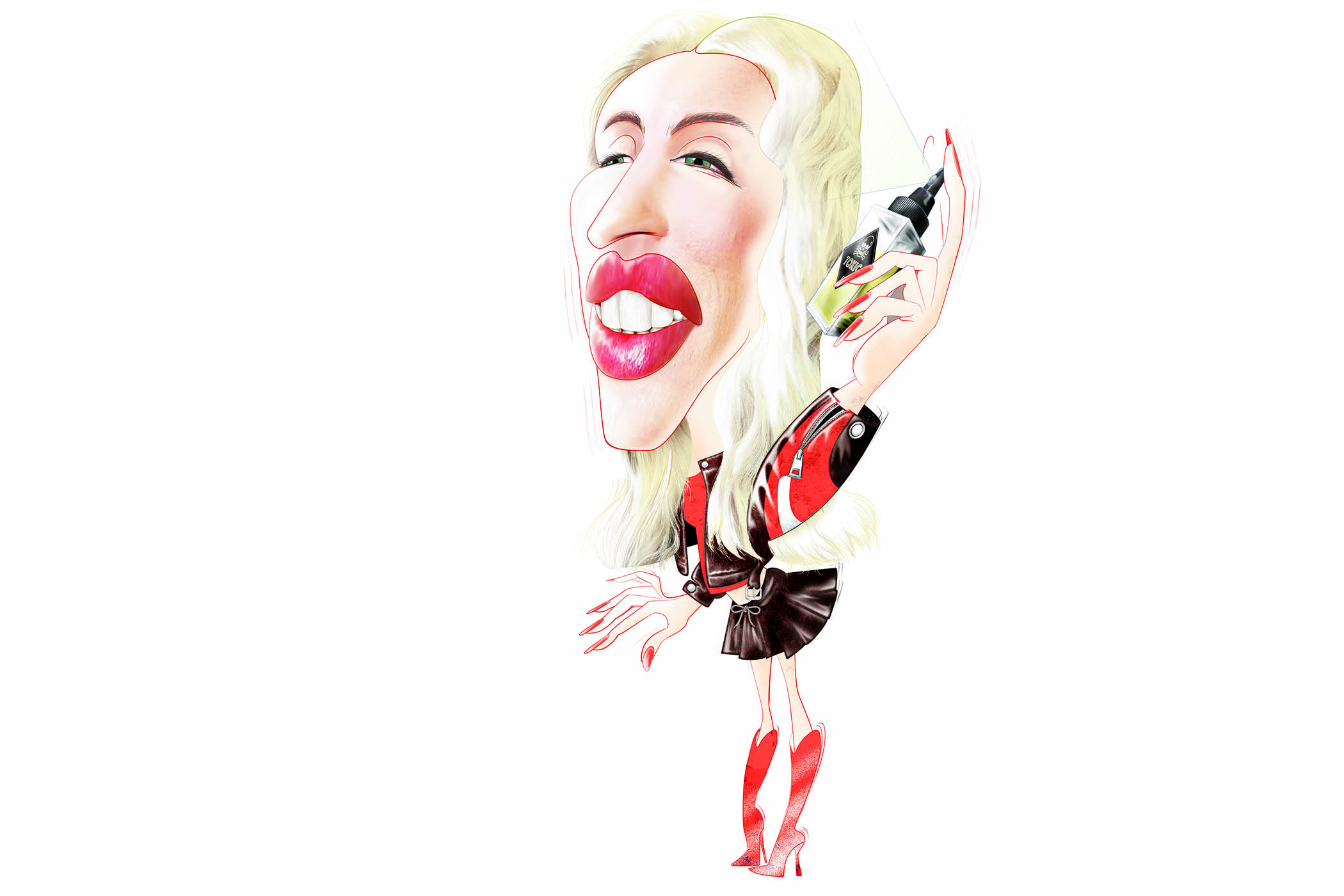
Illustration by Andy Bunday