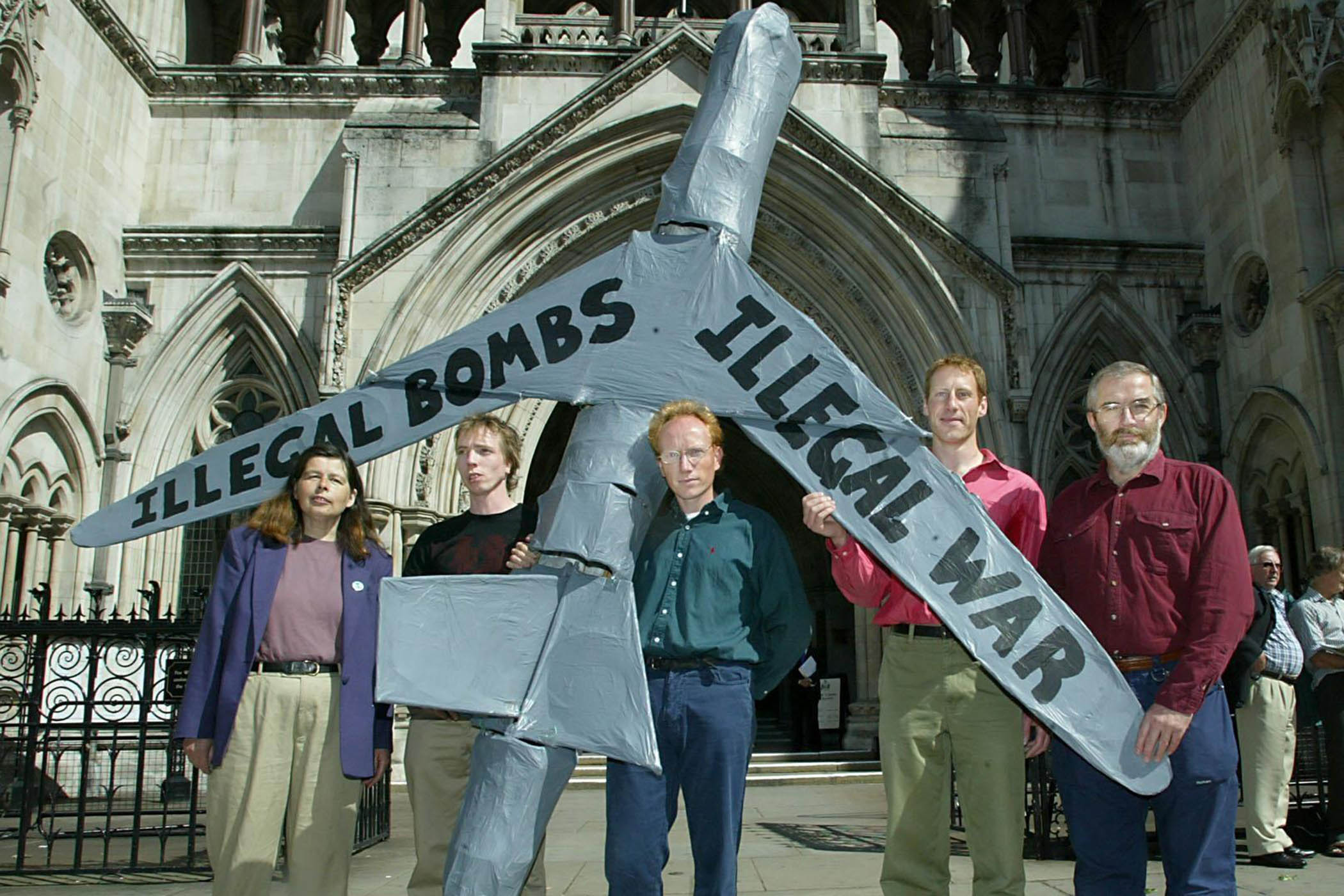



On the night of 13 March 2003, Paul Milling and Margaret Jones broke into RAF Fairford in Gloucestershire, piercing the fence and, with hammers and bolt cutters, disabled fuel tankers and trailers used for carrying bombs to the B-52s stationed there. Five days later, two other protesters, Phil Pritchard and Toby Olditch, also forced their way into the base but were arrested at the perimeter fence. That same night, a fifth protestor, Josh Richards, breached the fence, intending to set fire to the wheels of the B-52s. He, too, was arrested. Two days later, the B-52s took off to begin the “shock and awe” bombing of Baghdad, the start of the Iraq war.
The protestors – who became known as the “Fairford five” – were charged with criminal damage. All pleaded not guilty, arguing that their actions were justified because they were aimed at preventing a greater evil – the war in Iraq. It took three years for the cases to come to court. Milling and Jones were found guilty, the former being given a conditional discharge, the latter a curfew order. Pritchard and Olditch were acquitted by another jury. Two juries failed to reach a verdict in the case of Richards and he was cleared. No one thought any of the five were terrorists, least of all one of Richards’ barristers – a certain Keir Starmer.
Two decades on, Starmer now leads a government attempting desperately to maintain that the contemporary incarnations of the Fairford five are terrorists, and that their organisation, Palestine Action (PA), should be proscribed as such.
Earlier this month, a jury acquitted six members of PA of aggravated burglary, for having, in August 2024, broken into the premises in Bristol of Elbit Systems, which the defendants accused of manufacturing and supplying weapons to the Israeli military. The six were also charged with criminal damage, and three of them with violent disorder. The jury acquitted three but could reach no verdict on the other counts. One defendant, Samuel Corner, was charged with causing grievous bodily harm with intent by striking a police officer with a sledgehammer; again the jury failed to reach a verdict.
A year after the Elbit break-in, and three days after PA protestors had broken into RAF Brize Norton and sprayed red paint on two aircraft, the then home secretary, Yvette Cooper, proscribed Palestine Action as a terrorist group. On Friday, the high court ruled that proscription to be unlawful.
The court denied that PA was “an ordinary protest group” standing in the tradition of civil disobedience because its “pursuit of criminal damage is designed to intimidate the persons and businesses targeted”, and entailed “the real risk of injury” to members of the public (though the same could be said of many campaigns and movements whose actions we now accept as legitimate, from the Chartists to the Suffragettes to the anti-apartheid movement, and, indeed, to the Fairford five). The court declared, too, that “a very small number” of PA’s actions could be defined as “terrorist” under Britain’s terror laws.
Terrorism legislation is increasingly wielded to manage political dissent
Terrorism legislation is increasingly wielded to manage political dissent
Nevertheless, it judged the proscription of the group to be unlawful because the home secretary had breached her own policy as to when she would exercise discretion on the matter, because PA’s activities had “not yet reached the level, scale and persistence that would justify… proscription” and because proscription amounted to an “unjustified interference” with the freedom of speech and assembly of those who were not members of PA.
The judgment raises many wider questions, about terror laws and civil liberties.
Over the past 25 years, the meaning of “terrorism” has vastly expanded. As Mr Justice Chamberlain noted in a previous hearing last July, “it may fairly be observed that the statutory concept [of terrorism] is wider than the colloquial meaning of the term”.
Particularly troubling is the way that the 2000 terrorism act was, in 2019, broadened in scope to criminalise expressions of support for a proscribed organisation. This allowed for the arrest of more than 2,700 people who have protested against PA’s proscription, and which, the high court observed, was a key reason the government chose to proscribe the organisation. It illustrates how terrorism legislation is increasingly wielded to manage political dissent, the most ominous aspect of the drive to curtail free speech and civil liberties.
Newsletters
Choose the newsletters you want to receive
View more
For information about how The Observer protects your data, read our Privacy Policy
Some have questioned whether judges should be able to overturn a parliamentary vote on proscription. It’s an important issue, though in narrow terms, the judgment challenged not the vote but the home secretary’s order. It is necessary to defend parliamentary sovereignty. It is also necessary for politicians to take our liberties seriously.
Last November, a report from the Independent Commission on UK Counter-Terrorism Law, Policy and Practice called for a narrower definition of terrorism, observing that “a definition that relies heavily on executive discretion risks… the treatment of legitimate protest as terrorism” and that “the breadth of the executive power to order proscription… raises significant concerns about… the protection of legitimate political and humanitarian activity”. With members including politicians such as Dominic Grieve and Sayeeda Warsi, the commission is hardly a radical body. Its concerns highlight how deep-set has become the culture of illiberalism in this country.
The inclination of many on the right, who normally demand fewer restrictions on speech and liberties, to support PA’s proscription shows how thin is their attachment to freedom. At the same time, the case reveals how dangerous is the willingness of so many on the left to accept increasing curbs on speech and other liberties. Whether or not we like their views or methods, defending the rights of those who “cause trouble” is essential to defending all our freedoms.
Photograph by PA/Alamy