

Illustration byDavid Foldvari
For a reasonable amount of time in my early 20s, I thought it aspirational to be a girlboss. This is difficult for me to admit, because girlbosses are an embarrassing invention. Girlbossery is also the kind of thing that younger gen Z feminists will burn you at the stake for, because girlbosses are now outre. I can’t say, even as I start to feel the flames licking my face, that they’re unjustified in doing so.
Being a girlboss – the aspirational millennial career woman – was the ultimate end goal of the particularly millennial feminism in which I came of age. I bought into it wholeheartedly – and that is the right phrase: a lot of this era was about consumption. I bought into it all, from freeing the nipple to buying crop tops in millennial pink and thinking that Maria Grazia Chiuri was doing a good job at Dior. I stopped short of being a fan of Hillary Clinton, or Instagram graphics reading “we are the daughters of the witches you couldn’t burn”. But nonetheless I was cringe.
This wasn’t group psychosis. It was fourth wave feminism; an era deeply tied to the internet which came into prominence around 2012. Now, more than a decade on, it’s being eulogised in articles in the Atlantic and Slate, its legacy fiercely debated. Was it just social media activism, the early days of woke, now out of date and middle-aged?
There are many good things that millennial, fourth wave feminism introduced to the world, even though they might seem parochial or passe in retrospect. It’s the feminist era that got rid of Page 3, that coalesced under the banners of #MeToo and the 2018 women’s march. As a kind of all-encompassing cultural moment, it emphasised – or at least tried to emphasise – the importance of intersectionality, in terms of race, trans rights, gender. The Everyday Sexism Project was founded in 2012; the first SlutWalk took place in 2011.
Newsletters
Choose the newsletters you want to receive
View more
For information about how The Observer protects your data, read our Privacy Policy
Still, well meaning as it may have been, it’s impossible to ignore the fact that under millennial feminism, not much changed for women. Or not much changed for anyone except for those privileged white women who wanted to make millions as a SheEO and have their mustachioed boyfriends wear T-shirts reading: “This Is What A Feminist Looks Like.” Intersectionality was subsumed into celebrity moments and concentrated almost entirely in the US and UK, with the rest of us reduced to lazy online “slacktivism” and slogan T-shirts. The demand of the feminist punk band Le Tigre’s track Get Off the Internet was ignored.
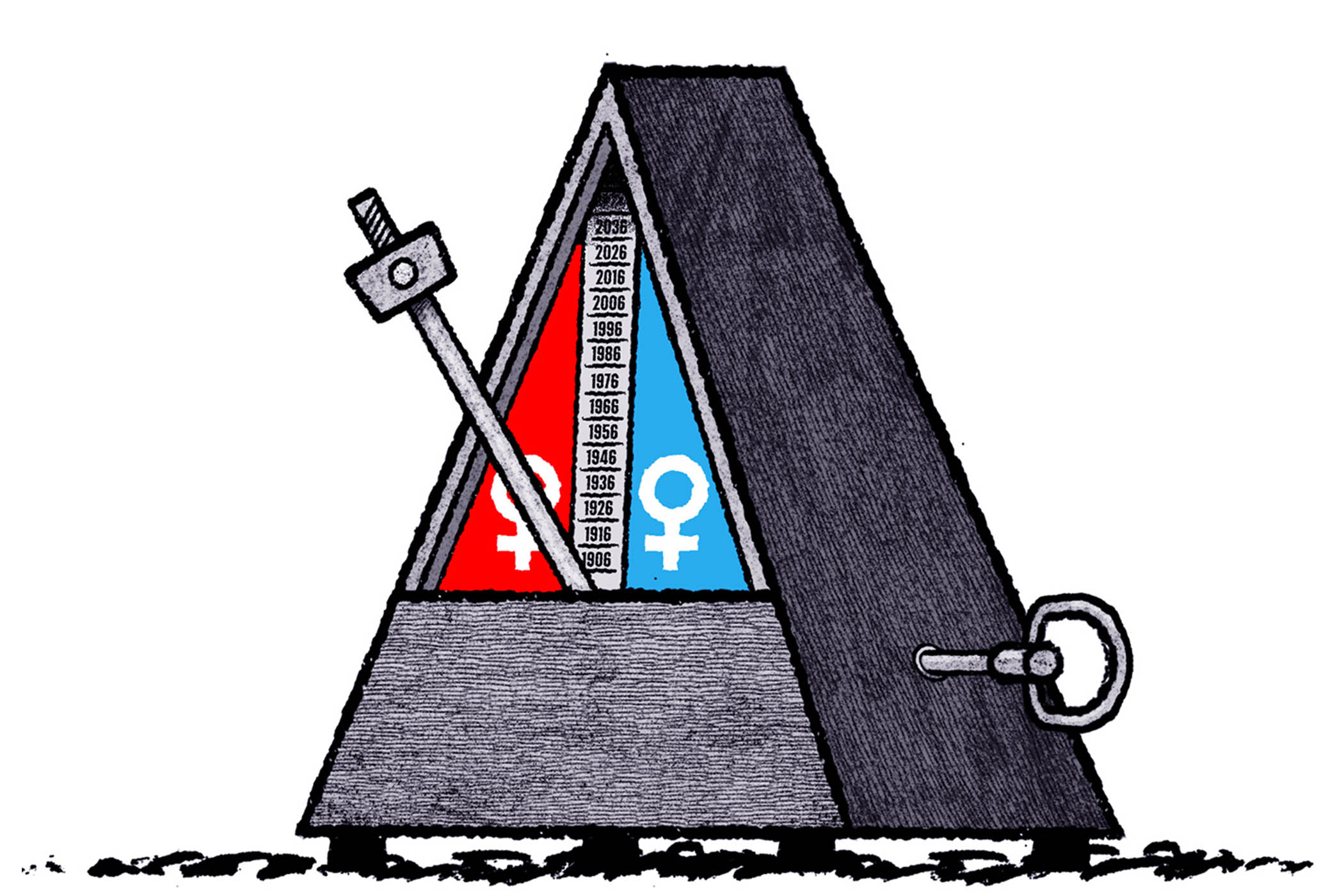
Le Tigre were probably right. But the gen Z descendants of millennial feminists did not get off the internet. It was far too late for that. Instead they created their own version of a feminised online world which inverted much of their predecessors’ ideology. With similarly disastrous results.
If millennial feminism was defined by individualistic liberalism, zoomer womanhood is defined by an almost puritanical rejection of casual sex, while a healthy distaste of capitalism has mutated into an embrace of traditional gender roles. It seems the younger generation would rather marry rich and stay at home. Why kill yourself at a job to be a girlboss when you can get the princess treatment instead? Why pretend to split labour equally when doing so is a fallacy?
Obviously I am generalising here. In actuality there is a huge shift in how gen Z views feminism since the years in which millennial women (and men) tried to make it fashionable to a mass-market audience. Although digital activism still exists, a recent survey suggests that only 53% of gen Z women and 32% of gen Z men identify as feminists – the largest gender gap of any generation when it comes to views on gender equality.
Why kill yourself at a job to be a girlboss when you can get the princess treatment instead?
Why kill yourself at a job to be a girlboss when you can get the princess treatment instead?
And whereas millennial men who didn’t identify as feminists were generally constitutionally apathetic, this new generation seems more reactionary. Research released last month by King’s College London found nearly a third of gen Z men believed a woman should always obey her husband; a fifth said she should never initiate sex; and 33% thought she should always let her husband have the final word on big decisions. It’s fairly obvious to anyone who has spent time on X or Reddit that the buzzwords of the 2010’s “Woke 1.0” era have given way to vastly more socially conservative ideas on gender.
This all feels depressing. It also feels somewhat inevitable. All generations are doomed to reject the ideology of the one that came before. The girlboss was a fantasy and, despite her feminist exterior, she was a conservative one. An ideal of femininity built around money and power. Yes, it’s a bit neo-lib, a bit passe. But what is the socially conservative figure of the trad wife if not just another conservative ideal? A wolf in sheep’s clothing. A SheEO in a milkmaid dress.
Although I might cringe at today’s “girl internet”, which is less “Yes She Can” and more “don’t date broke men”, I also want to be able to decode it. Millennials could trick themselves into believing the fantasy of the girlboss meritocracy. But in today’s economy, nobody is girlbossing their way to the top. Graduate salaries have flatlined and even becoming a sugar baby is off the cards (a recent article in the tech magazine Wired argued that Trump’s economy has killed off the sugar baby economy in the US, where wealthy men are reverting from paying their dates thousands of dollars to doling out free tax advice to them instead).
Stacked up against a looming recession, the insidious influence of the manosphere and a natural distaste for acting the way your older sisters did, the girlboss never stood a chance. Inevitably she’s come to seem as archaic and irrelevant as Mary Whitehouse, or Meghan Trainor singing All About That Bass, or that Barbie that dispensed diet advice.
Maybe one day gen Alpha – gen Z’s iPad-addicted successors – will dig the girlboss out, dust her off and make her cool again. But only if what comes after her is bad enough to warrant it.