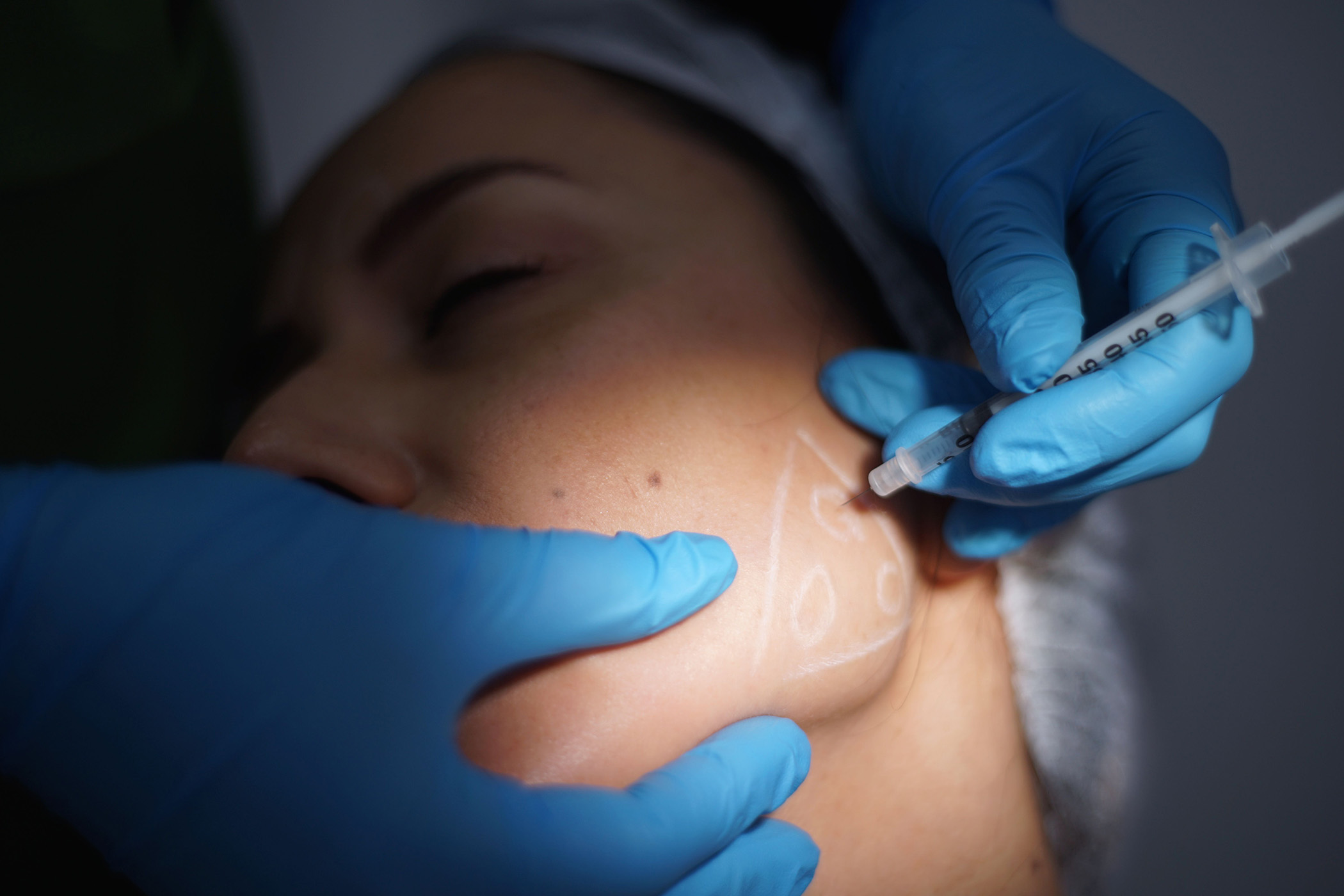
The reasons for the resurgence of face lifts, particularly the popularity of “early intervention” surgeries in 25 to 40-year-olds, read like a road map of our feverish present. One reason is the rise of weight-loss drugs, their users clipping away unwanted sagging skin. Another is a result of “cosmetic transparency”, with celebrities in particular destigmatising surgery by discussing the procedures they’ve had, alongside developments in the technology that claim ever more “natural” results. Running through all this too, is a language that minimises the scale of interventions and lubricates the path to body modification, with the result that one might expect a “tweakment” that’s intended to “refresh,” “restore” or “harmonise” might feel more like a relaxing spa break than a trip to have your eyelids chopped off. It’s into this raw and softened world that the PFL has landed, not with a bang, but a simper.
PFLs, explained the Business of Fashion, are “pre-facelift procedures”, such as injectable biostimulators and buccal-fat removal, which are “filling the gap” between baby Botox jabs and deep plane surgeries. “Clinics in New York and Los Angeles have developed sophisticated procedures to ‘train’ skin for a more-optimised facelift,” they report. Doing a facelift on skin that hasn’t been pre-treated and strengthened, continued the aesthetician Lauren Juliana Goodman, would be like running a marathon without training for it (by which she means spending from $500 for a basic Botox treatment to $7,200 for an arse to cheek fat transfer). “You can do it, sure, but the results won’t be the absolute best.” A whole sub-industry is forming within the aesthetics world centred around the idea, the big bet, that for many, face lifts are now an inevitability. A not if, but when.
‘I read this news, of a new destination on the Botox-to-face-lift pipeline, with a familiar lethargy as if in a half-light, or roofied’
‘I read this news, of a new destination on the Botox-to-face-lift pipeline, with a familiar lethargy as if in a half-light, or roofied’
I read this news, of a new destination on the Botox-to-face-lift pipeline, with a familiar lethargy as if in a half-light, or roofied. It was published the same day as New York Magazine ran a first person piece called “My Post-Face Lift Panic” in which a writer interrogated (then delighted in) her decision to get cosmetic surgery. With the rise of face lifts there is also a rise of writing about face lifts, with The Hollywood Reporter publishing a comprehensive piece last week on “Hollywood’s hottest plastic surgery and aesthetic procedures for every budget,” including PFL procedures like “micro-coring technology”, where hollow needles are used to remove minute columns of excess skin. The shame and privacy once attached to work like this has been flipped inside out, so now few women, it seems from here, have a procedure without then publishing an essay about it online.
The New York Magazine piece is a rollercoaster. Post op, “My iPhone refused to recognise my face. My husband avoided looking directly at me,” the writer recalls, between paragraphs about the staples and the pain. Having the surgery, “suddenly felt like a big gamble — I was back to fretting about what people thought of me, and now they would know that I had failed this most virtuous feminist litmus test... I would be ostracised!” While it finishes gently, with the saccharine happy ending familiar from most memoir pieces (“I feel lighter now, like it uncovered a measure of happiness that was lying underneath. It puts me in good stead to meet the next phase of life,”) there were moments where it veered darkly into the kinds of “cosmetic transparency” that I long for.
Instead of simply listing their operations, as the celebrities now tend to do, I want screaming, snotty tears about that threat of ostracisation, both for having surgery and for not, about how the the fear of having the ligaments in your face sliced, bones fractured, skin “redraped” and recovery in a darkened room while the scabs fall off are but passing inconveniences compared to the fear of death, about the desire to forget a decade of your life and look in the mirror without the marks of childbirth or divorce, about ageism, and the many myths of choice, and this one thing your mother said to you when you were 12. If the beauty industry must continue to reproduce in these sharp and creative ways that manipulate language to push us closer to the knife, then I think we too should be learning to use our words.
Newsletters
Choose the newsletters you want to receive
View more
For information about how The Observer protects your data, read our Privacy Policy