
Any sufficiently advanced technology,” wrote Arthur C Clarke many years ago, “is indistinguishable from magic.” At the moment, the fact that 5.78 billion people have a device in their pockets bears that out. We call it a smartphone: a powerful networked computer that fits in the hand. It can, of course, make telephone calls, but it does a thousand other things besides. And many of those things do indeed seem magical.
Click on an app, for example, and then on an icon of a screen, and, more or less instantly, you’re in a video conversation with a friend on the other side of the world. Check whether it’s raining in Copenhagen just now and you see that it’s sleeting. Or find out what your bank account balance currently is. Yet the strangest aspect is this illusion of weightlessness: touching an icon on a glass screen is like rubbing Aladdin’s lamp.
This is, naturally, an illusion fostered by a metaphor: “the cloud” – an ineffable space in which stuff just happens, where your photos are stored or your data is backed up. It started in the 1960s, when network engineers wanted a symbol to indicate a space where things happened but the details of them were unimportant for the topic under discussion. So they drew a squiggly circle and called it the cloud.
It turns out that this metaphor has done some heavy lifting for the tech industry: in particular, it has succeeded in obscuring the fact that digital technology is anything but weightless; that, in fact, it weighs heavily upon the planet.
How come? Because inside the cloud are two intensely physical things: a global network of submarine cables and a proliferating population of metallic sheds filled with computers. There are more than 420 submarine cables, with a total length of about 800,000 miles (1.3m km), which is at least three times the distance from Earth to the moon. And up to 99% of the world’s internet network traffic runs through them, including every interaction between UK users and US-based online services.
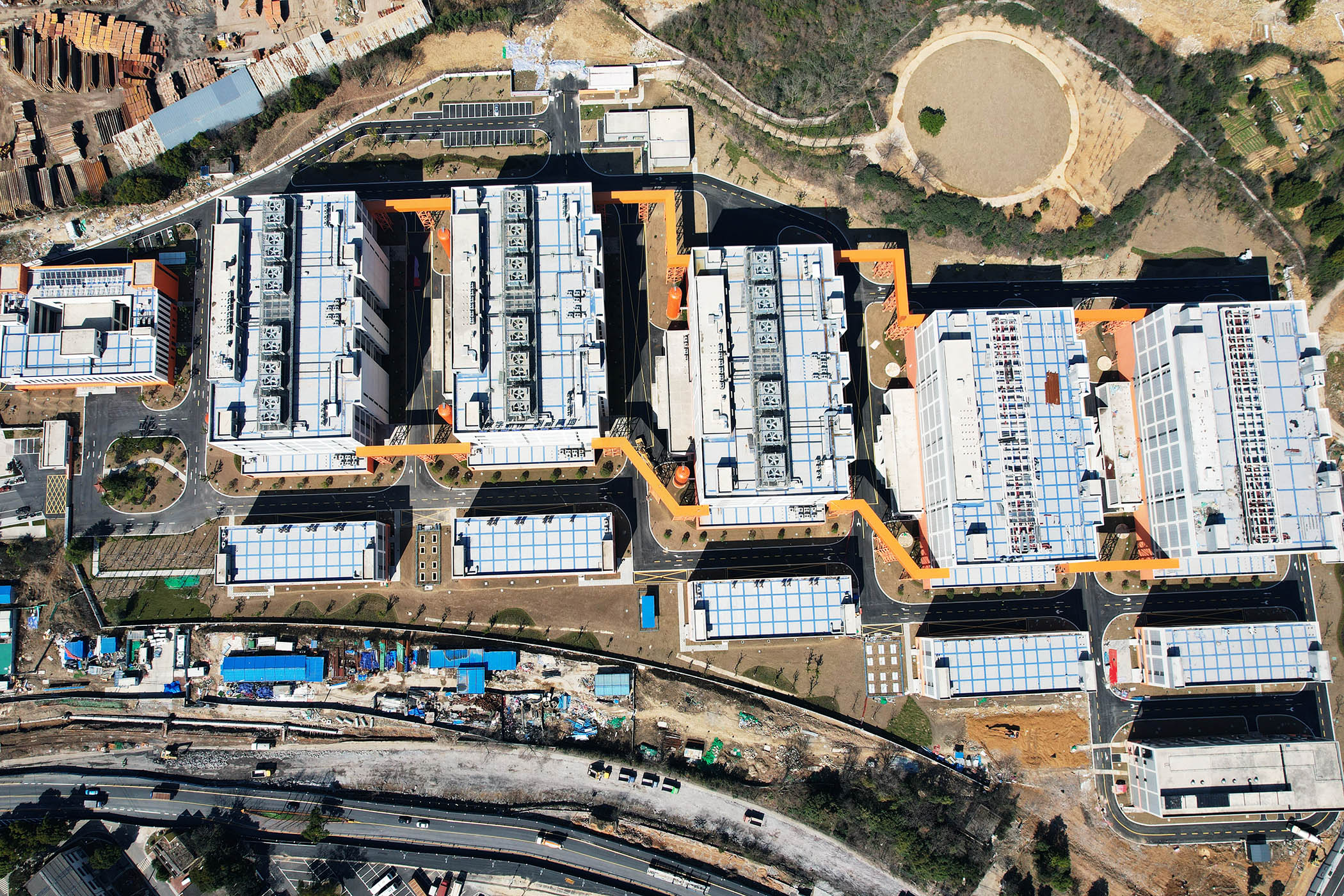
But at least the cables are out of sight. Datacentres, in contrast, are all too visible. They are universally hideous; products not of architects but of designers whose aesthetic sensibilities were surgically removed at birth. They are generally protected by the kind of fences usually seen around high-security prisons and they consume unconscionable amounts of electricity and water for cooling.
Newsletters
Choose the newsletters you want to receive
View more
For information about how The Observer protects your data, read our Privacy Policy
From the 1990s onwards – and particularly since the advent of the smartphone – datacentres have been a necessary evil of ubiquitous connectivity, but relatively modest in dimensions. This is no longer the case, as the tech giants become locked into an arms race (not to mention a gold rush) in their quest for global dominance in AI.
According to the Financial Times, they collectively plan to spend $660bn this coming year on “AI architecture”. The leader in tasteless giantism is Meta, whose planned $50bn Hyperion datacentre has fired the imagination of Donald Trump, who was recently seen waving a photograph (apparently taken from the blog of Meta’s chief executive, Mark Zuckerberg) showing the planned outline of Hyperion superimposed on – and largely obscuring – a map of Manhattan.
Meanwhile, on this side of the pond, Keir Starmer’s government, which is fully signed up to an AI strategy written for it by a tech bro investor named Matt Clifford, has defined such centres as “critical national infrastructure” and wants to have lots more of them in the UK. But it also fears that this may not go down well with citizens in whose parishes these sheds may be located. A recent opinion poll by YouGov on “Powering the fourth industrial revolution” suggests that these fears may not be displaced.
The survey reveals that only 8% of the public say they “know a lot” about datacentres, while 27% have never heard of them at all. Also, 75% support datacentres, but only on condition that they are powered by renewable energy. And while 52% support more datacentres nationally, only 44% would be content to have them nearby, revealing a predictable divergence between principle and proximity.
In a way, though, the most significant finding of the poll is that nearly a third of the population had never heard of datacentres. It’s a testament to the power of the cloud metaphor in sustaining the “weightless” myth about digital technology. Its genius is the way it has inverted reality.
After all, a cloud in the real world is the visible condensation of water vapour – the moment when something invisible becomes briefly visible. But in computing, the cloud does the exact opposite. It makes the deeply physical invisible by associating it with something intangible.
Those 1960s network engineers were more prescient than they realised.
What I’m reading
Importance of being Ernest
The Artist’s Reward, Dorothy Parker’s New Yorker profile of Ernest Hemingway, is a real gem, first published in November 1929.
Cutting comment
Tina Brown’s excoriating blogpost Bafflement with Bezos tackles the zillionaire’s gutting of the Washington Post, where, it turns out, “Democracy dies in darkness” was not a motto but an aspiration.
Sleep no more
When We At Last Awake is an interesting Substack essay by Michael Ignatieff on one upside of moral disgust at Donald Trump.
Photograph by Photo by VCG via Getty Images