Related articles:
Illustration by David Foldvari
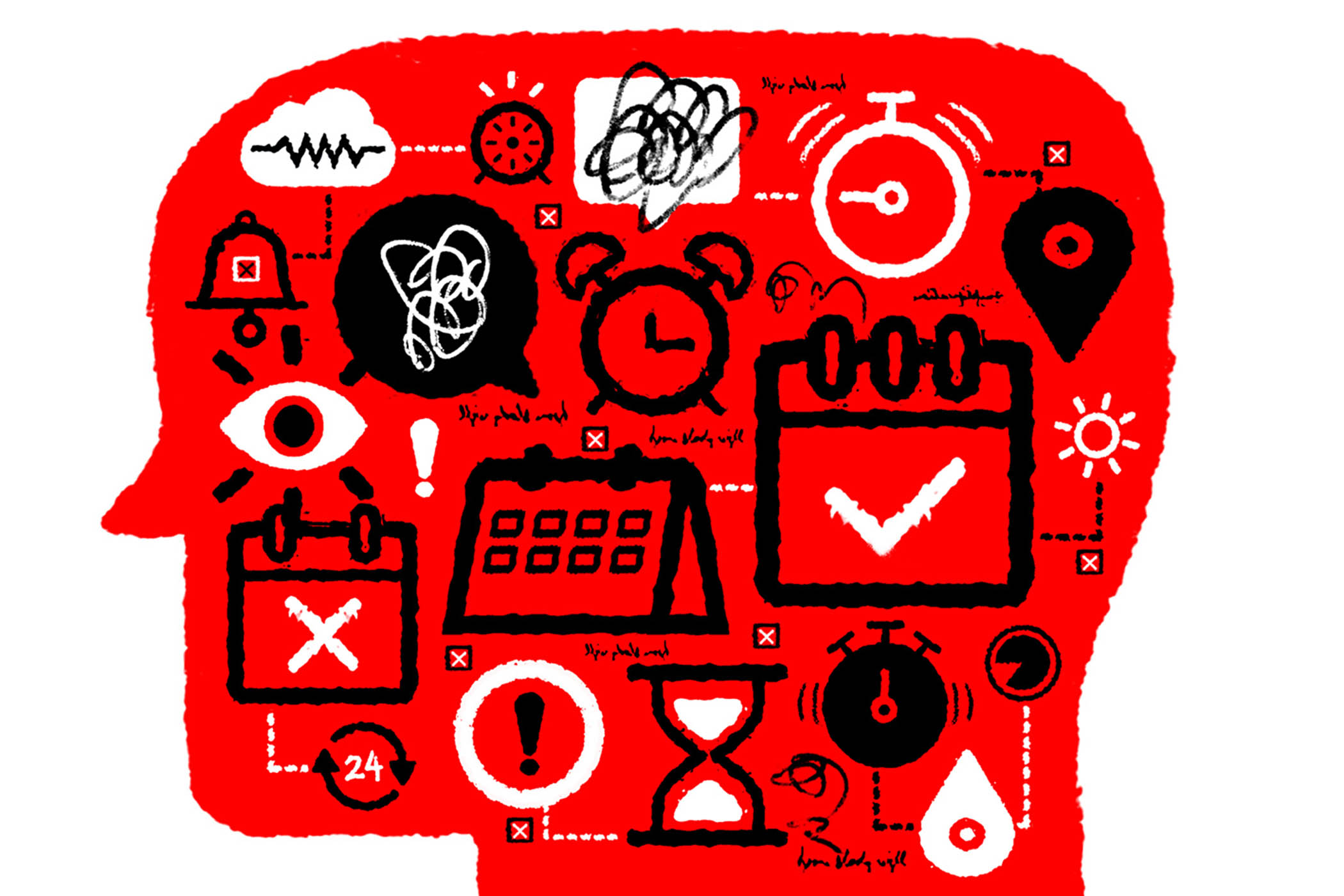
Sometimes when I’m having a particularly stressful day, I start to do something embarrassing in my head to get through it. I narrate each task to myself, like I’m an Instagram influencer telling my captive audience of thousands of adoring followers what a day in my life looks like. I imagine it as a series of short, aesthetic video clips. “Here I am writing my column for The Observer. Here I am at reformer pilates. I head home for a quick Zoom. Now I’m meeting my pal for a drink after work. Then I nip to the dry cleaners. I’m making a healthy dinner that always includes a sweet potato. I’m doing my skincare and taking my magnesium before I go to bed wearing linen pyjamas.”
This is an embarrassing thing to admit. What’s more embarrassing is that it actually works for me. I mentally slot my day into little boxes of productive time, tick them off and move on to the next thing. I am, as the American writer Jia Tolentino wrote in her seminal 2019 essay collection Trick Mirror, always optimising. “It’s very easy, under conditions of artificial but continually escalating obligation, to find yourself organising your life around practices you find ridiculous and possibly indefensible,” she writes. Like narrating your own life in your head, for instance, even if it’s a life made up of tasks as mundane as “schedule smear test” or “pick up pre-ordered lunch from The Salad Project”.
I might be alone when it comes to my deranged Foucauldian inner monologue, but I’m not alone in my constant striving towards the platonic ideal of perfect busyness. One of my friends is so pathologically overbooked that hanging out requires requesting access to a shared Google calendar. Another makes fun of me for being underemployed (to be fair, I’m Nigel Farage’s nightmare: I moved over here to take jobs away from English people and now I “work from home” and drink three iced matcha lattes a day). We poke fun at each other for laziness, feel bad about empty evenings or the audacity of ending a year looking and earning the same as when we started it.
They had children’s cereal for dinner, their apartments were a mess, and they didn’t shower enough
They had children’s cereal for dinner, their apartments were a mess, and they didn’t shower enough
All of which is odd, when I think about it, because we didn’t grow up with role models who were girlbosses or bootstrap billionaires or pilates princesses. We grew up with the hallowed figure of the slacker. Celebrated in endless movies and TV shows around the turn of the millennium and beyond – Pineapple Express, Broad City, Role Models, Napoleon Dynamite, Peep Show – the slacker was lazy and often stoned, but was always the hero of their own story. They had children’s cereal for dinner and didn’t shower enough. They dressed like shit, their apartments were a mess, and yet they maintained a Zen-like attitude towards the world. They were able to not only exist in it but enjoy it.
The slacker characters who millennials came of age with were obviously meant to be losers, and their arcs always pushed them gently towards self-improvement, growing up and brushing their teeth more regularly. But we were also supposed to like them. The slacker didn’t exist as a cautionary tale so much as a utopian fantasy. With no digital world to compare their lives to, no constant work emails on their iPhone, the slacker was able to differentiate between toil and leisure. They could relax. That they’ve virtually disappeared from the cultural landscape today says less about the idea that we’re done with their laziness, and more about the fact the slacker lifestyle just can’t exist anymore. Humour, after all, needs a basis of realism in order to work. This is why none of Ricky Gervais’s jokes are funny.
Today even the genuinely unemployed must spin their lack of motivation with fake jobs instead: “I’m a crypto investor”, or “I’m a trad wife.” Back then, there was no need for pretence. Broad City’s Ilana was able to live in New York while barely holding down a sales gig where she hides in the toilet to nap. Peep Show’s Jeremy managed to live in London while leeching off his university mate and claiming the dole. Their successes and failures were meritocratic because back in the 2000s everyone was still naive enough to believe in the concept of meritocracy. It just worked – and it made for good TV too.
Newsletters
Choose the newsletters you want to receive
View more
For information about how The Observer protects your data, read our Privacy Policy
The humble slacker has now disappeared from our always optimising, clean girl, hustle culture universe. TV shows focus instead on the rich, albeit morally reprobate (HBO’s Industry, which features sex, drugs and insider trading), or on big, sexy cities populated by little, sexy, generationally wealthy nepo babies (I Love LA, in which Rachel Sennott plays a striving talent agent). It’s not that we’re sick of the underemployed loser trope. It’s just that today, an underemployed loser – at least one who isn’t also a secret generationally wealthy nepo baby – simply wouldn’t be able to exist in Peep Show’s London or Broad City’s New York, or anywhere else where the rental market is controlled by an iron-fisted welfare class of multimillionaire octogenarians who own 17 houses each and simply refuse to die.
Related articles:
Graduates today leave university with, on average, £53,000 of debt, which will continue to accrue more interest than repayments can ever hope to make a dent in. More than a third of 20-34 year olds will continue living with their parents long into adulthood, not because they’re lazy, but because it’s too expensive to do anything else. The average graduate salary is about £36,000 a year. You can’t exactly cheerfully claim dole, a la Peep Show’s Jeremy, if the UK’s Kafkaesque benefits system continues to shut itself off to you. It’s a depressing picture, in other words.
And it’s little wonder, against that depressing backdrop, that the prospect of living off beans on toast, rolling your own joints and working part time at a gym to make ends meet seems less like a fun adventure in early adulthood and more like drudgery that you can offset by simply embracing the grindset mentality instead. Like it or not, the romance of the early millennial slacker lifestyle now only exists for the rich. The rest of us have to optimise.