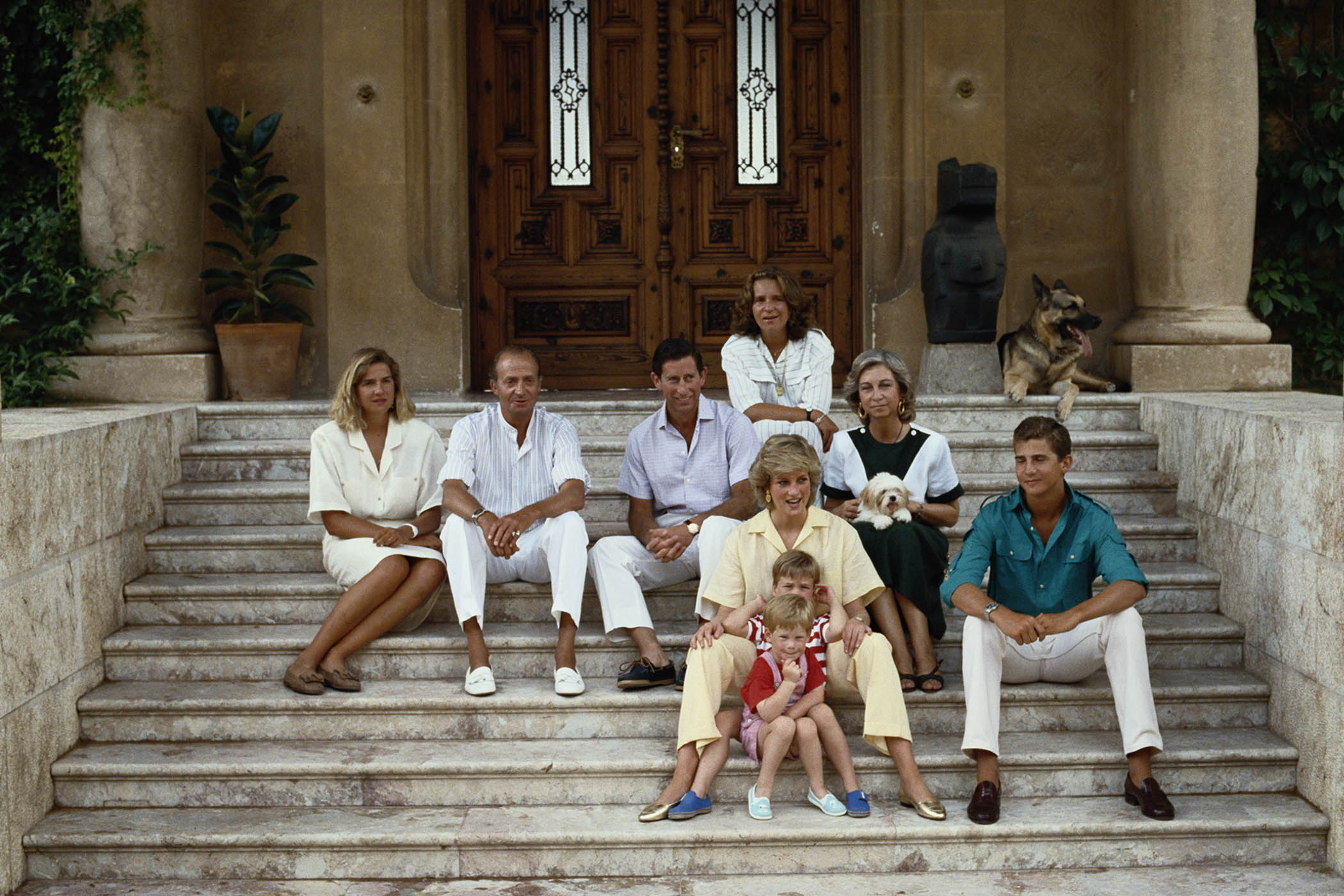

European monarchies are hardy institutions, survivors of almost every calamity. Spain’s King Juan Carlos, for example, was forced to abdicate in 2014 over sexual infidelity and financial chicanery that should have overwhelmed him and his office. He now lives comfortably in Abu Dhabi while his son Felipe carries on the day-to-day functions of the Spanish monarchy. Monarchies have deep roots.
Despite the darkening mood of crisis enveloping the House of Windsor, there is good reason to suppose the British monarchy will similarly pull through – but profoundly changed. In fact, in the long run, the constitutional, political, social and cultural consequences could yet prove positive, setting Britain free from self-made chains against which even the royal family, some more than others, has chafed.
The now famous photograph of Andrew Mountbatten-Windsor’s haunted devastation last Thursday night leaving the Norfolk police station where he had been questioned all day betrayed the degree to which this notoriously bovine, entitled man recognised how far he had fallen. The deference he had expected as of natural right was all over for him – the trigger for the necessary reinvention of the institution he had so soiled.
For the monarchy – apex of our constitution and which legally still defines the public interest in our courts – is at once the best and worst of us. Elizabeth II, King Charles and Prince William believed and believe in duty and public service while trying to embody essential British decencies. Charles’s faith, kindness and tolerant embrace of all Britain’s diversity are evident. His and William’s use of soft power to further great causes – the environment or Ukraine – has been hard to fault. Yet simultaneously and inevitably they are standard bearers of the hereditary principle and the shadows it casts over our social structures. It could be vast ducal estates whose justification is long forgotten but which grow ever larger as a form of 21st-century feudalism – for which Sandringham and Balmoral offer a carapace of legitimacy. Or the conferring of a parallel legitimacy on private schools, with their promise of paid-for guaranteed social and economic advantage – where the royals’ kids are unthinkingly sent. It is the primacy of received pronunciation and Oxford English, the tones in which the king speaks and which we reflexively expect our leaders to echo. If they don’t they are subtly diminished; compare Keir Starmer’s flat tones to Tony Blair’s. All needs to change.
Britain is not going to become a republic. The crown’s roots are too deep
Britain is not going to become a republic. The crown’s roots are too deep
Equally, the defects of government have monarchical roots. The great constitutional radical Tom Paine could write in Rights of Man that William the Conqueror would recognise the British constitution 700 years later in 1791. Rights, he argued, are essentially dispensed not as essential rights, but as dispensations resulting from the act of conquer and Saxon defeat – with elected governments now dispensing them on the monarch’s behalf. Bewilderingly, the same critique is valid in 2026. Even now,British democracy has its particular monarchical characteristics – abundant insider executive discretion, with the people cast too frequently as petitioners.
Nor would the riddle of British government – strong with a weak centre – be a riddle for William I. The strong centre is surely provided by the king and privy council of conquering barons, he would have asserted, exercising their prerogative powers. The fiction is that ministers, constitutionally servants of the crown, are thus still coordinated. That this apparatus is now a vacuous shell matters: the defunct form obstructs the creation of something better - and is abused. Recall the three Tory privy councillors who convened a privy council meeting with Elizabeth II to prorogue parliament for five weeks at Boris Johnson’s behest in 2019.
Unless defeated in war or through some other cataclysm, Britain is not going to become a republic. The crown’s roots are too deep. Britain is likely to want to retain the crown as its titular, ceremonial head of state, with monarchical executive powers and lack of transparency stripped out, but with the Windsors soldiering on. The model will need to be much closer to more modest European monarchies, with Denmark’s a good example. There, the monarch exists to serve the people, rather than double up as the head of a feudal, aristocratic social structure. The Danes have no huge coronation ceremonies or Ruritanian state openings of parliament. The royal family’s income there is a fraction of our royal family’s and their affairs are more transparent. King Frederik and Queen Mary shop and cycle round Copenhagen, managing whatever security concerns, their kids go to state schools; he enjoys approval ratings of 84% to 87%. Danish society is much less divided and more cohesive than ours, for which the character of its monarch must be partly responsible.
Prince William certainly leans into this vision – a modern father. He will know that openness and accessibility are how the Spanish and Dutch monarchies have rehabilitated themselves after scandals. But whether he and Kate, dispatching their kids to a lavish even if local prep school, can spearhead such a transition is an open question. Coronation by acclamation as in Denmark rather than in Westminster Abbey? Live more like his people? The redefining of our monarchy is a crucial building block in any programme of national rejuvenation. A Labour government should surely see and work for this with popular support; nor is it a project that the country would entrust to the wayward hands of Reform. Imagine living in a country where the state schools were good enough for princes and princesses? Where achievement and wealth were won by what you did rather than by birth and who you knew? And whose democracy properly functioned even with a constitutional monarch? You may say I’m a dreamer – but I’m not the only one.
Photograph by Tim Graham Photo Library via Getty Images
Newsletters
Choose the newsletters you want to receive
View more
For information about how The Observer protects your data, read our Privacy Policy