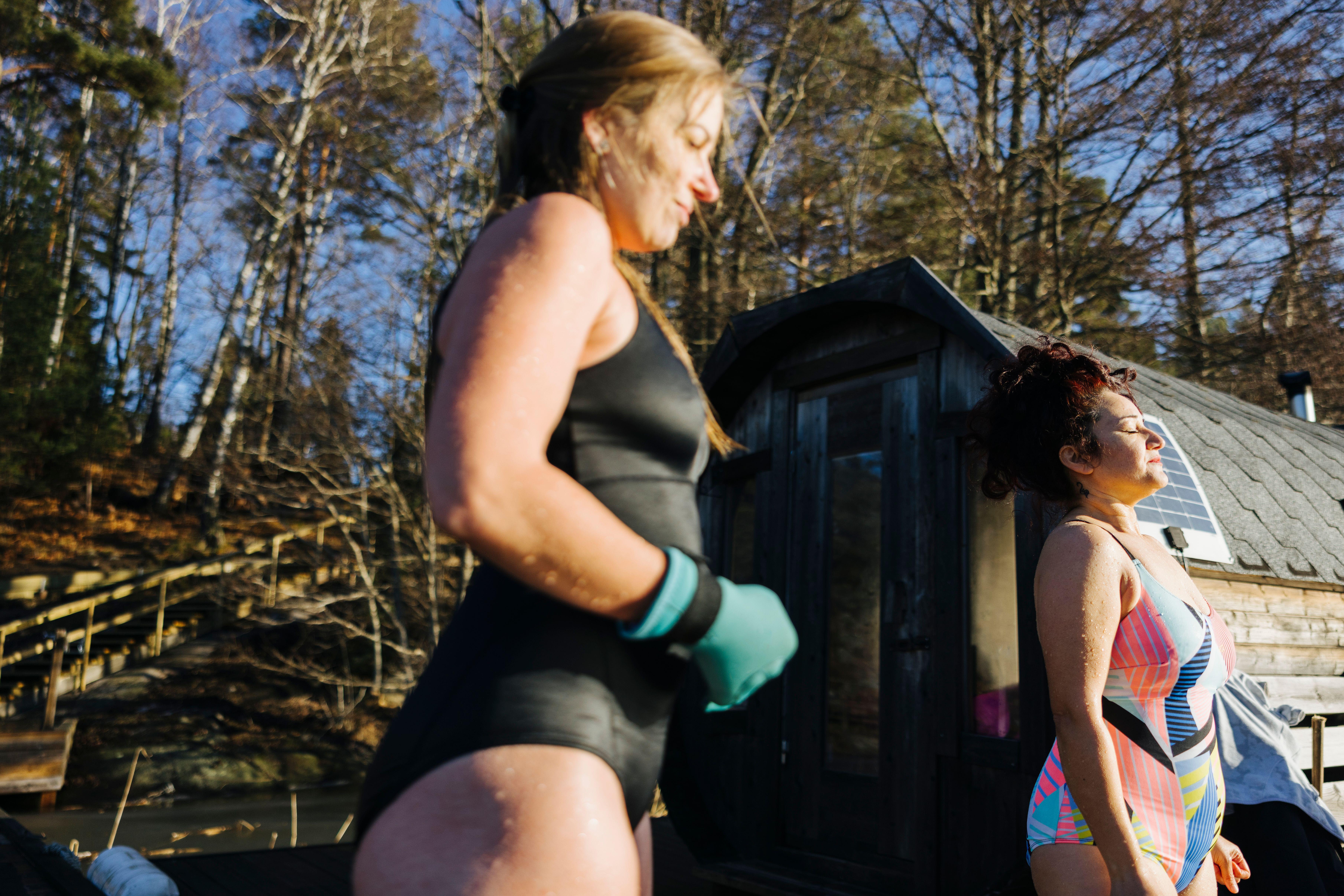


As a 31-year-old homebody who has never been a party girl, I can’t decide if it was kismet or karma that my first sauna trip was scheduled 10 hours after the biggest bender of my adult life. In August, I had booked an hour of alternating heat and ice baths and, hungover, having negotiated whether or not to get out of it, I told myself the experience would probably make me feel better.
Predictably, things started terribly. I forgot to remove my makeup and spent the first 20 minutes feeling mascara melt into my eyes. I tried to act normal when internal alarm bells started ringing as the heat began to choke my conversations with friends. Because I was wearing a sauna hat – a domed garment designed to trap cool air around your scalp, which only augmented the beetroot colour of my face – I imagined myself looking like a panicked garden gnome. But after the first shock of cold, my hangover faded and, ultimately, my decision healed the previous night’s mistakes.
Like an increasing number of Millennials and Zoomers, I have been sold on the unique effects of saunas, a booming craze across the US and Europe that has become especially popular in the UK over the past 18 months. Its popularity is likely to be the result of a cultural dovetailing. It’s part of the woo-woo wellness industry, of course: Wim Hof fans herald cold plunges and extreme heat as a form of bio-hacking, while saunas are pitched as alternative medicine by the types of people who listen to Russell Brand. The contested health benefits – reduced cortisol, increased endorphins, improved metabolism – have drawn crowds for which the pseudo-spirituality usefully masks the real motivation: self-optimisation. It has been integrated into their fitness regimens alongside activities like bouldering and Parkrun.
It feels good when you haven’t experienced real warmth for weeks to sit in a hot room that smells like cedar
It feels good when you haven’t experienced real warmth for weeks to sit in a hot room that smells like cedar
But the rise of the sauna has also been driven by the argument that we should embrace, rather than resist, the winter months. In serious works such as the 2020 bestseller Wintering, author Katherine May advocates for winter as a season of deep rest to mitigate spending a quarter of the year in misery. This approach borrows from Nordic traditions, where saunas and other restorative rituals have been routine for decades. Escapes to the southern hemisphere and staring at SAD lamps have been eclipsed by the idea that w e should eat well, move little, burrow into our homes until the break of spring.
In many British cities, from Ely to Edinburgh, you can now find dedicated sauna spaces which are not linked to grotty gyms or exclusive clubs. Wood cabins and cool tanks have also popped up across rural beauty spots, like the Scottish Highlands, and in coastal locations, where cold plunge pools are swapped for jumping in the sea. Some of these saunas are eye-wateringly expensive and objectively cringe, offering DJ sets or poetry workshops to suffer while you sweat. Others, like the one I go to, cost £14.50 per session and they hand out fresh-cut oranges as a 15-minute warning.
Beyond their trendiness, it makes sense that saunas are thriving. It feels good when you haven’t experienced real warmth for weeks, if not months, to sit in a hot room that smells like cedar. Even better to step outside, your body literally steaming, and have the cold feel like relief. But another benefit is seasonally agnostic. When your nostrils are burning from steam from water poured on hot rocks or your breath disappears in an icy bath, it’s hard to care – or even remember – where the fat sits on your body, or how you might look to the strangers around you.
We’re in a time obsessed with self-examination, where the mantra “new year, new me” has mutated into something worse than diet culture: a year-long marathon of habit-tracking and health-monitoring that stretches well beyond January. We are increasingly encouraged to outsource any connection with our bodies to shoddy data curated by private companies. Saunas instead ask you to forget metrics and follow what your body really wants and to embrace the solace of replacing your thoughts with instinct. The intensity of extreme and unusual temperatures shocks the system into thinking about little beyond physical sensation. You don’t wonder how long you’ve been inside or if you’ve spent enough time in the water, but – regardless – what might feel good next. For an hour, critical self-consciousness loses out to a much kinder intuition.
It may sound like saunas are sites of oscillating punishment, something to be stomached for the sake of the potential benefits. But there is a real high in the lightness you feel once it comes to an end. Most of the time, the thick heat and needling cold really are a welcome break from discomfort, seasonal or self-inflicted. Any indignities sustained in the process are negligible when you’re compelled to listen to your body and enjoy the freedom that comes with prioritising what truly feels best.
Newsletters
Choose the newsletters you want to receive
View more
For information about how The Observer protects your data, read our Privacy Policy