

Illustration by David Foldvari
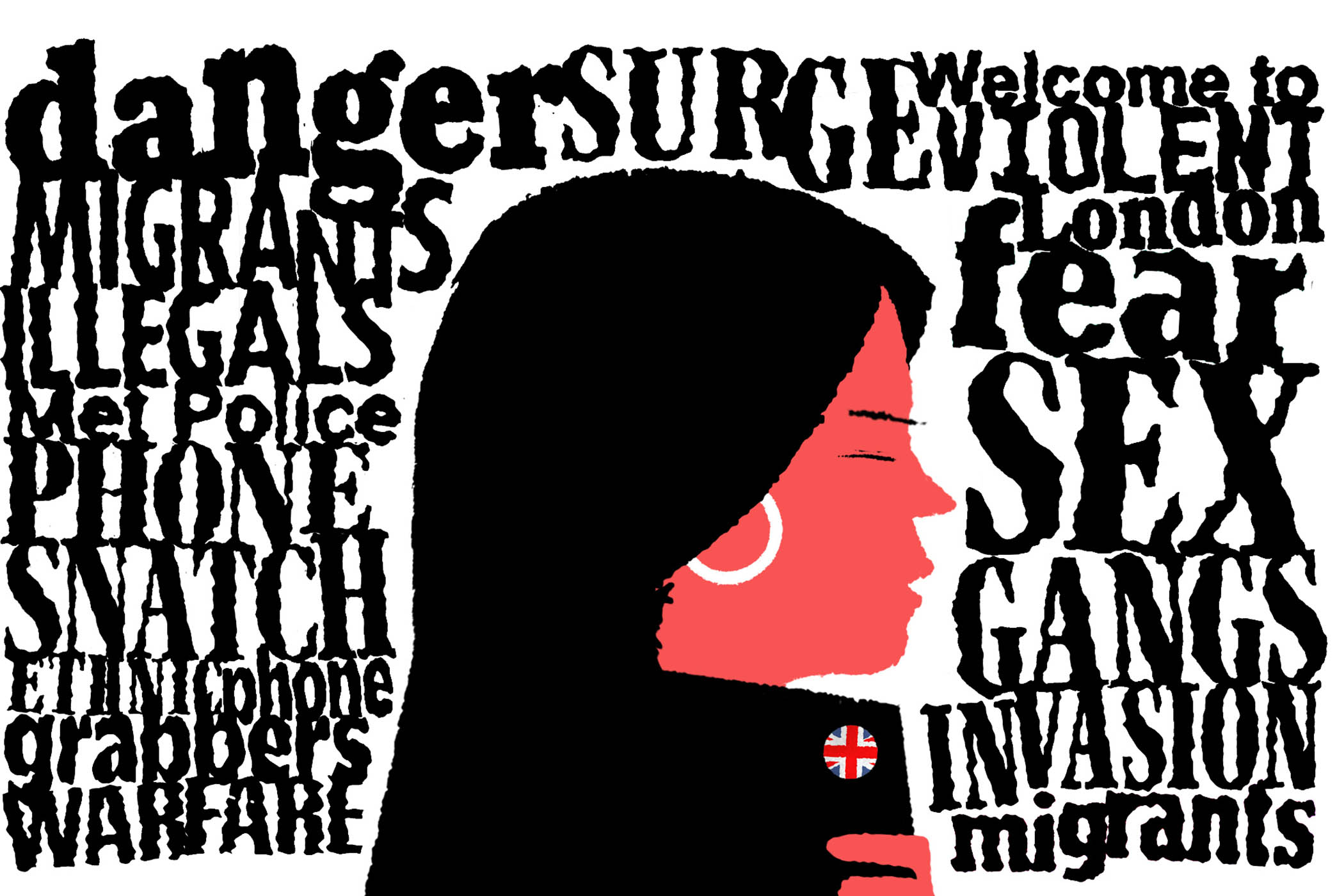
Picture the scene: I am walking down a high street, somewhere in the heart of middle England. My hair? Coiffed. Bleached. My dress? Low-cut. Tempting. Western. My hips? Undulating. My breasts? Huge. Like, absolutely massive. My age? Youthful to nebulously middle. The shops? Empty. The streets? Smoggy with shisha smoke. My countenance? Faint (I am unable to eat because every cafe stocks Halal meat, and there are no public toilets I can hide in without fear of attack). The men? Feverish. Everywhere there are potential dangers. Everywhere there are strangers, and the strangers are not People Like Us. They’re poised and ready to attack a woman, any woman, perhaps me. Their eyes are on me. I break into a run. My phone is snatched from my hand. My breath catches. I am a woman out in the world alone and I am terrified. Of everything.
This is a made-up scene, obviously. It’s never happened to me. Has it happened to anyone? The idea that Britain is some sort of Wild West for sensitive damsels who are collapsing en masse outside Greggs, yodelling for help like Olive Oyl and coughing shisha smoke into embroidered handkerchiefs is obviously a fallacy. And yet it’s an apocalyptic fantasy that has taken hold, particularly on social media, for a certain conservative cohort. A swathe of pretend scenarios heralding a Mad Max-style civil war on British streets have popped up out of nowhere, each more ridiculous – and more horny – than the one that came before.
First there was a viral X post, created with AI, that attempted to terrify everyone with scenes from the “Tube to Peckham”. “This is what you’re faced with,” the post read. It was accompanied by an image of five young men in black puffer jackets, wearing balaclavas and gold jewellery, staring intimidatingly into the mobile phone camera of the poster, Kiera Diss. Obviously, there is no Kiera Diss, just as there is no Tube line that runs to Peckham. She’s fabricated and the scenario is too. There are no teenagers waiting to terrify you, a presumably lovely, lily-white woman, every time you dare use public transport. The only terrifying thing about the train line running through Peckham is that it’s the Overground to Clapham Junction and it only comes every 15 minutes.
At the end of last month the US conservative pundit Tucker Carlson published an essay lamenting the decline of the “Yookay” (a dogwhistle meant to conjure up anarchic images of a UK ruined by multiculturalism) and maybe even the destruction of the West altogether. The streets are filled with litter. There is graffiti on public property. Women are getting abortions left right and centre. And “the whites” are “determined to eliminate themselves”. Carlson weeps over how London, a “dominant city”, has been “completely transformed by immigration”.
TalkRadio presenter Alex Phillips posted the pièce de résistance of what I’m calling “horn-mongering fright bait”. Phillips fired off a poetic post describing herself walking down Edgware Road: “I can feel leering eyes burning into me. I feel almost naked. Exposed. Extremely self-conscious of my blondeness and Western dress. I zip my coat up as high as possible and tuck my long hair down into the collar.” (You thought I was taking the piss with my fake scenario. I was actually very restrained.) Phillips ignores the “hissed comments” from men sitting outside shisha shops, a “tight fist of anxiety in [her] sternum”. “This is my capital city. London,” she writes. “Yet I know I don’t belong here. I am the exotic stranger having to adapt my dress and behaviour for my own safety.”
It’s smut for people who are more turned on by GB News stories than by stories of octopus tentacles
It’s smut for people who are more turned on by GB News stories than by stories of octopus tentacles
This reads like erotica. This is sexually charged fearmongering. It’s fascist romantasy; it’s Mills & Boon for flag-shaggers. It’s smut for people who are more turned on by GB News stories than by stories about octopus tentacles and dragons. It’s written in such a breathless, sexualised way that it’s surely meant to appeal to a certain kind of man – one who is perhaps less interested in stopping violence against women than they are about stopping the boats.
As Andrea Dworkin points out in Right-Wing Women (re-released in paperback earlier this year), conservatives, particularly conservative women, have rightly surveyed the world and found it to be a dangerous place. And they deal with that very real danger by displacing their rage and fear and contempt away from the men who are statistically more likely to abuse them (those close to them) and projecting it on to others who are far away from them; who are different, foreign. Disregarding structural oppression and misogyny, the threat to women is instead sexualised and sensationalised rather than dismantled or addressed.
Some women become “right-wing patriots, nationalists determined to triumph over populations thousands of miles removed,” Dworkin wrote, 42 years before the invention of modern titillating immigration slop. “Women cling to irrational hatreds, focused particularly on the unfamiliar, so that they will not murder their fathers, husbands, sons, brothers, lovers, the men with whom they are intimate, those who do hurt them and cause them grief.”
The symbols of danger – and objects of fear – change over time, but they’re always “outsiders”. This fear isn’t borne out by the statistics: this year’s ONS crime figures for England and Wales reported that the likelihood of violent attack by a stranger was 0.8%. For female victims of rape, the attacker (where known) had a 48% likelihood of being an intimate partner. Those figures are the evidence we need that the UK is a dangerous place to be a woman.
Newsletters
Choose the newsletters you want to receive
View more
For information about how The Observer protects your data, read our Privacy Policy
Yet they’re lost in the breathless media coverage of cases where a woman was attacked by a stranger, and the stranger was not “British”. We shouldn’t ignore those cases, but nor should we ignore the very real threat coming from within our homes. When violence against women and girls is reduced to racist social media erotica and invented AI threats, we have no chance of dealing with either.