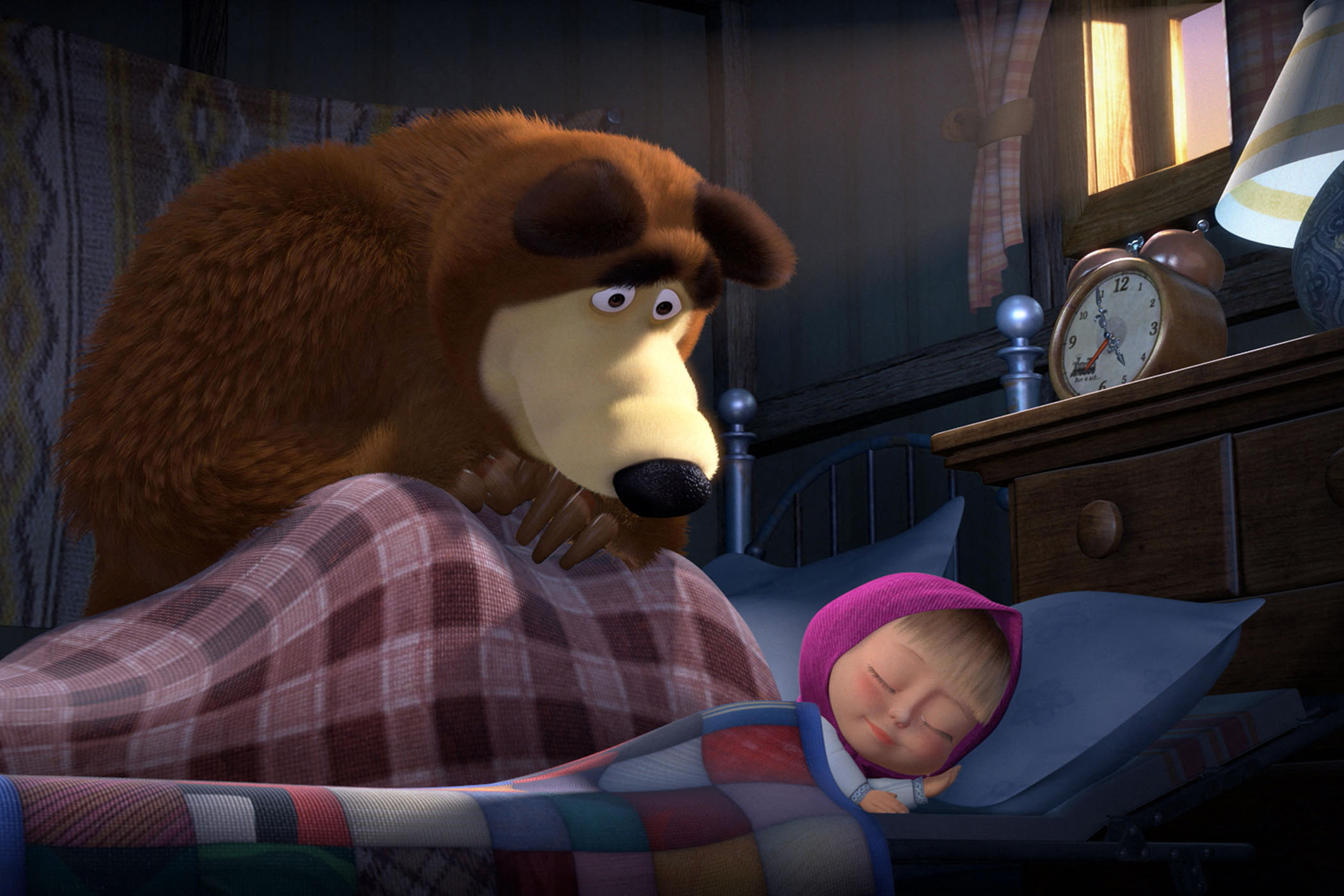
At first glance, the cartoon looks innocent enough. In it, an unruly girl called Masha creates havoc for her long-suffering companion: a retired circus bear.
But the animated series is one of Russia’s most successful cultural exports – and its runaway success has turned a cartoon bear into an object of growing scrutiny and suspicion among opponents of Moscow who see it as an instrument of soft power.
British MPs recently raised concerns over Masha and the Bear after Netflix acquired two more seasons of the programme, also shown on ITVX, urging culture secretary Lisa Nandy to consider revoking or suspending its license.
“British children are being reached through both a global streaming platform and a prominent domestic broadcaster, and we believe this is unacceptable,” read a letter signed by 50 MPs from six parties.
Based on a Russian folk tale, the cartoon has been translated into 40 languages and named the most in-demand children’s show in the world. One episode on YouTube is the most-watched non-music video in the platform’s history, surpassing 4.6 billion views.
“We know they have their own agendas and are trying to push their own narratives in whatever means and ways that are available and possible,” said Tom Gordon, Liberal Democrat MP for Harrogate and Knaresborough, who signed the letter. “At the moment it seems like we don’t have a mechanism to assess or actually even identify if this is a problem.”
In one episode, Masha, while guarding the Bear’s vegetable patch, dons a peaked cap with the blue band and red star in the style of the NKVD – the Soviet Union’s brutal secret police – before swapping it for a tank crew helmet.
A year after Russia annexed Crimea, Masha appeared wearing the NKVD-style cap again in an advertisement on the show’s official media account with the caption: “Hey, I’m in the army now”. It has since been deleted.
The Ukrainian World Congress said the cartoon fostered loyalty to Russia among children through the use of recognisable Russian cultural symbols including kokoshniks, a traditional Russian headdress, balalaikas, a Russian instrument from the lute family, samovars, and the image of the bear, which is an unofficial symbol of Russia.
“Is it whitewashing a regime simply by the fact that it’s conveying a positive image of a country that’s conducting a genocidal war?” said Seva Gunitsky, an associate professor of political science at the University of Toronto who wrote about the controversy on Substack. “Where do you draw the line?”
Newsletters
Choose the newsletters you want to receive
View more
For information about how The Observer protects your data, read our Privacy Policy
In the fifth year of the war, it is still a live question.
An EU court last week closed a loophole that allowed Russia Today and Sputnik to remain accessible in parts of the EU despite sanctions imposed on the Kremlin-backed media outlets in the wake of the invasion.
Elsewhere, however, restrictions appear to be loosening. As Russia intensified attacks on Ukraine this week, the International Olympic Committee cleared the way for Russian teams to compete in the Los Angeles 2028 Games. “We wanted to ensure all athletes have the possibility to compete at the Olympic Games and not be responsible for their government’s actions,” said IOC President Kirsty Coventry.
Earlier this year, the Venice Biennale Foundation allowed Russia to exhibit for the first time since the invasion, prompting the EU to withdraw 2 million in funding and the entire jury panel to quit.
After Netflix acquired two more seasons of Masha and the Bear last month, the Ukrainian World Congress urged Ukrainians around the world “to show Netflix that cooperation with an aggressor comes at a price” by cancelling their subscriptions.
It warned that algorithms drew children who watched Masha and the Bear into a “shared Russian semantic space”, leading them to other videos that were more openly propagandistic.
Beyond the impact on young minds, British MPs said the series – produced and distributed by Animaccord – contributes to the Russian state budget and by extension its war machine.
“What due diligence did these broadcasters and streaming services carry out?” said Gordon, the MP, who plans to write to ITV and Netflix.
A spokesperson for Animaccord, which is based in Cyprus, rejected the suggestion that Masha and the Bear was anything more than an animated series concerned with universal themes of friendship, kindness, humour and childhood.
“Masha and the Bear contains no political messaging and should be judged on its content and the experience of the millions of families who have watched it worldwide,” said Melanie Bonvicono.
Responding to the controversy, Kiril Dmitriev, a Russian businessman who has acted in negotiations between Moscow and the Trump administration, mocked the British parliament for focusing on a cartoon “instead of decimating the infamous UK grooming gangs”.
Others criticised the initiative on grounds of free speech.
“It’s easy to sneer and dismiss it as, like, all these silly Westerners, they have nothing better to do than talk about banning a Russian TV show. But I think this is completely ignoring the context,” said Gunitsky.
The MPs intervened not “because they’re afraid of preschoolers turning into sleeper agents”, he wrote on Substack. It is because they are grappling with the messy realities of collective responsibility and the difficult question of what we owe an aggressor’s culture in the midst of a war. “I don’t think the answer is a ban,” he wrote. “But I’m certain it’s not a shrug”.
Photograph by Collection Christophel via Alamy