I went to a school near Clapham Junction in south London, but it had ideas above its station. It wasn’t a fee-paying establishment back then, but its ancient history and vaulting ambition meant that, every Tuesday, I went to school in an RAF uniform. I looked a complete dickhead.
I can still feel the furious itch of the blue serge and the throttling collar stud; my feet still remember the endless absurdity of squad drill. And yet I wouldn’t have missed it. For a start, it means I can boast that the very first time I got into an aeroplane, I flew it myself.
There are four more reasons for gratitude to the school’s Combined Cadet Force (CCF) – and they’re all to do with the miracle of flight.
Or is it so miraculous? There I was on Tuesday afternoon being taught basic aerodynamics by a schoolboy sergeant with incomplete mastery of the subject. But I still kind of got it; a balance of four forces – lift, gravity, drag and thrust.
And, no, air isn’t empty. It’s a fluid medium, a life-sustaining soup and, when it passes over your wings, it creates a pressure difference; low pressure above your wings pulling you up, and higher pressure below your wings pushing you up. I was shown the secret of the world’s greatest conjuring trick; they don’t do it with mirrors; they do it with air. That was the first great thing.
Never mind bloody aeroplanes, I thought, being a nature-struck boy. The same magic formula has to work for butterflies and houseflies, and my grandfather’s honey bees. And for every bat that ever beat a pair of leathery wings. And for gulls and blackbirds and golden eagles – and, while we’re at it, for pterodactyls.
All these wonders could be explained by the same prosaic principles of pressure and lift. Powered flight has evolved quite separately four times over; this great convergence has allowed insects, the extinct pterosaurs, bats and birds to take to the wing. Humans followed them by a process of cultural evolution.
A few months later, I was staggering across the tarmac at RAF Manston in Kent wearing a parachute slightly smaller than I was. I climbed on board a two-seater aeroplane, taking care only to step on the black bits, lest I put my foot through the wing. Terror piled on terror as the pilot roared us up into the sky. I couldn’t reach the damn pedals and no one had told me where the ripcord was. The stuff on the ground got ridiculously small. And then a voice in my ears: “All right, cadet, you have control.”
“I have control, sir,” I replied in a panicky treble – the right answer. I grasped the stick and off we wobbled across the sky. I was invited to turn left. “No, bring her right over.” So I shoved the stick at my left knee and we stood on one wing, and I was looking down in wonder at the unyielding Kentish countryside so far below the port wing of the Chipmunk trainer I was flying.
We reached the ground miraculously unharmed, I said my thanks and spent the rest of my day – or my life – lost in the wonder of it. That was the second great thing. But I never for one moment wanted to be a pilot; I wanted only to be a swift.
Newsletters
Choose the newsletters you want to receive
View more
For information about how The Observer protects your data, read our Privacy Policy
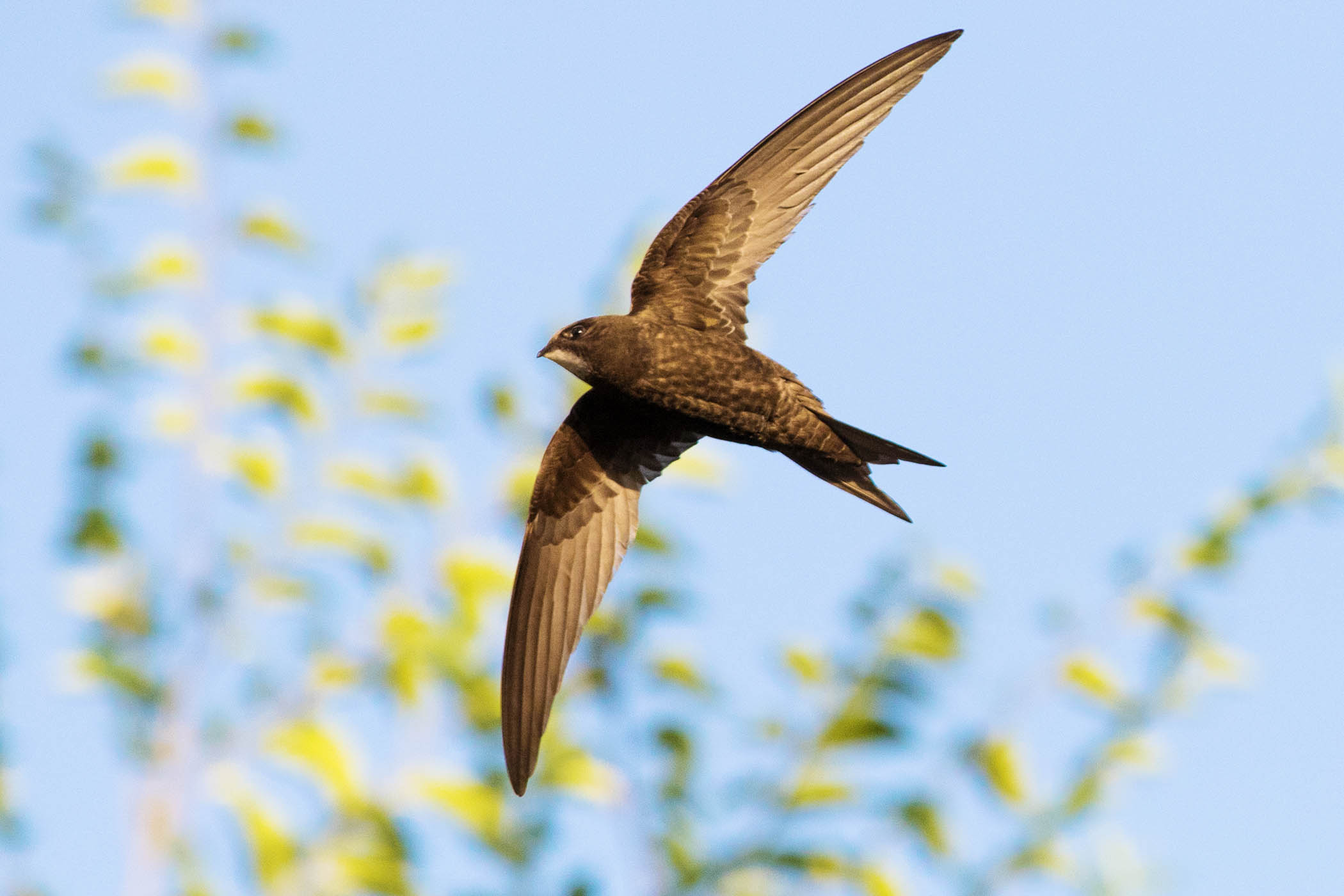
They were so much better at it than I was, arriving in late April on sweptback wings more dashing than those of the seven Lightnings and 18 Hunters I had seen at Farnborough international airshow. These were stylish trespassers: the swifts were at home. For them, the air wasn’t something you pass through on the way to somewhere else; it was the place where they lived, loved, fed, slept and had their being.
And they had such fun while doing so, unpaired young birds dropping down low to race each other while screaming at the tops of their voices, reaching speeds of 70mph in what I had been taught to call straight-and-level flight. Here was mastery; and not for the first or the last time in my life, my heart in hiding stirred for a bird.
Swifts have powerful muscles to supply the thrust required to generate the lift over those sickle wings – the engine, if you like. So now let’s try it without the engine.
This time I was sitting beside the pilot in a glider, a Slingsby Sedbergh TX Mk 1. A winch yanked us into the sky; my stomach caught up a minute or so later. The pilot released the winch with a massive jolt and I checked to see whether the wings were still there. Somehow, they were still attached; we performed a sedate circuit of the airfield and landed alive. And that was the third great thing.
The air alone had made this miracle possible. Many years later, I was in a clearing in the jungles of Borneo at dusk watching a squirrel climb to the very top of a tall tree. And jump off.
But he didn’t crash to his doom; he spread his legs and his tail and became a wing; the same pressure difference over the aerofoil surface that had sustained me in my glider sustained this mad leaping squirrel. He managed about 50 metres before slapping himself against the trunk of another tree. It was majestic and comic. It was also a revelation.
This wasn’t great flying, but it was a hell of a lot better than not flying at all. He could get from one food source to another without running the gauntlet of predators on the ground. Even in a debased form, flying is a massive evolutionary advantage; similar animal gliders include snakes, lizards, frogs, lemurs and possums.
I had one more day in a glider, and that was, of course, the fourth great thing. It was a sunny day, and that made all the difference. Because the sun warmed the land but did so unevenly; in some places, warmer air rose – as warm air will – and we rose with it.
The pilot took us in a tight spiral, using the joystick as if he was stirring an unusually thick pan of porridge – and up we went. Up and up. I could feel the air as a violent, tangible thing; it was easy to understand this powerful, substantial medium was keeping us up, allowing us to factor the ground out of existence – at least for a while.
It was as if the air had welcomed us: not interlopers but honoured guests. Again, years later, I was at the Great Lakes watching the autumn migration of hawks. They funnelled together to the minimum area of lake, because you don’t get thermals over water. In a couple of hours, I saw 10,000 of them, rising in leisurely circles in the obliging air – all using as much energy as I would lying on a sofa.
The bateleur eagle has the scientific name Terathopius ecaudatus, which means “tailless marvel”. I’ve often seen them over the Luangwa valley in Zambia, cruising from thermal to thermal, wings held in a shallow “V”; a dihedral angle that gives them stability, while their almost complete lack of tail gives them marvellous efficiency on the glide.
It was October in the valley. The roasting sun dramatically lessened its ferocity. A chilly and totally unexpected wind struck up, and with it came a vast reef of cloud. I could hear a wild screaming, and looking up, just ahead of the clouds, I could see swifts. Many swifts. It was as if they were towing the rains to bring life back to the land.
And then, six months later, back home in England, that glorious screaming again. Late April and it seemed that the swifts were bringing us the gift of life once again, this time in the form of spring. Flying, always flying, and doing so by way of those curious clunky principles the cadet-school sergeant tried to teach me while I itched and longed for five o’clock.
An orange-tip butterfly has just hurried past my window in a frantic rush to find a female before he dies. Yesterday, I glimpsed an early pipistrelle bat at dusk and listened to the sound of its sonar on my bat detector. I’ve been reading about the extinct pterosaur Quetzalcoatlus with its 11-metre wingspan.
I’ve been researching the uncannily brilliant flight of the houseflies in the kitchen and admiring the generosity of vampire bats. A marsh harrier is nesting a few hundred yards from my desk; there he is, flying past with his wings in a dihedral. All these marvels, all of them obeying the same rules of flight that the sergeant tried so gallantly to explain.
And, above all – quite literally – are the swifts, the greatest aeronauts of them all: a bird in steep decline that lives by way of glorious ascent. For a swift, the sky is home. Not even the CCF could provide such an experience. You have to be a swift.
Photograph by Mircea Costina/Getty Images