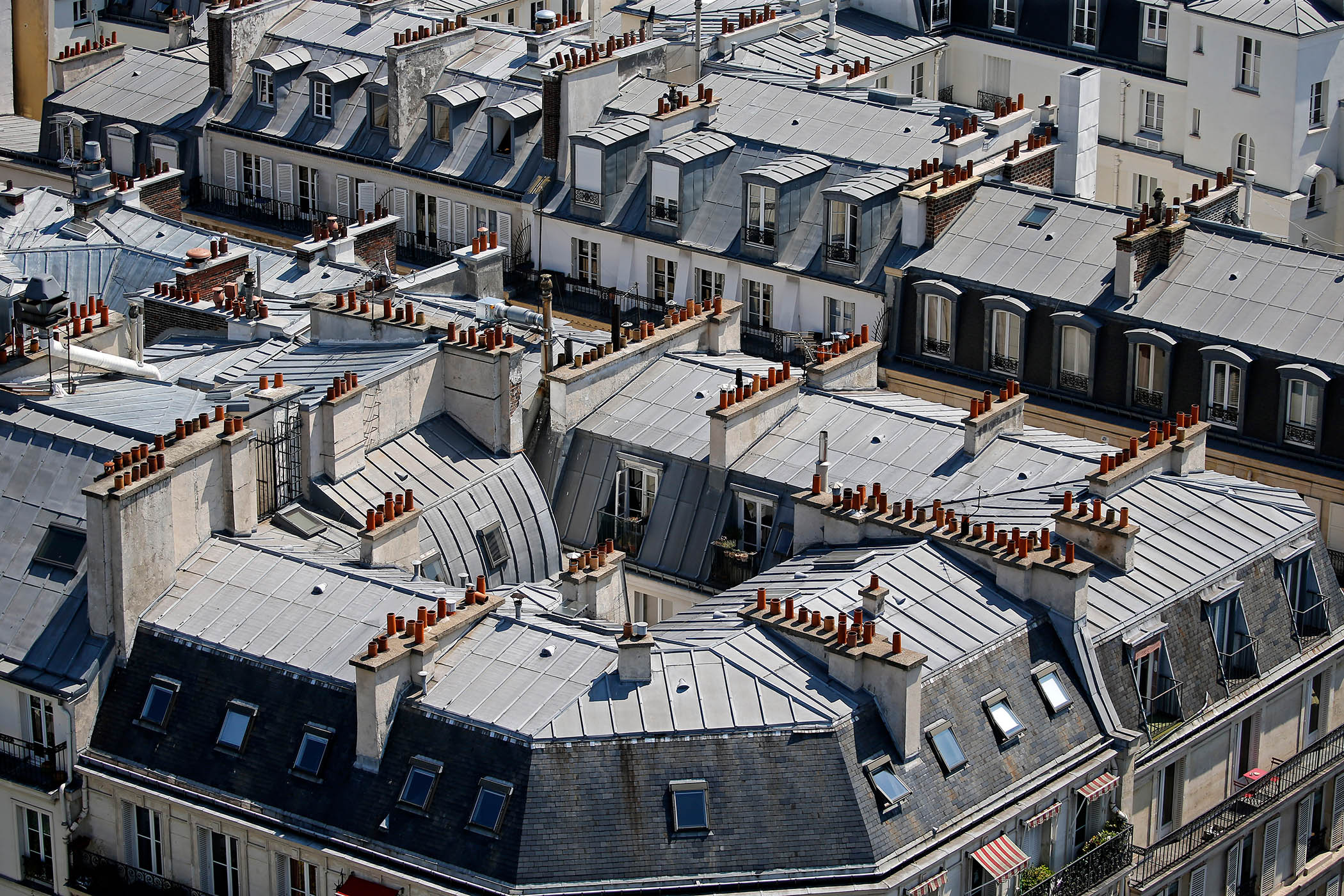


High above Paris on the shimmering rooftops of Georges-Eugène Haussmann’s elegant apartment buildings, the zinc is scorching. The blue-grey mansards – as much a symbol of Paris as the Eiffel Tower and Notre Dame – can get hot enough to fry a passable rare steak.
Baron Haussmann’s Paris was designed for moderate summers of late 19th-century Europe. Today, with temperatures forecast to reach 40C in Europe’s most densely populated big city – further crowded by music lovers who have crossed the Channel for Sunday’s Fête de la musique – Parisians are the ones roasting.
“The highest temperature we recorded on a zinc rooftop is 80C,” said Eytan Levi, a French former Massachusetts Institute of Technology (MIT) student, whose company Roofscapes has experimented with creating rooftop gardens to mitigate the heat. “Yes, you can cook on that, but more seriously, it means anyone living underneath is overheating.”
Extreme heatwaves have become a recurrent feature of Paris summers over the past decade, creating a social and political dilemma. More than 70% of the city’s buildings are Haussmannian and protected by stringent regulations overseen by France’s building architects’ heritage authority and the country’s culture ministry. Applications for external air-conditioning (AC) blocks on historic facades or wrought-iron balconies are almost always refused.
This, and a general antipathy towards AC – historically seen as another American assault on culture – means few private buildings have it.
“Nobody wants to see air-conditioning units dotted all over Haussmann buildings,” Levi added. “But the risk is people are getting too hot in their homes and taking matters into their own hands. They are no longer waiting to get permission for AC units, but are installing them unofficially.
“And what many don’t realise is that such units push hot air from inside to outside, which makes the city even hotter.”
Instead, residents are left to sweat it out – sometimes with tragic consequences. In 2003, a prolonged August heatwave caused an extra 14,800 deaths in France, the majority of them elderly people. In Paris, where many families had left for holidays, morgues and undertakers were so overwhelmed, bodies had to be stored in freezers at the fruit and vegetable market south of the city.
Levi says covering zinc rooftops with vegetation can reduce the temperature of the surface metal to 36C and the apartments below to a bearable 30C. But getting the authorities to agree has been “frustratingly slow”, he said.
Alexandre Florentin, a former city councillor and a climate engineer, says with heatwaves becoming longer and more frequent, there is worse to come. He warned that temperatures in Paris could reach 50C by 2050.
Newsletters
Choose the newsletters you want to receive
View more
For information about how The Observer protects your data, read our Privacy Policy
“People are well aware climate change is not going backwards so we must prepare for a lot worse. Everyone, including politicians and the media, needs to get this into their heads,” he said.
“Even those who are well informed and involved in environmental issues aren’t prepared. I hear them say they’ll escape the heat by going to Brittany for the weekend – except, when it’s that hot, trains are cancelled.”
In 2023, Florentin and environmental specialist Maud Lelièvre, author of Faire Face à la Canicule (Facing the Heatwave), produced a report – Paris à 50°C – on the city’s preparedness for extreme heat. It warned that railway tracks, steel bridges and asphalt roads would expand or melt under the heat, bringing transport to a halt. Two years later, the government launched a national plan with 52 “concrete measures” to address the climate emergency.
“The plan was adopted, but the money hasn’t been invested in it, and the measures haven’t been taken,” Lelièvre said. “Until very recently, we treated the heatwave as an exceptional crisis and didn’t regard it as an annual event. Now it’s as if we are in a war situation: a climate war.”
Leliève believes more vegetation in a city desperately short of green spaces and parks, and opening air-conditioned public buildings to the city population during heatwaves, are immediate measures that could be taken.
“The structural emergency will take 10 to 20 years to address,” said Leliève, who believes individual AC units are not the answer. “It’s an individual choice in the face of a collective problem. It’s a policy of everyone for themselves.”
Last week, the Paris authorities allowed bathing in a restricted section of the Canal Saint-Martin. From July, three sites along the Seine will be open for swimmers.
Along the canal, in the northern 10th arrondissement, youths ignored “risk of death” signs, as well as floating bottles, submerged bikes and the threat of fines, to launch themselves into the murky water from iron footbridges. “I just jumped – I didn’t think about it,” one teenager said. “I know it’s dangerous, but it’s too hot. Too, too hot.”
Photograph by Chesnot/Getty Images
Photograph by Jerome Gilles/NurPhoto via Getty Images