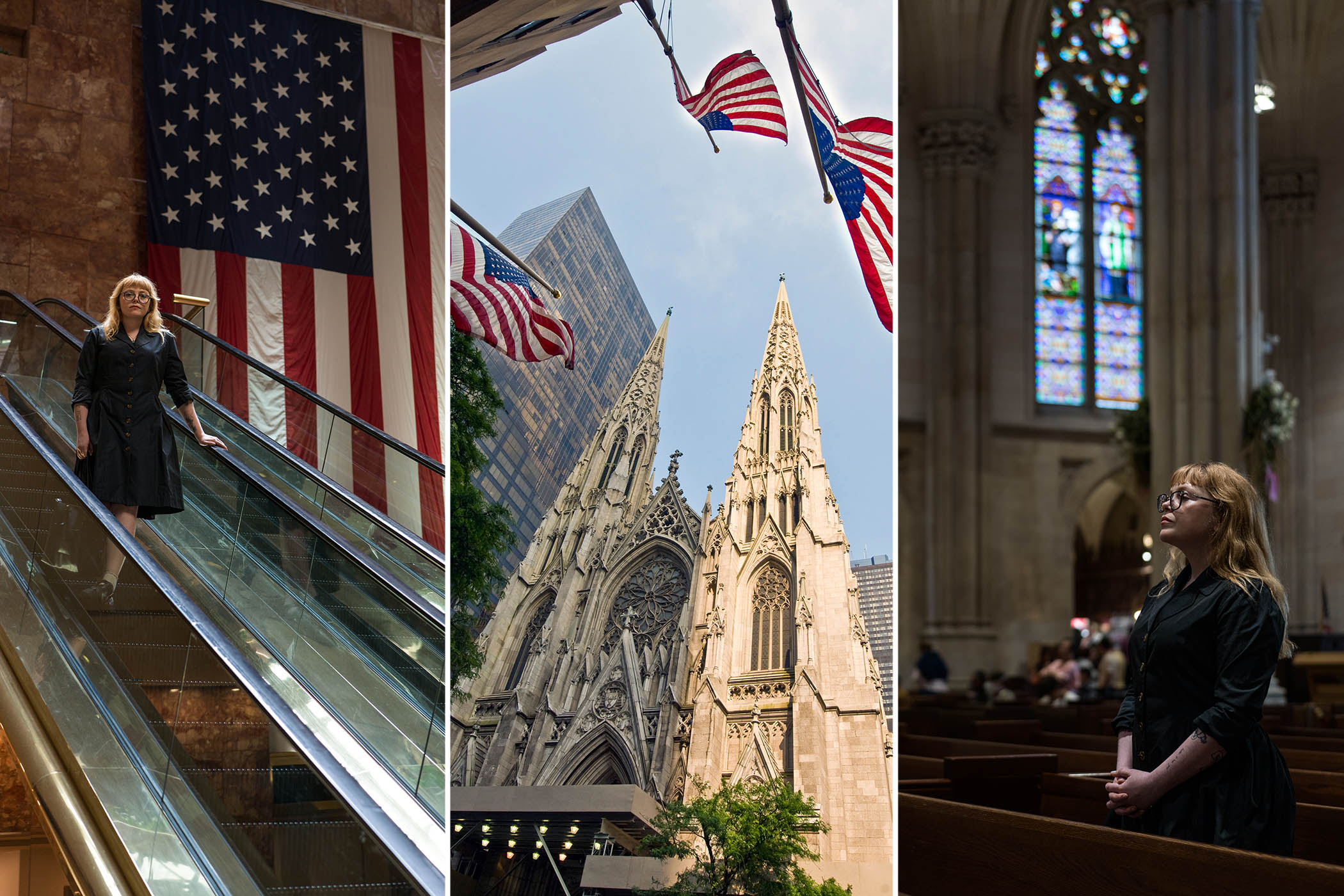

In St Patrick’s Cathedral on Fifth Avenue, a five-minute walk from Trump Tower, a responsorial psalm rings out: “The Lord Hears the Cry of the Poor,” Father Enrique Salvo intones, and we repeat it back faithfully. I am at midday mass at St Patrick’s, the seat of the archbishop, which has occupied its block since the 1870s. Back then, its location was criticised as being too far out of town. Now it stands at the heart of New York’s most crassly consumerist territory, near the ludicrous 15-storey Louis Vuitton bag installation, surrounded by luxury retailers guarded by doormen and patronised by extremely wealthy tourists.
Before this mass, I had stepped into Trump Tower, a couple of blocks away, for the first time. It’s both less and more grotesque than I might have hoped. I ride up the golden elevator and laugh to see a group of teenage boys posturing while getting their picture taken by mom and dad, middle fingers up and mouths protruding in would-be ominous pouts of disaffection.
I peek around at the restaurant, largely deserted, then downstairs at the concession selling Maga tat. It’s eerily empty, which, alongside the half-hearted decadence applied to the erstwhile food court and mall, gives it the feeling of a hastily abandoned palace.
In St Patrick’s, the response about the cry of the poor strikes more keenly because of where I have come from. Just as I am enjoying this smug little observation of mine, however, I register the magnificent altar I am staring at and think: “Hang on, I seem to remember another corrupt body you could always critique for its love of bejewelled decadence.”
I realise this is where we find ourselves – and I resent it. Donald Trump’s attacks on Pope Leo last week were so deranged that I and many others have become reflexively defensive of the church. It’s a suddenly jarring experience when my whole life has been lived in awareness of the Roman Catholic church as a totalitarian force that wounds.
Any Catholic should be angry to have a president who speaks this way
Any Catholic should be angry to have a president who speaks this way
Not even his own fans could have interpreted Trump as a man particularly disposed towards holiness. He has made frequent reference to his faith, but wisely chosen not to dwell on the claims. His denunciation of the pontiff in a lengthy and personal diatribe on Truth Social last week shocked many of his Catholic and Christian supporters; those who have been willing to gloss over many things in deference to his support on their core issues, such as criminalising abortion.
Leo, the first American pope, was inaugurated last year and initially welcomed by Trump as a feather in the Maga cap. Last week’s papal insistence, though – a rather predictable insistence, you would have thought – on endorsing peace and conciliation has not gone down well.
After Trump’s threat to destroy an entire civilisation in Iran, the pope responded by criticising the “delusion of omnipotence” fuelling the conflict while preaching the word of the gospel that seeks peace and forsakes conflict.
“I don’t want a Pope who thinks it’s OK for Iran to have a Nuclear Weapon,” Trump wrote in response. “I don’t want a Pope who criticizes the President of the United States because I’m doing exactly what I was elected, IN A LANDSLIDE, to do.”
In the same outburst, Trump shared an AI-generated image of himself as Jesus Christ. The post was later deleted. A few days later, he posted another image, this time showing Jesus embracing Trump. One member of the congregation I spoke to outside St Patrick’s was more upset by the image of Trump as Jesus than by his rebukes to Pope Leo.
Newsletters
Choose the newsletters you want to receive
View more
For information about how The Observer protects your data, read our Privacy Policy
Miles, a 66-year-old man on holiday from Missouri, told me he was uncomfortable with the tone in Trump’s messaging, but that the pope had commented on political matters and so could expect some response in kind.
The Rev James Martin, a Jesuit priest and editor-at-large of America magazine, told the Public Broadcasting Service: “The picture, though, of him as Jesus Christ – that went too far, and I think I’ll never forget it. It saddened me, it saddened me to have a president who takes [religion] so cheaply.”
He added: “Some people have used the term blasphemy. I think it’s more appropriate to call it idolatrous. The first commandment is: ‘You shall have no other gods before me.’”
More outraging, perhaps, has been the hubristic response of the Catholic convert vice-president, JD Vance, who has taken it upon himself to lecture the pope on doctrine: he should, Vance instructed the man who has a doctorate in canon law, “be careful when he talks about matters of theology”.
In downtown Covid-era Manhattan, there was a small but significant flurry of converts to Catholicism, all tied to the same Maga-adjacent rejection of liberal pieties. Where does their faith lie in the pope versus Trump stand-off? On one hand, their representative of Jesus Christ on Earth is being maligned; on the other, the president is posting some amusing memes.
Claims of infallibility from competing quarters are difficult to reconcile. Another visitor to St Patrick’s, a friendly blond, middle-aged woman in town from Illinois, who did not wish to share her name, said she was both a devout Catholic and a devout Trump supporter. Did she think one of them should apologise, I asked her, or at least back down from this particular war of words?
“The president is the president, and the pope is the pope,” she said, affirming that they are both owed unquestioning support, shrugging at the current impossibility of providing it to the pair of them, showing no discomfort at the paradox. A perfect bit of Catholic logic, in its way: the mystery of faith. Her husband was more forthright: “Any Catholic should be angry to have a president who speaks to the pope this way. I am.”
I found, to my surprise, that I was too, though as a non-citizen and a mostly lapsed Catholic, I don’t have a dog in the fight. It can be instructive to see how persistent your ancient inclinations are when they are threatened by outsiders. More or less my whole relationship with the church has been one of disentanglement and wariness, particularly after learning as an adult about its malign presence in my own family.
My grandmother’s young life was marred by the Catholic church, and yet she remained an ardent faithful to the day she died. Something in her dedication both depressed and inspired me; the dogged resilience of it, the transformation of a great source of pain into one of power and comfort. And I never quite lost the ability to take comfort from mass myself, no matter how I disavowed the church intellectually. The part of me that still retains the lineaments of absolute respect for the church can’t help but be provoked on a visceral level.
As I sat in St Patrick’s, mindlessly parroting the refrains and kneeling down and popping back up like clockwork, crossing over my head, lips and heart, I thought about a question I’d seen online the day before: what do we call someone who was raised Catholic but doesn’t actively practise any more? Is there a word for a secular Catholic? Yes, came the response: that’s called a Catholic.