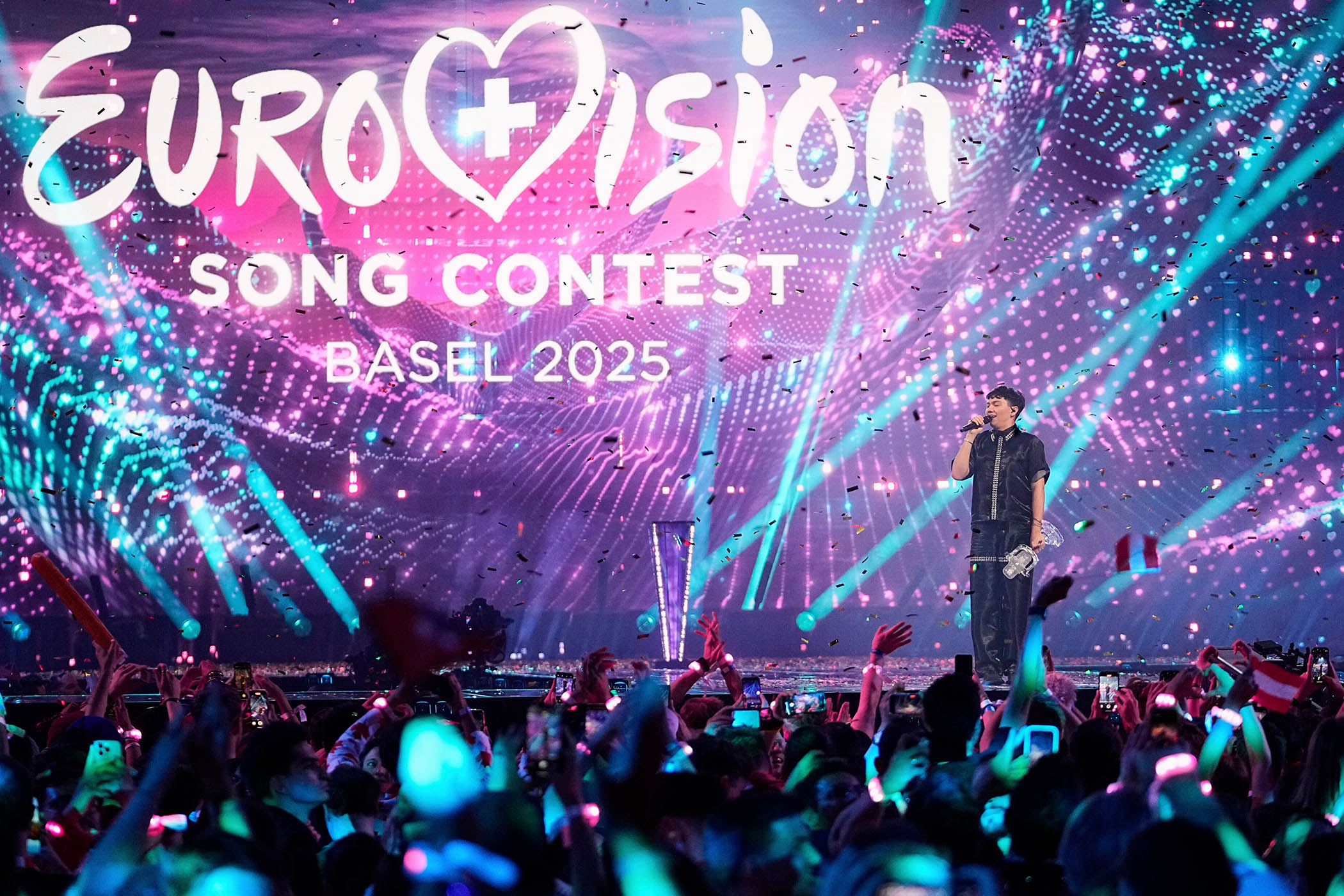
It has survived the invasion of Ukraine, a singing turkey, Brexit and the inexplicable (some say inexcusable) inclusion of Australia, but the war in Gaza is the controversy that has come closest to bringing the Eurovision song contest to its knees.
On Thursday, Spain, Ireland, the Netherlands and Slovenia withdrew from the world’s biggest singing competition, a festival of glitter, strobe lights and LGBTQ+ rights that has increasingly also become a reflection of a crumbling global order.
The countries’ public broadcasters announced the move after members of the European Broadcasting Union (EBU), which runs the contest, elected at its annual general assembly not to expel Israel. The Icelandic broadcaster said it was “considering its position”. The BBC backed the decision to let Israel take part next year.
Dominic Kraemer, host of The Europeans podcast and self-confessed “total Eurovision nut”, said this was the greatest crisis the contest has faced in its 70-year history. “This could be seen as existential for Eurovision,” he said.
The contest is supposed to be politically neutral, but Russia was expelled in 2022 following the full-scale invasion of Ukraine after a number of broadcasters threatened to withdraw if it stayed.
No such consensus was reached on Israel over the war in Gaza, during which Israeli forces have killed more than 70,000 Palestinians, according to the territory’s Hamas-run health ministry – a death toll that continues to rise by an average of seven people a day, despite the ceasefire.
Israel’s 2025 entry, New Day Will Rise by Yuval Raphael, came second in May, scoring poorly with the panel of judges but amassing a huge tally in the public poll after a concerted get-out-the-vote campaign. Some broadcasters raised concerns about how those votes were mobilised, and the EBU announced it would revisit its regulations for the 2026 contest.
EBU members voted on Thursday to reduce the number of votes per person from 20 to 10, reintroduce juries in semi-finals and discourage governments and third parties from promotional campaigns – measures that a majority of members considered robust enough to avoid a subsequent vote on Israel’s participation.
Contest director Martin Green characterised it as a victory for neutrality. “It is not governments that participate in Eurovision, it is public service broadcasters and artists,” he said after the vote.
This distinction is growing harder to parse. No one knows that better than the BBC, which has repeatedly found itself in the crosshairs over editorial decisions relating to Israel and Gaza since 7 October.
Newsletters
Choose the newsletters you want to receive
View more
For information about how The Observer protects your data, read our Privacy Policy
‘In the past few years it has been tense, with booing and people tryingto storm the stage’
‘In the past few years it has been tense, with booing and people tryingto storm the stage’
‘Dr Eurovision’ Paul Jordan
A spokesperson for the BBC would not say who made the call but told The Observer that outgoing director general Tim Davie, who resigned over accusations of bias against Donald Trump in an episode of Panorama, was in attendance. “We support the collective decision made by members of the EBU. This is about enforcing the rules of the EBU and being inclusive,” the spokesperson said.
Paul Jordan, who goes by the name Dr Eurovision, used to work in communications for the EBU and wrote a PhD about the contest, described the BBC as “one of the more cautious broadcasters” in the union.
Most of the countries that have withdrawn are big hitters: the Netherlands is a founding member; enthusiastic participant Ireland jointly holds the record with Sweden for most wins; and Spain is one of the “big five” broadcasters that provides the most funding for Eurovision and thus had a guaranteed place in the final.
“We’re stepping into the unknown, because how do these countries undo this decision in future years?” Kraemer said.
Israel has participated in the contest since 1973, winning the top prize four times. Another victory in Vienna in May, which would come with hosting rights, would be the true test of the competition’s longevity. “I think that’s when we could see a mass boycott,” Jordan said.
In Israel, members of the Netanyahu government are threatening public broadcaster Kan with closure or privatisation. But as a member of the EBU, Kan is, as Jordan puts it, Israel’s “ticket to Eurovision”. This gives the government a choice between muzzling an inconvenient free press in a time of war and maintaining the soft-power juggernaut that is Eurovision.
It often seems that Eurovision was conceived for a simpler world. Kraemer describes it as the “connective cultural tissue of Europe” at its best. But today the competition must walk a near-vanishing line on what it means to be political.
“In the past few years, it has felt tense. There have been protests; there have been people booing, people trying to storm the stage,” Jordan said. “It has turned into something which is really quite ugly.”
Photograph by AP/Martin Meissner, File