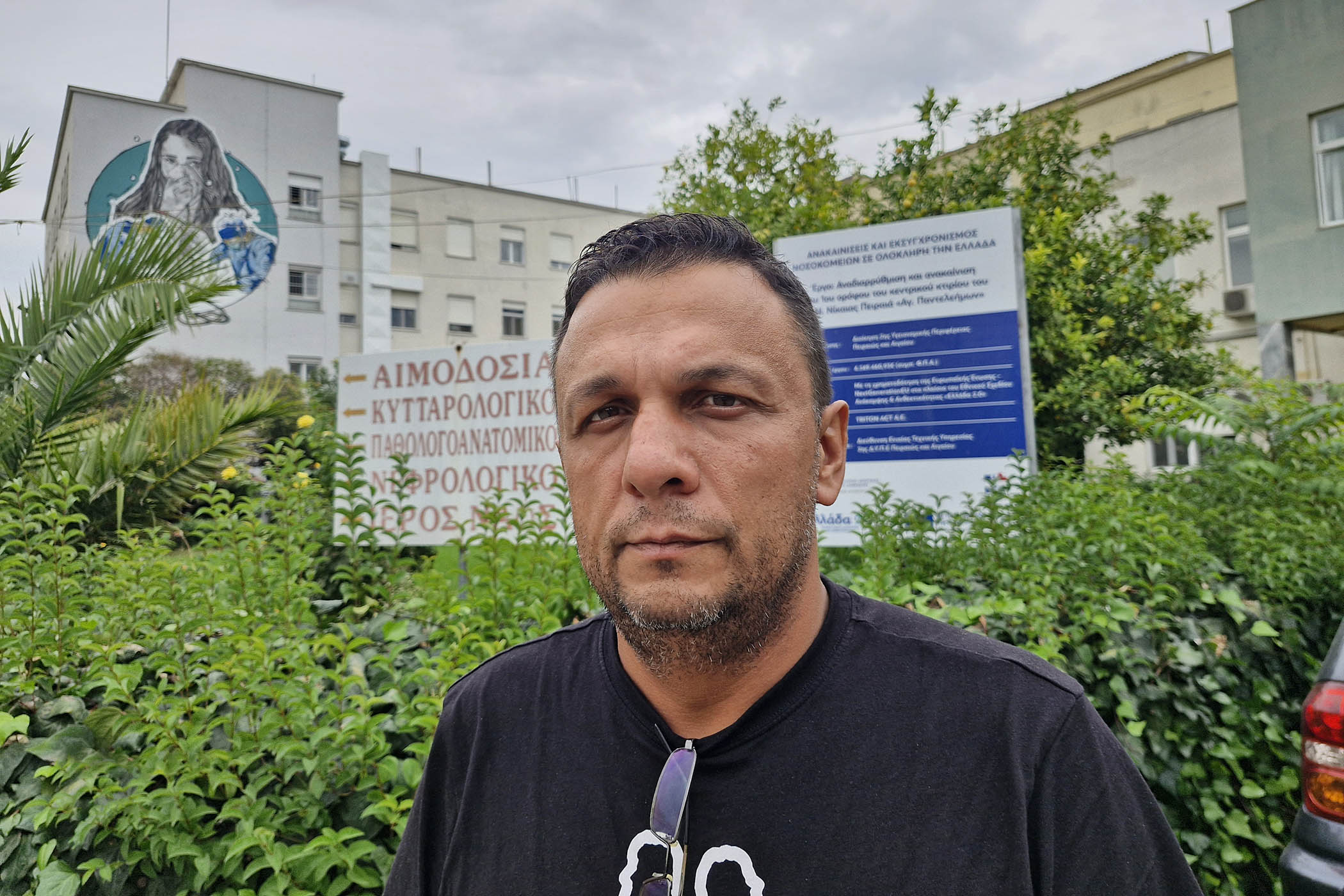

Even now, after stints in and out of hospital and a hunger strike that has left him visibly frail, Panos Ruci still wants to be in Syntagma Square. It is the plaza, he says, that calls every night because it is there that he feels “closest” to his son.
“That’s where I want to be,” he tells The Observer. “There, in front of the Greek parliament, beside the memorial, where the names of those who so needlessly lost their lives are read out every night at 18 minutes past 11.”
It was at that hour on 28 February 2023 that Intercity 62, a northbound passenger train crammed with students returning from a holiday weekend in Athens, crashed into a freight carrier heading south. For 12 minutes the two locomotives had been barrelling towards one another on the same track. The head-on collision in the vale of Tempi was of such ferocity it ignited a fireball that lit up the night sky.
Ruci’s son, Denis, like others killed instantly, was sitting at the front of the train. “Moments earlier he had sent a friend a picture from the canteen,” his father says. “He was holding a bottle of Coca-Cola. Smiling.”
As dawn broke over the valley it became clear that the train accident was like no other Greece had ever seen. TV images of debris, overturned carriages and buckled tracks were the visible signs of what lurked below: a mass grave of 57 people, mostly young and from Thessaloniki.
In the age of automated safety systems on Europe’s rail networks the collision, say experts, was preventable.
Nearly three years on, most Greeks are convinced they have yet to hear the truth about Tempi and accuse the government of a cover up. The crash is far from explained, no public official has been held to account, there are still doubts over the justice system’s impartiality, the cause of death of many of the victims, and a lingering debate over the origins of the explosion and the blaze that raged for more than an hour after the collision.
Last year’s anniversary sparked protests not seen since the collapse of military rule in 1974 and outrage over the tragedy shows no sign of being assuaged. Instead, with the centre-right government still struggling to contain its fallout, and a trial scheduled for March, the disaster appears poised to further unnerve the prime minister, Kyriakos Mitsotakis.
Last month, in what has been interpreted as the latest sign of a brewing crisis of confidence in mainstream politics, polls revealed significant support for Maria Karystianou, a doctor who lost her daughter in the crash and established a party that would take on a political system mired in scandal.
For relatives, there remain questions too painful to ponder. Ruci, like other parents, still has no idea if the body he buried in a sealed casket belonged to his son. “Was that my child in there?” he asks. “We have a right to know and we have a right to know how they died. All any of us families want is justice. ”
Newsletters
Choose the newsletters you want to receive
View more
For information about how The Observer protects your data, read our Privacy Policy
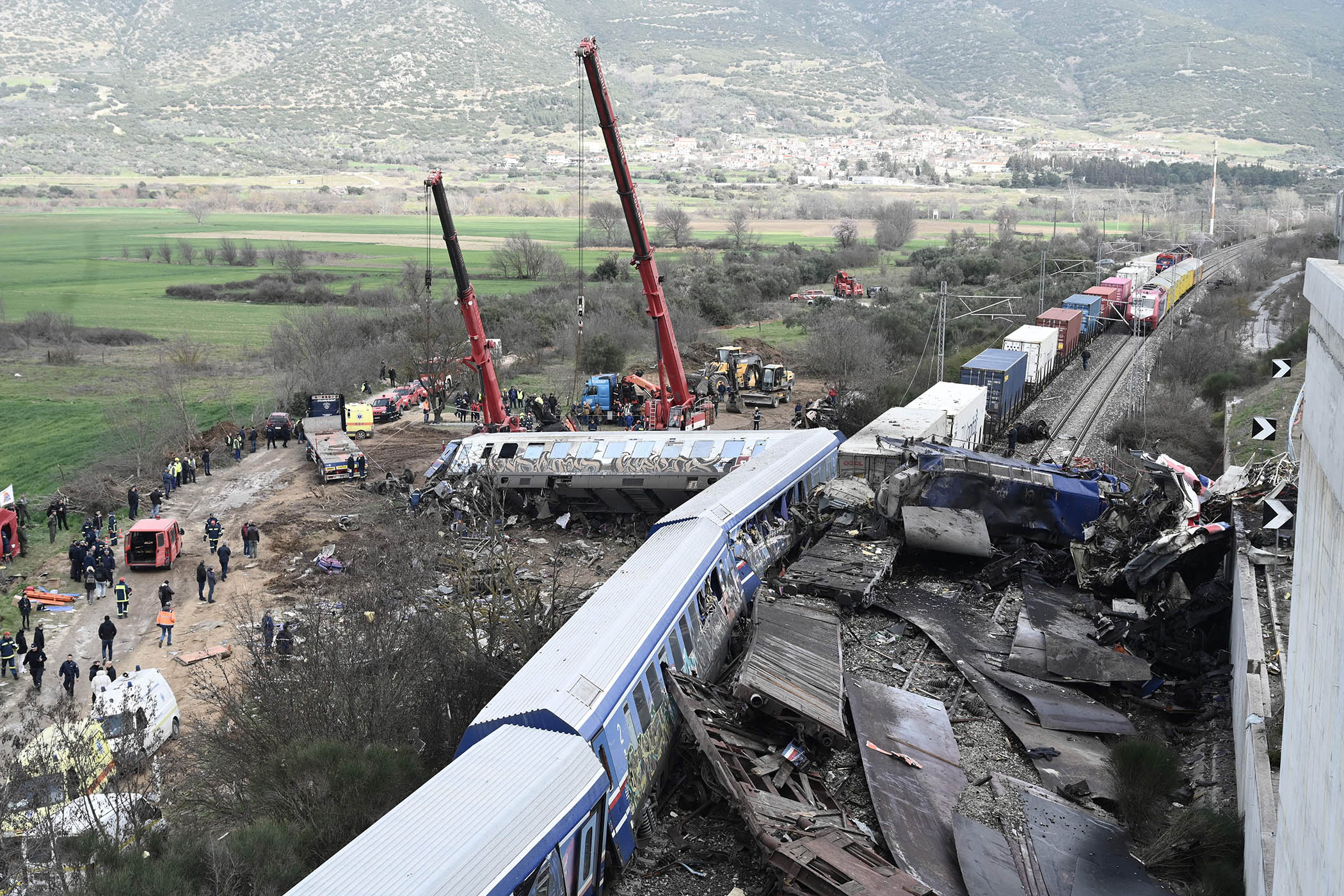
The crash site in the Tempi Valley near Larissa in March 2023
It is in Syntagma, where with funereal solemnity the names of the victims are nightly read aloud by activists, that Ruci chose to stage his hunger strike, pitching a tent and tarps close to the makeshift memorial that is now an unofficial shrine to Tempi’s dead. His protest had one goal: to get authorities to accept his demand to have Denis’s remains exhumed “so that the cause of death can finally be determined through toxicological tests”.
As one week blended into the next, the once burly 48-year-old, a courier company manager “in more normal times”, became thinner, darker and ever more fatigued. But Ruci drew psychological support from well-wishers who dropped by daily in what became a battle of David v Goliath proportions that caught the popular imagination.
“Any of us could have been on that train – those kids could have been ours,” said Livia Kaitsi, a retired schoolteacher who had travelled to Athens from Thessaloniki “to behold this hero and shake his hand”.
On the 23rd day of his refusing to consume anything but liquids, judicial officials finally agreed to Ruci’s request.
The process of exhumation is expected to start in the coming weeks. Forensic tests will follow. “I am a father who lost his son,” he murmurs, his eyes fixed on the floor of a hospital canteen where we meet. “Until we know what really happened that night, I will do everything in Denis’s memory to unearth the truth.”
More than 15kg lighter, Ruci now allows himself to smile. The hunger strike may have left him feeling vulnerable and weak but a battle has been won. “There’s still a long war ahead of us,” he says. “OK, they agreed to conduct DNA and toxicological tests that will confirm identification [of remains] and, we hope, pinpoint the cause of death. But it’s not over. We have to be able to bring in our own, foreign, experts so tests are carried out abroad. After all we’ve been through, we don’t trust anyone in Greece.”
‘We have to be able to bring in our own, foreign, experts. After all we’ve been through, we don’t trust anyone in Greece’
‘We have to be able to bring in our own, foreign, experts. After all we’ve been through, we don’t trust anyone in Greece’
Panos Ruci
Distrust fuels the belief, conveyed in several surveys, that from the outset authorities have attempted to stop the truth from coming to light. The vast majority of Greeks regard Tempi as an unpunished crime, with a trial yet to take place, a public inquiry limited to a parliamentary committee investigation that even Mitsotakis described as “not the parliament’s finest hour”, and almost no political reckoning.
A government decision to remove topsoil regarded as vital evidence from the crash site, followed by an equally controversial move to cement and gravel it over, has fanned the perception of dishonesty.
“Instead of taping off the area, they rushed to clean it up and the question is ‘why?’” Ruci says, the incredulity resonant in his voice.
As suspicions have grown, so has the belief that the freight train was carrying an undeclared cargo of combustible substances. Some suspect the fireball was caused by illegal chemicals. Relatives fear victims may have been killed not on impact but as flames consumed the carriages – speculation reinforced after audio recordings surfaced capturing a call made to emergency services: “I have no oxygen,” the woman gasped.
The argument the crash could have been avoided if a EU-financed state-of-the-art signalling system had been installed on tracks connecting Greece’s two largest cities has only added to the outrage. Train driver unions had often warned of the safety risks of failing to make the upgrade. The European public prosecutor’s office has weighed in, saying €41m (£36m) in EU funds was earmarked for the project. Citing the inexplicable delays, the agency has pressed charges against 16 employees of the body tasked with handling railway contracts and the consortium in charge of its implementation.
When the trial begins on 23 March in Larissa, the nearest city to the accident, it will be the stationmaster, who confessed to mistakenly putting the trains on a collision course, and other officials in the dock. High-ranking politicians have not received summons. Parliament’s reluctance to lift the immunity of former ministers from prosecution – a protection embedded in the constitution – has ensured criminal charges have not been levelled at MPs. Visiting Athens in October, Europe’s chief prosecutor, Laura Kövesi, called for the law to be amended, saying it had obstructed a full-scale inquiry into the tragedy.
Mitsotakis has vigorously denied accusations of a cover-up. But the prime minister, usually a deft handler of crises, is perceived to have misjudged public sentiment, leaving his government, which was re-elected after the disaster, increasingly open to attack. He has likened the accident to “an open wound for Greek society, a collective trauma”.
With emotions running so high, what comes next is ripe with uncertainty. Activists, who stand guard over the Syntagma shrine, have vowed not to leave until “real justice” is rendered.
“We still haven’t had time to properly grieve,” Ruci laments, insisting that he won’t be giving up either. “It’s all been about this fight for truth. The desire for truth makes a man do things he could never have imagined.”
Photographs by Sakis Mitrolidis/AFP via Getty Images, Helena Smith