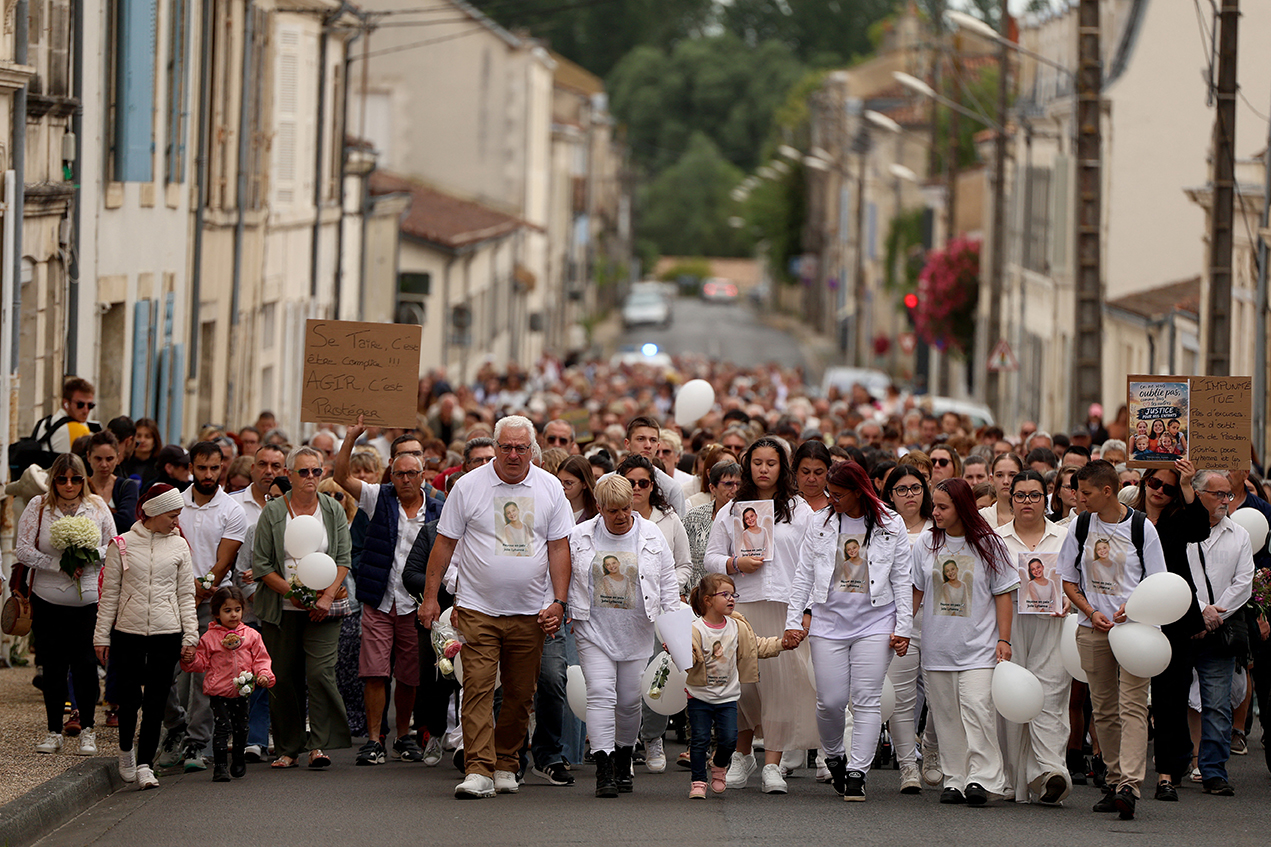

Shortly after 3pm on Friday 29 May, a CCTV camera outside the secondary school in the picturesque town of Fleurance in south-west France recorded a young girl getting into the car driven by the father of one of her best friends.
It would be the last time 11-year-old Lyhanna Rameau Bernard was seen alive. Her body was found less than a week later, dumped in a disused grain silo in the surrounding countryside. She had been kidnapped, raped and murdered.
Today, the Lyhanna Affair, as it is known, has profoundly shaken France on a human level and provoked an escalating political crisis with calls for ministers to resign over child safeguarding failures and the country’s tortuously slow legal system.
For even as gendarmes and locals combed the area around Fleurance in a futile search for the missing girl, investigators discovered the chief suspect Jérôme Barella – owner of the car Lyhanna got into – had been on the police’s radar for almost a decade. Despite being linked to several reports involving the rape and sexual abuse of children, the school janitor had never been arrested or questioned.
Barella, 41, has denied any wrongdoing or involvement in Lyhanna’s rape and murder.
In response to public outrage, France’s justice minister, Gérald Darmanin, has ordered the immediate review of 70,000 outstanding cases of child rape and sexual abuse, some of which have been open for years.
After a 44-page preliminary report on the case was published last week, the prime minister, Sébastian Lecornu, told MPs that child protection, the police and the legal system had failed with a series of “errors, acts of negligence, inaction, and poor decisions” that led to Lyhanna’s death.
For Lyhanna’s family, there was worse to come.
In August last year, investigators opened a case against Barella after the mother of a 10-year-old girl alleged he had raped her daughter “around 50 times” between September 2024 and April 2025. Medical and psychological examinations confirmed that the child had been sexually abused. Yet, in the eight months before Lyhanna’s murder, investigators failed to question or even contact Barella.
Laurent Boyer of the child-abuse charity Les Papillons told The Observer he is shocked that anybody is shocked.
Newsletters
Choose the newsletters you want to receive
View more
For information about how The Observer protects your data, read our Privacy Policy
“It’s as if politicians have suddenly discovered this problem in the justice system when it’s systemic. Every day we receive messages from parents explaining they have reported child sexual abuse to the police, and months later the suspect has not been questioned and they have the impression that nothing has been done,” he said.
“We should not be waiting for the death of a child to discover there is a problem with the justice system. Lyhanna should not have died.”
Since Barella’s arrest, several other victims have come forward with allegations against him. Detectives discovered that in 2021, he was fired from his job as janitor at a high school after “inappropriate behaviour” with a female student. No complaint was reported to police.
The following year a girl claimed Barella raped her when she was seven and staying at his home for a sleepover with his daughter. The girl’s evidence was deemed “fabricated” and the investigation dropped.
The response from the police, gendarmes, prosecutors and magistrates is that they are overloaded with cases and lack funds and staff. Investigators have reportedly admitted it is often difficult to “balance the risks of a poorly put-together case” that could jeopardise a prosecution and speeding up the process.
Boyer says it is also the result of a systemic failure to treat child sex abuse as a priority. “It’s very hard on the families. The children are often questioned several times while the suspect hasn’t been interviewed. Their aggressor continues their life and they continue in limbo.”
Lawyer Francesca Satta, who represented several families of child victims of paedophile surgeon Joël Le Scouarnec, jailed last year for abusing 300 children – most of whom were in hospital – said France lagged behind other countries in its approach to child sex abuse. Le Scouarnec continued practising after a “chain of structural failures” in the country’s justice and health systems failed to stop him.
“There is a need for total change in France. We are completely lagging behind. I work with magistrates, I know they have a lot of files to manage and deal with staff shortages and reduced finances, but we need to do something about it.
“It’s deplorable that in France we have to reach a catastrophic situation, we have to have a Dominique Pelicot or a Le Scouarnec before we suddenly say, there’s a problem,” she said.
Satta is campaigning for France to set up special child abuse investigation teams and courts as it has for crimes against humanity and terrorism cases.
“Child sexual abuse needs to be dealt with by specialised teams with specific training. I do not understand French inertia,” she says. “In England you are very reactive when it comes to violence against children, but it’s not a priority in France.”
Darmanin insists there will be a “before Lyhanna and an after Lyhanna”, which will be of little comfort to the girl’s grieving parents.
Boyer is dubious. “French society has been pushed up against a wall with the Lyhanna case, which has caused a storm because of an accumulation of failings.
“But it seems each time something terrible like this happens there is shock, then everyone moves on and it’s forgotten.”
Photograph by Romain Perrocheau/AFP/Getty Images