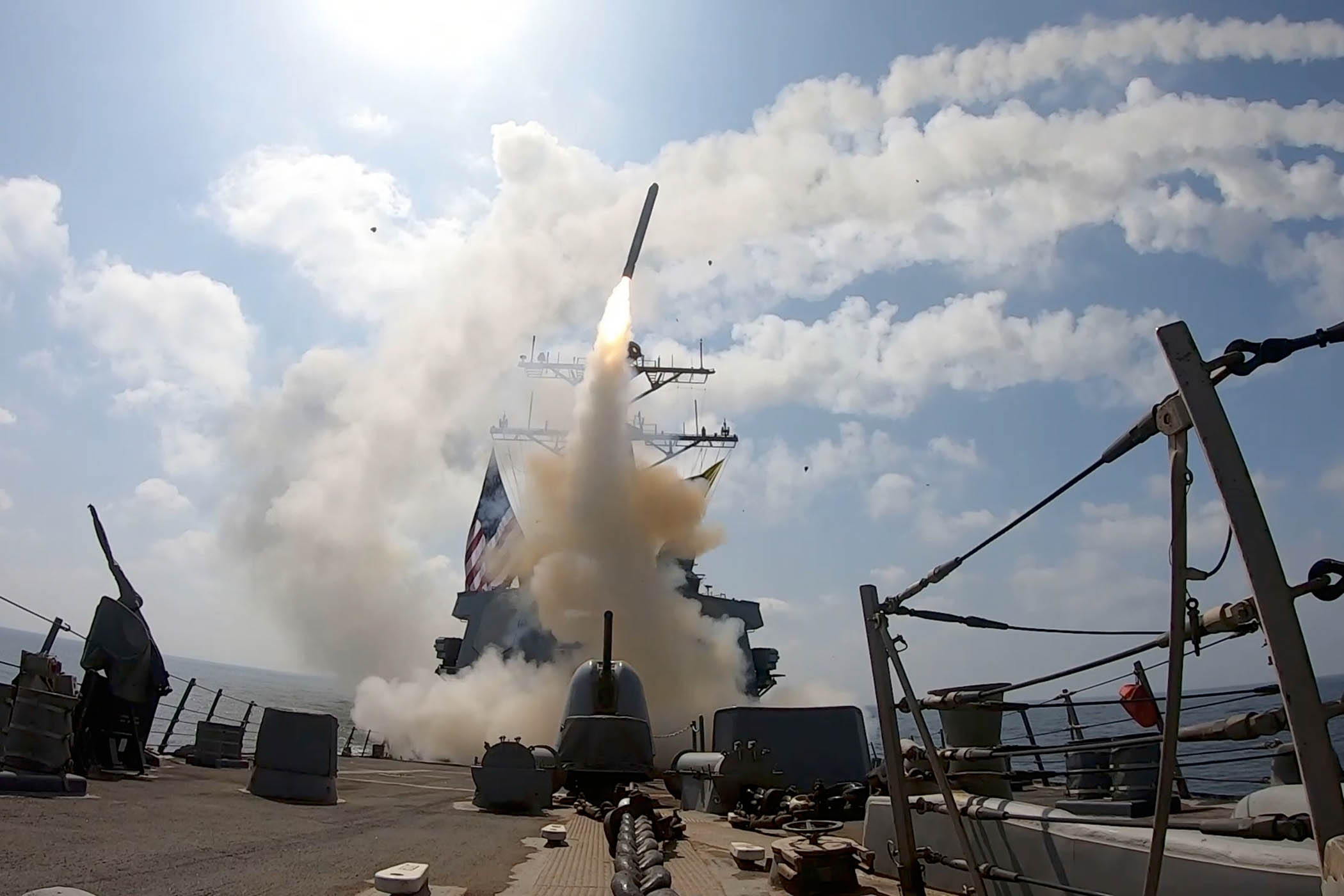


The first wave of US strikes against Iran on Saturday were most likely Tomahawk cruise missiles, fired from US surface ships and submarines. Tomahawk is a favoured weapon for the early stages of a conflict, because of its long range, high accuracy and large warhead. It is particularly useful for hitting fixed targets, such as the factories producing Iranian ballistic missiles, Islamic Revolutionary Guard Corps headquarters, and fixed air defences.
The US is capable of firing very large numbers of the weapons simultaneously, to blind and disable the integrated defences of its opponent, and to launch surprise attacks against targets which the defending forces cannot easily move. This “degrading” of a country’s defences makes follow-on attacks by manned aircraft much safer for US pilots.
More than 140 of the US navy’s escort ships carry Tomahawk, including the Arleigh-Burke class destroyers ts Virginia class attack submarines also carry Tomahawk. Perhaps the deadliest of the US ships carrying the weapon are the SSGN Ohio class submarines, which are former Trident nuclear missile submarines that have had each of their 24 missile tubes converted into 6-pack Trident launchers. This allows the submarine to launch up to 156 Trident missiles undetected and near-simultaneously – a massive attack from a single warship.
Follow-on attacks will come from USAF B1 and B2 bombers, which can carry a huge range of ordnance, and in very large volumes. One B1 Lancer can carry up to 34 tonnes of bombs, while the B2 can deliver 20 tonnes of ordnance. The most common type of bomb used by the B1 is the joint direct attack munition (JDAM) which is a highly accurate 2-tonne, free-fall guided bomb, and the AGM-158 JASSM 0.5 tonne stand-off missile. The B2 is notable as the only aircraft large enough to carry the 15-tonne Massive Ordnance Penetrator “bunker-busting” bomb used to destroy the underground uranium enrichment facilities at Fordow, Natanz and Isfahan in June 2025. JDAM will often be used against military targets, such as concentrations of IRGC forces, while the MOP will be used to attack leadership bunkers
Finally, JDAM and JASSM are both launched from USAF and US Navy tactical fighters, such as the F-15E Strike Eagle, and the F-18 Super Hornet, the F15 flying from land bases, and the F18 from the US carriers in the region. These aircraft are likely to take up the majority of the strikes as the campaign continues.
In response, Iran has been launching its Shahab-3 surface-to-surface ballistic missile, which has been the mainstay of its missile programme for more than 20 years, and which has been developed into various longer-range variants capable of striking Jerusalem. However, this missile has been easily countered by a mixture of Israeli and American defensive missile shields. Most notable among these are the US Patriot missile, and the US Theatre High Altitude Air Defence weapon (THAAD). THAAD is perhaps the most advanced interceptor in the world, and is capable of shooting down even very long range weapons moving at more than 7,500 km/h.
As a result, in the last campaign of Iranian strikes against Israel, only about 6% of missiles are thought to have struck urban targets.
At sea, the US fleet relies on its standard missile to perform the same role as Patriot/THAAD does on land, with the weapons also being launched by the Arleigh-Burke air defence destroyers.
Photograph by U.S. Central Command via AP
Newsletters
Choose the newsletters you want to receive
View more
For information about how The Observer protects your data, read our Privacy Policy